A grinder is the highest-return purchase in home coffee, and the good news is that the return arrives long before $100. The bad news is that this is also the price band where blade grinders live, and a blade grinder is not a cheap burr grinder — it is a different, worse machine. Every pick below is a real burr grinder, and the ranking is about what each one gives up to hit its price.
The mechanism is worth restating because it decides everything here. A burr grinder crushes beans between two shaped surfaces set a fixed distance apart, so particles come out roughly uniform and the whole dose extracts at the same rate. A blade grinder chops randomly, producing dust and boulders together; the dust over-extracts into bitterness while the boulders under-extract into sourness, in the same cup, and no brewing skill fixes it. If that is new to you, read burr vs blade grinders before spending anything.
One structural note about this budget: under $100, manual hand grinders out-perform electrics, and it is not close. An electric at this price has to pay for a motor, a housing, a hopper and a switch out of the same money that a hand grinder spends almost entirely on burrs. If you make one or two cups a day and can spare a minute of cranking, buy manual. If you make a pot for a household every morning, buy electric and accept the compromise.
The short answer
Quick picks
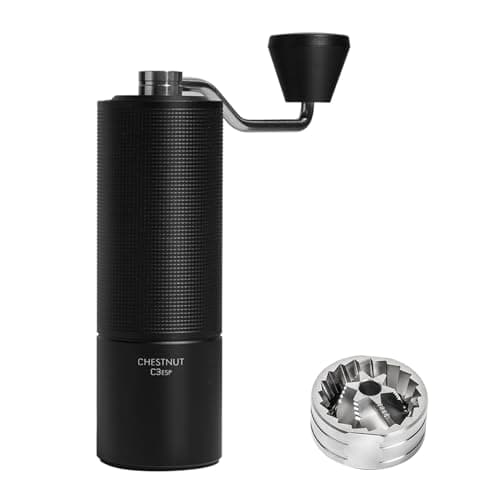
01Timemore Chestnut C3 ESPThe best grinder under $100, full stop: stainless S2C conical burrs with an espresso-capable fine range, in a body that feels like it cost twice as much.
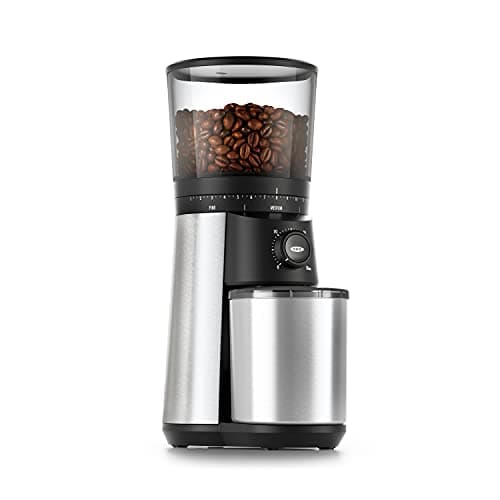
8.2Best overall under $100 02OXO Brew Conical Burr GrinderThe best electric under $100 for brewed coffee: a stainless conical burr, 15 settings and a one-touch timer, in a machine that just works every morning.
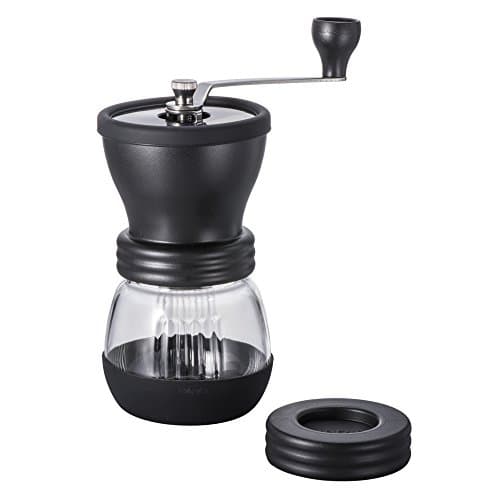
6.8Best electric under $100 05Hario Skerton ProThe long-serving cheap hand grinder: ceramic burrs, a glass jar and a stabilized shaft that fixed the wobble the original was criticized for. Good for press and pour-over, not espresso.
7.0Best cheap hand grinder 06JavaPresse Manual GrinderThe cheapest real burr grinder we will recommend. It is slow and basic, but it is a burr grinder, and that alone puts it in a different class from any blade unit at the price.
6.9Cheapest real burr grinder
| # | Product | Best for | Score | Price |
|---|
| 01 | Timemore Chestnut C3 ESPThe best grinder under $100, full stop: stainless S2C conical burrs with an espresso-capable fine range, in a body that feels like it cost twice as much. | Best overall under $100 | | $99.00·Amazon |
| 02 | OXO Brew Conical Burr GrinderThe best electric under $100 for brewed coffee: a stainless conical burr, 15 settings and a one-touch timer, in a machine that just works every morning. | Best electric under $100 | | $109.95·Amazon |
| 03 | | Most adjustment per dollar | | $69.98·Amazon |
| 04 | | Best for drip & press only | | $79.95·Amazon |
| 05 | Hario Skerton ProThe long-serving cheap hand grinder: ceramic burrs, a glass jar and a stabilized shaft that fixed the wobble the original was criticized for. Good for press and pour-over, not espresso. | Best cheap hand grinder | | $42.10·Amazon |
| 06 | JavaPresse Manual GrinderThe cheapest real burr grinder we will recommend. It is slow and basic, but it is a burr grinder, and that alone puts it in a different class from any blade unit at the price. | Cheapest real burr grinder | | Check price → |
#ad · Live prices from the Amazon Product API, as of October 18, 2026. Where we have no verified live price, we show none — a gap beats a number that has rotted.
In detail
The picks, in full
Best overall under $100
Timemore Chestnut C3 ESP
Stainless S2C conical burrEspresso-capable fine rangeAluminum bodyManual, ~1 minute per dose
The best grinder under $100, full stop: stainless S2C conical burrs with an espresso-capable fine range, in a body that feels like it cost twice as much.
- Grind consistency
- 7.5
- Adjustment range
- 7.5
- Retention
- 9
- Build
- 7.5
- Value
- 9.5
Pros
- +Stainless burrs grind faster and far more uniformly than the ceramic burrs typical at this price
- +The ESP version genuinely reaches espresso fineness, which almost nothing else here does
- +Near-zero retention compared with any electric at this price
- +Compact enough to travel with
Cons
- −You have to crank it — about a minute for a double espresso dose
- −Adjustment is internal, so counting clicks matters
- −Slower than the pricier 1Zpresso grinders on a big filter dose
Don't buy this if…
…you grind for a full pot every morning or you have wrist or grip issues — a minute of cranking for a single dose becomes three or four for a carafe.
The C3 ESP is the honest answer to “what is the cheapest grinder that will not hold my coffee back.” It out-grinds every electric on this list, and the only real cost is your arm. Compare it against the rest of the hand-grinder field in our manual grinder ranking.
Best electric under $100
OXO Brew Conical Burr Grinder
Stainless conical burr15 grind settingsOne-touch timerHopper with UV-blocking finish
The best electric under $100 for brewed coffee: a stainless conical burr, 15 settings and a one-touch timer, in a machine that just works every morning.
- Grind consistency
- 7
- Adjustment range
- 6
- Retention
- 5.5
- Build
- 7
- Value
- 8.5
Pros
- +Push-button convenience for a household making a full pot daily
- +Genuinely consistent grind across the filter range
- +Timer remembers your last setting, so mornings need no thought
- +Sturdier and quieter than most electrics in this band
Cons
- −Does not go fine enough for real espresso
- −Conical burr and chute retain grounds, so single-dosing means purging
- −15 settings is a coarse set of steps if you like fine-tuning
Don't buy this if…
…espresso is in your plans at all — this tops out too coarse and no amount of adjustment gets it there.
Most adjustment per dollar
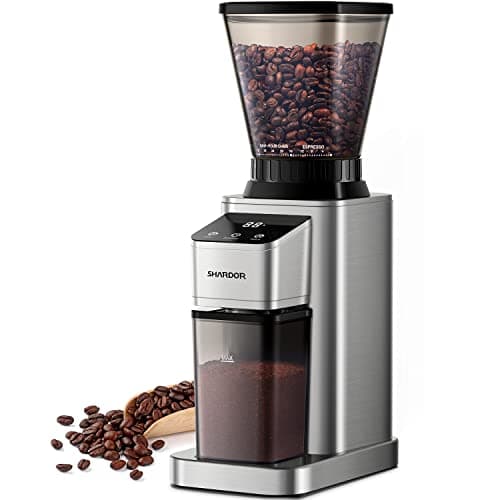
SHARDOR Professional Conical Burr Coffee Grinder (48 settings)
Conical burr48 grind settingsTimed dosingEspresso through French press range
The cheapest electric here with a claimed espresso-fine setting and 48 steps of adjustment — a lot of range for the money, with the build compromises you would expect.
- Grind consistency
- 6.5
- Adjustment range
- 7.5
- Retention
- 5
- Build
- 5.5
- Value
- 8
Pros
- +48 steps give far more granularity than the 12-to-15-step electrics around it
- +Reaches genuinely fine settings, so it can feed a pressurized-basket espresso machine
- +Timed dosing and a removable grind chamber make daily use simple
Cons
- −Plastic-heavy construction; not a grinder you keep for a decade
- −Fine settings are usable but not precise enough to dial a non-pressurized espresso shot
- −Static cling at fine grinds means grounds stick to the chamber
Don't buy this if…
…you own a machine with non-pressurized baskets — for real espresso you need repeatable micro-adjustment this cannot deliver.
$69.98·View on Amazon$79.9913% off
Price as of October 18, 2026. Prices change — Amazon's at checkout is the one that counts.
#ad · we may earn a commission from this link to SHARDOR Professional Conical Burr Coffee Grinder (48 settings)
Best for drip & press only
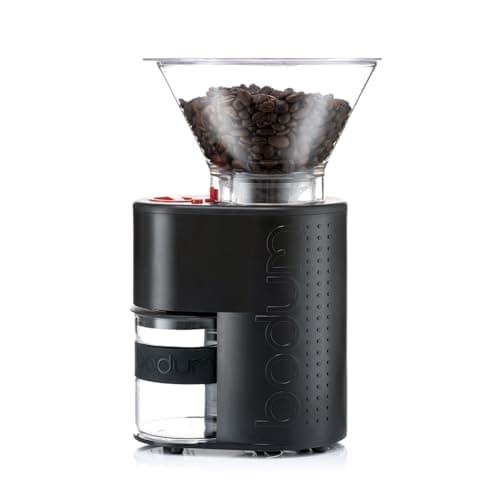
Bodum Bistro Electric Conical Burr Coffee Grinder
Conical burr12 grind settingsPreset timer dialBorosilicate glass catch jar
A tidy 12-setting electric with a borosilicate catch jar that fights static better than plastic — a good, simple drip and press grinder with no espresso ambitions.
- Grind consistency
- 6.5
- Adjustment range
- 5.5
- Retention
- 6.5
- Build
- 6.5
- Value
- 7.5
Pros
- +Glass catch jar holds much less static than the plastic bins on rival grinders
- +Simple timer dial means the same dose every morning
- +Compact and genuinely nice to have on a counter
Cons
- −Only 12 settings, all in the medium-to-coarse range
- −No espresso capability whatsoever
- −Hopper capacity is small for a household pot
Don't buy this if…
…you brew anything finer than drip. This is a filter-coffee grinder and it is honest about that.
Best cheap hand grinder
Hario Skerton Pro
Ceramic conical burrStabilized center shaftGlass catch jarCoarse-to-medium focus
The long-serving cheap hand grinder: ceramic burrs, a glass jar and a stabilized shaft that fixed the wobble the original was criticized for. Good for press and pour-over, not espresso.
- Grind consistency
- 6.5
- Adjustment range
- 5.5
- Retention
- 8.5
- Build
- 6.5
- Value
- 8
Pros
- +Costs about half the C3 ESP and still beats every blade grinder ever made
- +Glass jar and ceramic burrs are easy to clean and will not rust
- +Reliable at French press and pour-over grinds
Cons
- −Ceramic burrs are slower and less uniform than stainless
- −Adjustment is a nut under the burr — fiddly to change and hard to repeat exactly
- −Not usable for espresso
Don't buy this if…
…you switch brew methods often — resetting the adjustment nut precisely is tedious compared with a click-stop grinder.
Cheapest real burr grinder
JavaPresse Manual Grinder
Ceramic conical burrClick-stop adjustmentStainless bodyManual, slow on large doses
The cheapest real burr grinder we will recommend. It is slow and basic, but it is a burr grinder, and that alone puts it in a different class from any blade unit at the price.
- Grind consistency
- 6
- Adjustment range
- 6
- Retention
- 8.5
- Build
- 6
- Value
- 8
Pros
- +Genuinely uniform grind for the money, and clicks make settings repeatable
- +Small, quiet and packable — the obvious travel or office grinder
- +Nothing to break and nothing to service
Cons
- −Slow — a large French press dose is a real workout
- −Ceramic burrs dull and struggle with very dark, oily beans
- −Small capacity per fill
Don't buy this if…
…you grind more than a couple of cups at a time — the time cost compounds fast and you will stop using it.
What you are actually giving up under $100
Three things, in order of how much they matter. Burr material and size: stainless burrs cut cleanly and fast; ceramic burrs are slower, run cooler and are more brittle, and small burrs of either material take more passes and produce more fines. Adjustment precision: premium grinders offer stepless or very fine stepped adjustment because espresso lives in the gaps between clicks; budget grinders give you a dozen or so coarse steps, which is plenty for filter and hopeless for espresso. Retention: cheap electrics trap grounds in the chute and burr chamber, so today’s first few grams are yesterday’s stale coffee. Manual grinders barely retain anything, which is a quiet advantage people forget to count.
Manual or electric at this price?
Under $100, almost all of a hand grinder’s cost goes into burrs and the mechanism holding them true; an electric has to spend the same money on a motor, gearbox, housing and hopper. That is why the Timemore C3 ESP out-grinds every electric on this list. The trade is time and effort: roughly 40–60 seconds for a double espresso dose, two to three minutes for a full French press. Decide honestly — a great grinder you resent using every morning is worse than a decent one you actually use.
Espresso changes the calculation completely
Espresso needs a grinder that goes very fine and adjusts in tiny repeatable increments, because a fraction of a turn separates a gushing shot from a choked one. Under $100 the only pick here that genuinely does that is the Timemore C3 ESP. If you have a machine with a pressurized basket, a coarser budget grinder will produce acceptable results because the basket is doing the resistance work — but that also means the grinder is not really the limiting factor. If you have non-pressurized baskets, budget more; our espresso grinder ranking starts where this page ends.
Grind size by brew method
| Brew method | Grind | Cheapest pick here that does it well |
|---|
| Cold brew | Very coarse | JavaPresse |
| French press | Coarse | Hario Skerton Pro |
| Drip / pour-over | Medium to medium-fine | OXO Brew |
| Moka pot | Fine, but not espresso-fine | SHARDOR 48-setting |
| Espresso | Very fine, micro-adjustable | Timemore C3 ESP |
Care that makes a cheap grinder last
Brush the burr chamber out weekly — oils build up and go rancid, and stale oil is a flavor you will taste before you notice it. Avoid very dark, oily beans in ceramic-burr grinders, which gum up faster. Never grind anything but coffee: a single stone or spice seed can chip a burr edge permanently. And do not leave beans sitting in a hopper — they stale in the open air, which undoes the entire reason you bought a grinder.
How we picked
We did not lab-test this gear
Everyone in this category says they tested twenty machines. We have not lab-tested any of these, and we say so. What we did instead: compiled the published manufacturer specifications, read the manuals, ran the math where there was math to run (heat-up time, pressure, dose capacity, grind range, cost per cup), and scored each pick against a published rubric. The scores are judgments from documented research — not measurements we took, because we do not have a lab and we will not pretend we do. Where a number came from someone else's work, we name them in Sources.
Questions
Frequently asked
What is the best coffee grinder under $100?+
The Timemore Chestnut C3 ESP. Its stainless burrs and espresso-capable fine range beat every electric at this price, and it retains almost no coffee. The trade is that you grind by hand.
Is a cheap burr grinder better than a blade grinder?+
Yes, decisively. Even the cheapest true burr grinder produces roughly uniform particles, while a blade grinder chops randomly into dust and boulders that extract at different rates — bitter and sour in the same cup. It is the one upgrade with no downside.
Can a grinder under $100 do espresso?+
One on this list can: the Timemore C3 ESP. Most budget grinders cannot go fine enough or adjust precisely enough. Machines with pressurized baskets are far more forgiving, so a coarser budget grinder can work with those.
Manual or electric grinder for a beginner?+
Manual, if you make one or two cups a day — you get better burrs for the money. Electric, if you brew a full pot every morning or grinding by hand would stop you brewing at all.
How long do budget burr grinders last?+
Stainless burrs typically outlast the machine around them; ceramic burrs dull sooner, especially on dark oily beans. The usual failure point on cheap electrics is the motor or the plastic housing, not the burrs, which is another argument for manual at this price.
Receipts
Sources
We do not run a testing lab, and we do not pretend to. Where a measured number came from someone else's work, we name them and link them. Where we could not verify something, we say so on the page rather than quietly leaving it out. Read our full method.