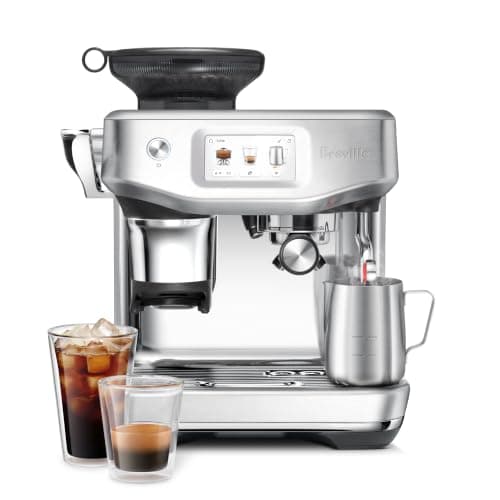
Cafe drinks on day one, without the learning curve
Breville Barista Touch Impress (BES881)
The most hand-holding semi-automatic Breville makes: assisted tamping, automatic milk texturing and a prompted touchscreen, so the two steps beginners get wrong are handled for you from the first shot.
- Shot quality
- 8.5
- Steam power
- 8
- Build
- 8
- Ease of use
- 9.5
- Value
- 6.5
Pros
- Assisted tamping applies consistent force and a polish twist, removing the uneven puck that causes most beginner channeling
- Auto MilQ holds a chosen temperature and texture level and handles alternative milks, which is the other step beginners reliably fail
- Touchscreen prompts the sequence rather than assuming you remember it, with 13 presets and 6 custom drinks
- Grind dose self-corrects after a shot, so dialing in is a nudge on the screen instead of a re-weigh
- ThermoJet heating reaches extraction temperature in about three seconds, which decides whether you make espresso on a weekday
- Baratza European Precision Burrs with 30 settings is real grinder hardware, not a token mill
Cons
- The price premium over a Barista Express Impress or Barista Pro buys automation, not a better shot
- Automating the tamp and the milk means you learn less — the skills stay with the machine
- 54mm platform, so the cheap and enormous 58mm accessory market does not fit
- Breville does not list simultaneous brewing and steaming on this model, so milk still comes after the shot
- Low thermal mass is the trade for the three-second heat-up: it favors convenience over back-to-back stability
- More automated subsystems means more to service eventually than a plain single-boiler machine
Don't buy this if…
…you want to learn espresso properly, or the budget is tight. A Barista Express Impress gives you the same assisted tamping for materially less, and a Bambino Plus automates the milk for a fraction of this price.
What the Impress mechanism actually does. Breville's assisted tamping is a lever that lowers a tamper into the basket with a set force and finishes with a polish twist. That sounds cosmetic and it is not. An uneven or under-compressed puck gives water a low-resistance path through the coffee — channeling — and channeling is why a shot sprays, runs fast and tastes thin and sour even with good beans and the right grind. Hands are inconsistent at this for the first few months; a lever is consistent on the first morning. The machine also corrects the grind dose after a shot, nudging the next dose up or down, so you are not weighing and re-weighing to find the right amount for your beans.
Auto MilQ, honestly described. Breville publishes texturing settings for dairy, soy, almond and oat milk, eight texture levels and a temperature range from 104°F to 167°F. In practice that means you pick a drink, drop the wand in the jug and let it stop itself. The two beginner milk failures — overheating it past the point where it stays sweet, and beating in big bubbles instead of folding in microfoam — are both temperature and technique problems, and a machine that owns both does not make them. The limit is the predictable one: automated milk is reliably good, and a skilled hand on a manual wand still goes further for latte art. If pouring art is the goal, read how to froth milk and buy a machine that makes you do it.
The grinder is the part people underrate. Breville lists Baratza European Precision Burrs with 30 settings and dose control. Thirty steps is enough range to dial in most beans most of the time, which is the practical bar for a built-in grinder. It is still a built-in grinder: a $500 standalone with finer, stepless adjustment will beat it on clarity, and that is the normal upgrade path for anyone who stays in the hobby — see best espresso grinders. What the built-in buys instead is that nothing else needs purchasing, which at this price is a real part of the value.
Heat-up and what it costs. ThermoJet reaches extraction temperature in about three seconds, per Breville's published spec. That single number changes whether a machine gets used on a Tuesday, and it is the clearest everyday advantage the modern Breville platform has over a traditional boiler machine like a Rancilio Silvia, which wants twenty minutes. The trade is thermal mass: a thin, fast heater has less stored heat than a brass group, which is why heavy boiler machines still hold temperature better through a run of back-to-back shots. For one or two drinks a morning, the fast heater is the better engineering choice for a home kitchen.
54mm, and why it matters later. The portafilter is 54mm stainless. Breville's platform has a decent aftermarket — precision baskets, bottomless portafilters, puck screens and a 53.3mm tamper are all available — but it is smaller and pricier than the 58mm commercial standard, where parts are plentiful and cheap. If you expect to accessorize heavily, that is a mild tax. Our Breville accessory picks cover what fits, and the tamper size guide explains why the number has to be right.
One thing to be clear about. Breville does not list simultaneous brewing and steaming for this machine, and the ThermoJet platform is built around a single fast heater, so milk comes after the shot rather than alongside it. For one or two drinks that is irrelevant. For three milk drinks in a row it is the one inconvenience this machine does not remove, and the fix is a dual boiler.
Price as of October 18, 2026. Prices change — Amazon's at checkout is the one that counts.
#ad · we may earn a commission from this link to Breville Barista Touch Impress (BES881)