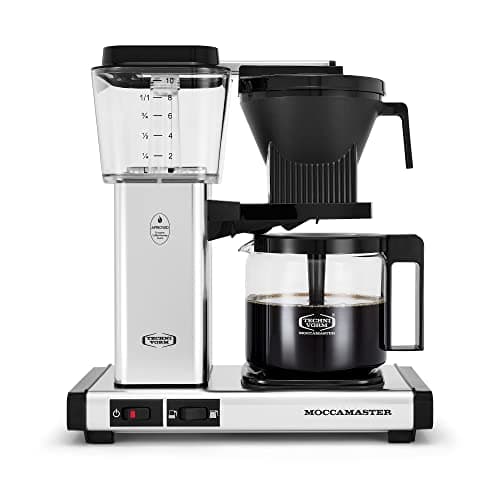
The Moccamaster is the machine people buy when they have decided the coffee is the point and the features are not. It is a hand-assembled aluminum-and-glass drip brewer made in the Netherlands, it holds the brew water in the right temperature window from the first second to the last, and it has no clock, no timer, no screen and no app. Almost everything people love and resent about it follows from that one editorial decision by Technivorm.
This review is built on what Technivorm publishes about the KBGV on its own site, plus the Specialty Coffee Association standard it is measured against. We do not have a lab, so there are no brew-temperature readings or taste scores of our own here — what you get instead is a careful read of the published specs, the certification claim unpacked rather than repeated, and a direct answer on whether the price is defensible.
What it is, in specifics
The KBGV Select is a 1.25 liter / 40 oz / 10-cup glass-carafe drip machine. Technivorm publishes it at 1475W on 120V, 14" high by 12.75" wide by 6.5" deep, with a five-year warranty, and states that it is handmade at the Technivorm factory in the Netherlands. The Amazon listing for the polished silver version carries the model number 53941.
Two mechanical details do the work. The first is the heating element: Technivorm’s own documentation refers to it as a copper boiling element, and copper’s job here is thermal stability — getting the water into the correct window quickly and holding it there for the whole cycle rather than drifting cool as the tank empties. The second is the hotplate, which has its own independent heating element and holds the finished carafe warm after the brew. Both are design choices with consequences, and the second one is a mixed blessing we come back to below.
What the certification actually certifies
This is where most reviews of this machine get lazy, so here is the careful version. Technivorm states that the KBGV is “ECBC certified and SCA approved to meet and exceed the golden cup standard,” and it also makes the stronger claim that the KBGV is “the only coffee brewer certified by the Specialty Coffee Association.” That second sentence is the manufacturer’s own marketing statement about its own product, and we are reporting it as that rather than endorsing it — several other machines, including two on our best coffee makers ranking, are sold as certified.
What the certification itself means is narrow and worth knowing. A certified brewer has been tested to brew within a defined temperature window, to deliver the right contact time, and to extract within the target strength and extraction-yield band using a specified dose. The window is the headline: Technivorm quotes “a consistent brewing temperature between 196°F - 205°F,” and the SCA standard is commonly stated as 195-205°F — the same target band either way. Technivorm also cites the standard’s 4 to 6 minute saturation target.
Here is the honest limit of that: certification tells you the machine is capable of a correct brew with a correct dose and decent coffee. It does not grind for you, it does not weigh anything, and it will brew stale supermarket pre-ground to exactly the right temperature and hand you a disappointing cup. The certification removes the machine as a variable. It does not remove the other three.
One thing we will not do is quote a brew time as a Technivorm figure. Its product page publishes no model-specific brew duration for the KBGV — only the standard’s 4-6 minute saturation target. Our drip roundup describes a full carafe as taking about six minutes; treat that as our characterization rather than a published specification.
The Select switch is the feature that matters
The “Select” in the name is a physical selector switch for full or half carafe, and Technivorm says it automatically adjusts the brewing process for the selected volume. This solves a problem most drip machines ignore and most buyers never diagnose. If a machine is tuned to pour the right amount of water at the right rate over a full basket of coffee, then brewing half a carafe through the same hardware wets a half-sized bed with full-sized flow — and the result is thin, over-fast, under-extracted coffee. Half-batch performance is the single most common weakness of drip machines, and this switch is the direct fix.
If you live alone or brew two mugs on weekdays and a full pot on Sundays, this feature is a bigger part of the machine’s value than the certification is.
What it deliberately does not do
No timer and no clock.You cannot set it the night before and wake up to coffee. You walk into the kitchen and flip a switch. For a significant group of buyers this is a dealbreaker all by itself, and the right response is to buy something else — not to buy this and be annoyed every morning for ten years.
Auto-off at 100 minutes. Technivorm publishes that number. It is a safety feature rather than a coffee feature, and 100 minutes is long enough that it will not save your coffee from the hotplate.
No adjustable temperature, bloom or flow. The machine is fixed at the values that pass the standard. That is the entire philosophy, and it is the opposite of the Breville Precision Brewer approach, where you get knobs for all three. Which you want is a question about you, not about which machine is better.
The glass carafe is the real catch
This is the thing to think hardest about before you buy. The KBGV puts a glass carafe on a heated plate, and a hotplate is the enemy of brewed coffee. Coffee held at hotplate temperature continues to change — aromatics drive off, and the bitter, flat, slightly scorched character people associate with office coffee develops within half an hour. The machine brews beautifully and then, if the pot sits, slowly undoes it.
The practical rules are simple. If you and the people you live with drink the carafe within about twenty minutes, the hotplate is a convenience and the glass version is the right buy. If the pot routinely sits for an hour, buy the thermal-carafe model instead — Technivorm sells one, it is the same brewing hardware, and it has no hotplate because it does not need one. The thermal version is also the better choice if you want the coffee to still taste like itself at 10am.
Repairability is a real part of the price
The five-year warranty is the headline, but the more interesting fact is the construction: this is a simple machine of discrete, replaceable parts, assembled by hand, with no electronics to fail. Technivorm sells parts for it. A machine you can keep running for a decade is a different economic proposition from one that becomes landfill when a control board dies in year four, and it is a large part of why people who own one talk about it the way they do. It is also the honest counter to the price objection — though only if you actually keep it that long.
So is it worth it?
It sits in the premium bracket for a home drip machine, several times the cost of a basic one and meaningfully above the certified machines in the middle of the market. Our answer in three parts:
Yes if you brew a pot of filter coffee most days, you already grind your own beans, and you want the machine to be the part of the chain you never think about again. That is the buyer this thing is built for, and nothing cheaper does the job with less fuss.
No if your coffee is currently pre-ground from a supermarket bag. Put the money into a burr grinder and fresher beans first. That order of operations buys a far bigger improvement, and it is the standing advice on this site regardless of which machine you end up with.
Not this version if you need a timer, or if your pot sits on the plate for an hour. Buy a certified machine with a timer in the first case, and the thermal Moccamaster in the second.
Glass or thermal: which KBGV to buy
Same brewing hardware, different ending. The glass version brews into a glass carafe on a heated plate; the thermal version brews into an insulated steel carafe and has no plate. Decide with one question: how long does the pot sit?
Under about twenty minutes— glass. You get a carafe you can see through, a slightly lower price, and the hotplate is a convenience rather than a liability.
An hour or more, or you drink a cup at a time across the morning— thermal, without hesitating. Heat is what degrades brewed coffee, and an insulated carafe keeps it drinkable far longer than a hotplate keeps it good.
What you still have to get right
A certified machine removes one variable and leaves three. In rough order of how much they change your cup:
1. The grind.A drip basket wants a medium grind, evenly produced. This is the biggest remaining lever by a distance, and it is why we tell people to buy the grinder before the machine — see coffee makers with built-in grinders if you would rather it were all one box, and quiet coffee grinders if the 6am noise is what has been stopping you.
2. The dose.Weigh it. The SCA target the machine is certified against assumes a specific ratio, and “a scoop” is not one. Coffee to water ratio has the numbers by carafe size.
3. The beans, and how long ago they were roasted. Freshness beats origin for most people most of the time. Best coffee beans covers both.
4. The water. Coffee is overwhelmingly water, and very hard or very soft water changes the cup and, over years, the machine. Our guide to brewing water applies to drip machines too — the mineral chemistry does not care what the water is heated in.
Living with it
The maintenance is deliberately boring: rinse the basket and carafe after use, and descale on a schedule set by your water hardness rather than by the calendar. There is no cleaning cycle to run and no filter cartridge to buy. Scale is the one thing that genuinely shortens the life of any heated brewer, and the same mechanism and method we set out in how to descale an espresso machine applies here.
What else to consider at this price
A certified machine with a timer. If waking up to brewed coffee matters, that single requirement should drive the decision. Several certified mid-market machines have one; the Moccamaster never will.
A pour-over setup. For one or two cups, a dripper and a kettle make a cup as good or better for a fraction of the price, at the cost of four minutes of your attention. See best pour-over coffee makers.
An AeroPress.If the honest answer is that you brew one mug at a time, the cheapest thing in the house competes surprisingly well — we compare it directly against the other single-mug immersion option in AeroPress vs French press.