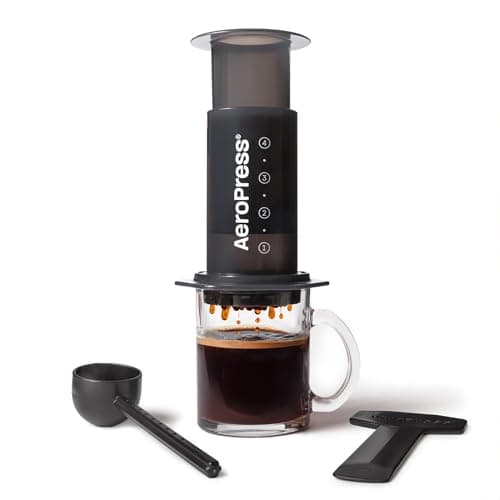
Buy the AeroPress if you make one or two drinks at a time and you want a clean cup with no sediment, almost no technique and a five-second cleanup. Buy a French pressif you brew for more than one person, or you want a thick-bodied cup and do not mind the grit and the cleanup that come with it. At this price the question is rarely which is better — it is which one matches your household.
Both are immersion brewers: the coffee sits in the water for the whole brew rather than being poured through, which is why both are forgiving and neither needs the technique a pour-over demands. Two things separate them, and everything people argue about downstream comes from those two.
Difference one: what the coffee passes through
A French press filters with a metal mesh. The holes are sized to hold back grounds, which means they pass oils and the very fine particles every grinder produces alongside its target size. Those fines go into your cup, and they do two things there: settle into the sludge at the bottom of the last third of the mug, and carry on extracting after you have plunged, which is why a press that tasted fine at minute one can taste harsh at minute six. The oils are the upside — they are what gives a press its heavy, rounded body.
An AeroPress filters with a paper micro-filterand pushes the brew through it with plunger pressure. Paper traps the fines and most of the oils, so the cup is clean and bright rather than heavy, with no sediment at all. AeroPress describes this on its own site as “micro-filtration: for zero grit,” and that is a claim the mechanism supports.
So: body and oils, or clarity and no grit. That is a preference, not a quality ranking, and anyone who tells you otherwise is describing their own taste. The one place it becomes a practical matter rather than a preference is your grinder — a mesh filter punishes a grinder that makes a lot of fines, while paper forgives it, which is the whole argument of the best grinders for French press.
Difference two: how much coffee it makes
This is the one that actually decides most purchases, and it gets discussed far less than taste.
AeroPress publishes the Original’s capacity as 10 oz, 1-2 cups. One cycle, one drink — or a concentrate you dilute. A Bodum Chambord in the common size is 34 oz (Bodum counts that as 8 of its 4 oz cups; call it three or four real mugs). If you are brewing for two people on a weekday morning, the French press does it in one go and the AeroPress does it in two, back to back, with the second person waiting.
That asymmetry is why the AeroPress is not simply the better buy despite winning on cup cleanliness and cleanup. A brewer that makes one drink at a time is perfect for one person and a daily irritation for a household of three.
Bitterness, and what AeroPress actually claims
AeroPress states that its method “minimizes bitterness, acidity and over-extraction,” and that the device “uses air pressure and micro-filtration to brew faster so coffee doesn’t over-extract.” Those are the manufacturer’s claims, and the mechanism behind them is real and easy to state: a standard AeroPress recipe steeps for well under two minutes where a French press steeps for four, and the paper filter removes the fines that over-extract fastest. Shorter contact time plus no fines in the cup is, genuinely, a recipe for less bitterness.
The honest caveat is that this is a comparison of defaults rather than of ceilings. A French press brewed at a coarse grind, poured off the grounds immediately instead of left standing, will not taste bitter either. The AeroPress makes it harder to get wrong; it does not make the press incapable of getting it right. Why a shot or a brew turns bitter in the first place is covered in why espresso tastes sour or bitter, and the same extraction logic applies to both brewers here.
Speed and cleanup
AeroPress publishes “brew and clean in 2 minutes” for the Original, and the cleanup half of that is not marketing: you pop the compressed puck of grounds into the bin and rinse the rubber seal. It takes seconds and there is nothing to disassemble.
A French press is the opposite end of the category. You have to get wet grounds out of a glass beaker without putting them down the sink, and the three-part mesh plunger needs taking apart periodically to clean properly. It is not difficult; it is just the single most common reason people stop using one.
Durability, travel, and the counter
The AeroPress is polypropylene and BPA-free, 5.25" tall, and the whole kit weighs 7.75 oz — so it goes in a bag, survives being dropped, and is the default office and camping brewer. It will also never look like an object you display.
The Chambord is borosilicate glass in a polished steel frame, made in Portugal, and it is the piece of coffee equipment most likely to be on a counter on purpose. The trade is obvious: it breaks if you knock it hard, and replacement beakers are cheap and widely sold because people do.
Cost: effectively a tie, with one asterisk
These two sit in the same low bracket, which is why the comparison exists at all — neither is a financial decision. The asterisk is consumables: the AeroPress uses paper filters, which are cheap but are an ongoing purchase, while a French press has no consumables at all. A reusable metal filter for the AeroPress exists and removes that cost, at which point you have also given up the clean cup you bought it for. Live prices for both are on their cards above.
What each one is genuinely best at
The AeroPress winson cup cleanliness, cleanup, forgiveness, portability, durability, and tolerance of a mediocre grinder. It also makes a concentrate, which nothing else at the price does — brew at a tight ratio and dilute, and one device covers black coffee, an Americano-style drink and a base for milk.
The French press wins on volume, body, having zero consumables, brewing unattended while you do something else, and looking the part. It is also the easier of the two to hand to a guest without instructions.
Neither is the answer if you want to brew a full pot and walk away: that is a drip machine, and the certified ones are in best coffee makers, with the premium case made in our Moccamaster review.
Pick by household, not by taste
The fastest way through this decision, in the order the questions actually matter:
How many drinks at once? One or two, AeroPress. Three or more, French press. This question alone settles most purchases and it is the one people ask last.
Does sediment in the last mouthful bother you? If yes, AeroPress. Some people genuinely do not notice it; others cannot stop noticing it once they have.
How good is your grinder?A mesh filter exposes a grinder that makes a lot of fines; paper hides it. If you are grinding with a blade grinder or a cheap mill, the AeroPress will flatter you — see burr vs blade grinders for why a blade grinder is the worst possible input to a press.
Who is doing the washing up?Not a joke. The press’s cleanup is the reason most abandoned ones are at the back of a cupboard.
The grind is different for each
French press: coarse— like coarse sea salt, particles you can see individually. Going finer is the most common French press mistake and it causes both the sludge and the bitterness in one move.
AeroPress: medium to medium-fine, and genuinely flexible, because the paper filter catches what a finer grind produces and the short steep limits how far it extracts. The standard recipes and the inverted method run across a wide range. Targets for both are in the coffee grind size chart, and the dose numbers are in coffee to water ratio.
Owning both is cheaper than it sounds
Together these two cost less than one mid-range drip machine, and they do not overlap much: the press for a weekend pot, the AeroPress for a weekday mug and for travel. If you are genuinely torn, that is a legitimate answer rather than a cop-out, and it is what a lot of people with a shelf of brewers actually did. What we would not do is buy a second one to fix a cup problem that is really a grinder problem.
If neither of these is quite it
You want clarity and are willing to pour. A V60 or Chemex gives a cleaner, brighter cup than either of these and rewards attention: best pour-over coffee makers and French press vs pour-over.
You want a pot, hands off. A certified drip machine, which is a different category of convenience: best coffee makers.
You want espresso.Neither of these makes espresso, and the AeroPress “espresso-style” wording means a concentrate, not a 9-bar shot. What espresso actually requires is in what is espresso.