Skip to content
Tamp & Pour

Roundups & reviews · Coffee Makers

AeroPress Original review

Thirty dollars, ninety seconds, and almost nothing to clean. What the AeroPress genuinely does better than everything at its price — and where it stops.

By Stephen V.Updated How we review
#ad

We earn a commission when you buy through our Amazon links, at no extra cost to you. It never changes a verdict, and we say so when the cheaper product is the better buy. How this works.

The AeroPress is the most disproportionately good piece of coffee equipment we know of. It is a plastic tube and plunger costing about the same as two bags of decent beans, and it makes a cleaner, more concentrated, more consistent cup than a French press, in a quarter of the cleanup time, with no electricity and nothing to break.

It works by combining two methods. You steep the coffee in water like an immersion brewer, then press it through a paper microfilter using air pressure from the plunger. The immersion gives you full, even extraction and forgiveness; the paper filter gives you the clarity of a pour-over with none of the pouring technique. That combination is the whole product, and it is why the AeroPress has survived nearly two decades of competitors.

01
AeroPress AeroPress Original Coffee Press

Best cheap brewer, and best for travel

AeroPress Original Coffee Press

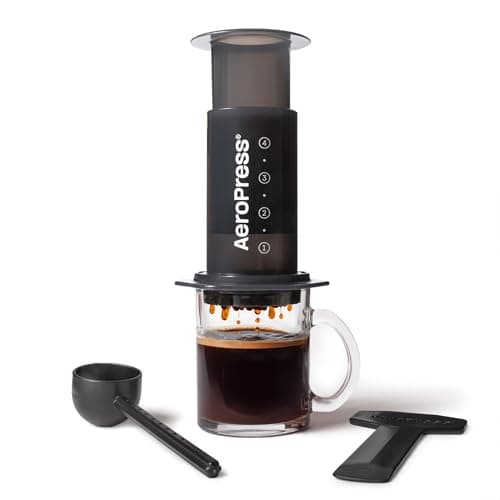
Immersion brewing with plunger pressurePaper microfilters (metal filters available separately)Brews roughly 1–3 small cups or one concentrateBPA-free plastic, no electricityCleanup in about five seconds
9.5/10

The best coffee per dollar in the house: immersion brewing through a paper filter, in ninety seconds, with a cleanup that takes five, and a price nothing else at this quality approaches.

Cup quality
8.5
Forgiveness
9.5
Cleanup
10
Portability
9.5
Value
10

Pros

  • Extremely forgiving — the immersion phase means grind and pour precision matter far less than in pour-over
  • Paper filter produces a clean cup with none of the sediment a French press leaves
  • Cleanup is genuinely five seconds: pop the puck into the bin, rinse the seal
  • Nearly indestructible and packs into a bag — the default travel and office brewer
  • Enormous recipe community, including the inverted method and a world championship built around it

Cons

  • Makes a small volume — one mug at a time, or a concentrate you dilute
  • It is a plastic tube; it will never look like a piece of furniture on a counter
  • Paper filters are a small ongoing consumable, though a metal filter is available
  • The rubber seal stiffens over a few years and eventually needs replacing

Don't buy this if…

you brew for more than one or two people at a time. The AeroPress makes one drink per cycle, so a household of four means four rounds, and a drip machine or a large French press is the right tool for that.

Why the hybrid method works. Pour-over is precise and unforgiving, because water passes through the bed once and your pour rate directly controls extraction. Immersion is forgiving but muddier, because everything steeps together and a metal mesh lets oils and fines through. The AeroPress takes the forgiving part of immersion and the clean part of paper filtration, and the pressure at the end simply speeds up what gravity would eventually do. The practical result is that a careless AeroPress is still good, which is not true of a careless V60.

The concentration is the underrated feature.Standard recipes brew at a much tighter ratio than drip — often around 1:8 to 1:12 rather than 1:16 — and then you dilute to taste. That means one device makes a strong, espresso-adjacent concentrate for an Americano-style drink, a normal-strength black coffee, or a base for a milk drink, depending only on how much water you add afterwards. It is not espresso — the pressure you generate by hand is a fraction of nine bars, and there is no crema — but it is the closest a $30 device gets.

Cleanup is the reason it gets used daily. Unscrew the cap, push the plunger, and the spent puck and paper eject in one piece into the bin. Rinse the seal. That is the entire routine, and it takes about five seconds against the minute or two of rinsing grounds out of a French press plunger assembly. Equipment that is easy to clean gets used; equipment that is not sits in a cupboard.

The honest limits.Volume is the real one. A standard AeroPress brews roughly one mug per cycle, so it does not serve a table. It is also, unavoidably, a plastic tube — functional rather than beautiful, which matters to some people on an open counter. The seal is a genuine wear part that stiffens over years of use, though replacements are cheap and the rest of the device outlives almost anything. And it makes no crema and no true espresso, so if that is what you want, our espresso machine picks are the right page.

$39.95View on Amazon

Price as of Sep 2, 2026. Prices change — Amazon's at checkout is the one that counts.

#ad · we may earn a commission from this link to AeroPress Original Coffee Press

A starting recipe

Use about 15g of coffee to 200g of water at roughly 175–185°F — noticeably cooler than pour-over, because the immersion time and pressure do some of the work heat would. Grind medium-fine, a little finer than drip and coarser than espresso. Add coffee, add water, stir for ten seconds, steep for about a minute, then press slowly over 30 seconds. If it tastes thin, grind finer or steep longer; if it tastes harsh, coarsen or shorten. That is the entire adjustment space, which is why it is so easy to learn.

Standard or inverted?

The standard method sits the AeroPress on your mug with the filter cap on, and a little coffee drips through while it steeps. The inverted method builds it upside down so nothing escapes during the steep, then you flip it onto the mug to press. Inverted gives you total control of steep time and is the method most competition recipes use; it also involves flipping a chamber of hot coffee, which is exactly as risky as it sounds until you are used to it. Start standard. Move to inverted if you want to experiment.

Paper or metal filter?

The included paper microfilters produce the clean, sediment-free cup that is the AeroPress’s signature, and they are extremely cheap. Aftermarket metal filters let oils and some fines through, giving a heavier, French-press-like body and removing the consumable entirely. Neither is better — it is the same clarity-versus-body trade we cover in French press vs pour over. Many owners keep both and choose by bean.

Which AeroPress model?

The Original is the one to buy for home use and the one reviewed here. The Go is a smaller travel version that packs into its own mug, at the cost of brew volume. The XL brews a larger batch, which addresses the main limitation if you regularly want more than a mug. The Clear is the Original in transparent material. They all brew the same way; choose on capacity and portability.

Which beans suit it

Almost anything, which is part of the appeal. The paper filter and clean extraction flatter light and medium single origins in the way a pour-over does — see our single-origin picks. Darker roasts brewed as a concentrate and cut with hot water make an excellent Americano-style drink. As always, whole bean ground fresh does more for the cup than any technique change, so pair it with a burr grinder— and note that a hand grinder plus an AeroPress is the classic travel setup, since neither needs power.

Who should buy something else

If you brew for a household, a drip machine or a large French press makes several cups at once. If you want espresso with crema for milk drinks, no AeroPress recipe gets there. And if you specifically enjoy the ritual and control of pouring, a pour-over coneis the more rewarding hobby — the AeroPress is deliberately the opposite, a device that removes variables rather than offering them.

How we picked

We did not lab-test this gear

Everyone in this category says they tested twenty machines. We have not lab-tested any of these, and we say so. What we did instead: compiled the published manufacturer specifications, read the manuals, ran the math where there was math to run (heat-up time, pressure, dose capacity, grind range, cost per cup), and scored each pick against a published rubric. The scores are judgments from documented research — not measurements we took, because we do not have a lab and we will not pretend we do. Where a number came from someone else's work, we name them in Sources.

Questions

Frequently asked

Is the AeroPress worth it?
For one or two cups at a time, it is arguably the best value in coffee — a cleaner cup than a French press, far more forgiving than pour-over, and cleanup in about five seconds, for around thirty dollars.
Does the AeroPress make espresso?
No. It makes a strong concentrate you can dilute into an Americano-style drink, but the pressure you generate by hand is a small fraction of the roughly nine bars espresso needs, and there is no real crema.
AeroPress vs French press — which is better?
The AeroPress makes a cleaner cup with no sediment, is more forgiving, and cleans up in seconds. The French press makes more coffee at once and gives a heavier, oilier body. Volume and body versus clarity and convenience.
What grind size should I use for AeroPress?
Medium-fine — a little finer than drip, coarser than espresso. Because the immersion phase does most of the extraction, it is far more forgiving of grind variation than pour-over is.
What is the inverted AeroPress method?
Assembling it upside down so no coffee drips through during the steep, then flipping it onto your mug to press. It gives total control of steep time and is what most competition recipes use — but you are flipping a chamber of hot coffee, so start with the standard method.
How long does an AeroPress last?
Years. The plastic body is close to indestructible; the rubber plunger seal is the wear part and stiffens over time, but replacements are inexpensive and easy to fit.

Keep reading

Receipts

Sources

We do not run a testing lab, and we do not pretend to. Where a measured number came from someone else's work, we name them and link them. Where we could not verify something, we say so on the page rather than quietly leaving it out. Read our full method.