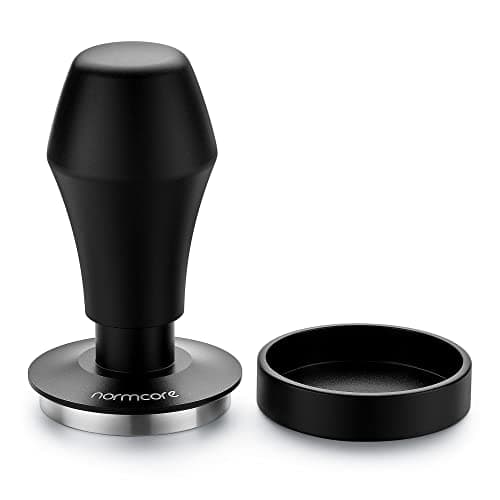
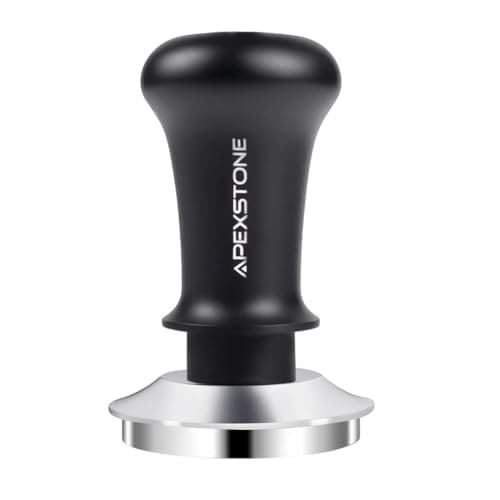
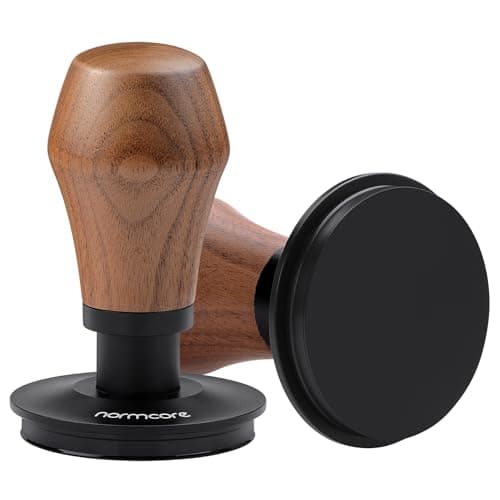
The short answer: measure the inside diameter of your portafilter basket, and buy a tamper a fraction smaller than that number. Not the outside of the portafilter, not the number printed in the marketing copy — the inside of the basket, where the coffee actually sits. Almost every tamper returned to Amazon is returned because someone measured the wrong thing.
Three sizes cover the overwhelming majority of home machines. 58mm baskets are the commercial standard and are used by the Gaggia Classic family, Rancilio Silvia, Lelit, ECM, Rocket and most prosumer machines — a 58.5mm tamper is the snug fit. 54mm baskets are the Breville and Sage standard, covering the Bambino, Barista Express, Barista Pro and Barista Touch — the correct tamper is 53.3mm. 51mm baskets appear on many De'Longhi machines, including the Stilosa and Dedica families. There are outliers, which is why measuring beats assuming.
Why the fractions matter is worth one paragraph, because it is the entire reason this page exists. A tamper smaller than the basket leaves an unpacked ring of coffee around the edge. Water under nine bars of pressure will always take the path of least resistance, so it goes straight down that ring instead of soaking through the puck — that is channeling, and it produces a shot that is sour and bitter at the same time and cannot be fixed by grinding differently. A tamper larger than the basket simply will not seat. This is why a 58.5mm tamper is the standard recommendation for a 58mm basket: baskets have a slight taper and the extra half-millimeter is what closes the gap where the coffee actually sits.
Tamper size by machine, at a glance
54mm basket, 53.3mm tamper: Breville and Sage — Bambino, Bambino Plus, Barista Express, Barista Express Impress, Barista Pro, Barista Touch. 58mm basket, 58.5mm tamper: Gaggia Classic and Classic Pro, Rancilio Silvia, Lelit, ECM, Rocket, Profitec, most E61 machines and essentially all commercial machines. 51mm basket: many De'Longhi machines including the Stilosa and Dedica families, and a number of compact own-brand machines. Because manufacturers change baskets between revisions and some models are exceptions, treat this as a starting point and confirm with a ruler.
How to measure, in thirty seconds
Take the basket out of the portafilter. Lay a ruler across the inside of the basket at its widest point, at the top rim, and read the number in millimeters. That is your basket size, and it is the number every accessory listing refers to. Do not measure the outside of the portafilter body, which is much wider, and do not measure the bottom of the basket, which is narrower because baskets taper. If you land between sizes, round to the nearest standard: 51, 53.3 or 54, or 58.
Why 58.5mm rather than 58mm
A nominal 58mm basket is not exactly 58mm at the coffee line, and a 58mm tamper in a 58mm basket leaves a visible gap around the edge once the coffee is compressed. The half millimeter is the industry's pragmatic answer to that: 58.5mm seats properly and leaves the smallest practical unpacked ring. A very small number of baskets are tight enough that 58.5mm binds, which is why 58mm tampers still exist — but for the large majority of 58mm machines, 58.5mm is the right default. The same logic explains 53.3mm for a 54mm Breville basket.
Flat, convex or ripple — and why it matters much less than size
A flat base is the default and the easiest to use well: it produces a level puck if you hold the tamper level. A convex base curves slightly and packs the edges a little harder, which some people find reduces edge channeling on machines with aggressive water distribution. A ripple or patterned base is a marketing differentiator with the thinnest evidence behind it. All three work. None of them compensates for the wrong diameter, and a beginner buying their first tamper should buy flat in the correct size and stop thinking about it.
Calibrated or not?
A calibrated tamper has an internal spring that gives at a set pressure, usually around 30 pounds, so every tamp is the same regardless of your mood or your grip. What it buys is consistency, not quality — an experienced hand with a solid tamper produces a puck just as good. It is genuinely useful for beginners, for anyone with wrist problems, and for households where more than one person makes coffee. It is not necessary, and a correctly sized solid tamper beats an incorrectly sized calibrated one every time. The full ranking of both kinds is our best espresso tampers roundup.
The other things that must match your basket size
Tampers are the first fitment decision, not the last. Puck screens, bottomless portafilters, distribution tools with fixed collars and dosing funnels are all sized to the basket too, so once you know your number, write it down. We have grouped the rest of the size-specific gear by fitment: Breville 54mm accessories and 58mm accessories. If you are buying a grinder at the same time, our grinder and tamper pairings page matches both to common machines.