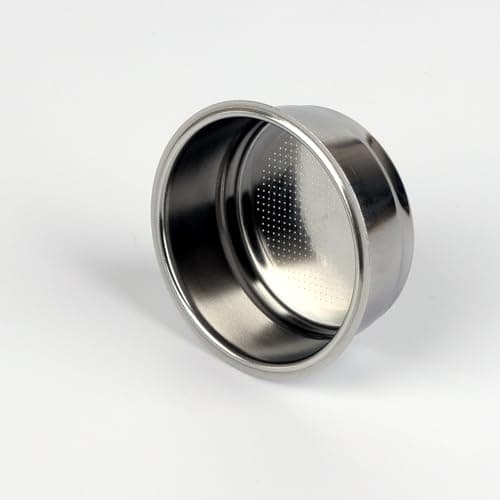
Dose to the capacity printed on your basket, not to a number from a 58mm machine. Most 51mm single-wall baskets sold for De’Longhi-family machines are rated around 14–16g for a double, and the single-wall basket we recommend below is a 16g basket. If you are still on the stock pressurized (dual-wall) basket, dose is close to irrelevant — the crema valve, not the coffee, is generating your pressure, which is why changing grams there does almost nothing. That is the single most useful fact on this page, and it is the reason the first thing we recommend is a different basket rather than a different dose.
The 51mm size is used on the De’Longhi Dedica family and a number of other entry machines, including several budget brands. It is the smallest of the three common portafilter sizes — 51mm, 54mm and 58mm — and almost every dosing number published online is written for 58mm commercial baskets, where an 18g double is standard. Copying that number into a 51mm basket overfills it, and an overfilled basket is a shot that chokes, a puck that imprints on the shower screen, and water that finds the easiest path around the edge instead of through the coffee.
Why dose capacity is set by the basket, not the machine
A basket’s rated capacity is a volume figure translated into grams of ground coffee at a normal density. Two things constrain it. First, the walls: a 51mm basket is simply a smaller cylinder than a 58mm one, so the same depth holds less. Second, headroom — the gap between the top of the tamped puck and the shower screen. Coffee expands when it absorbs water, and if there is no headroom the expanding puck presses against the screen, which both blocks even saturation and leaves a telltale imprint on the dispersion plate.
That is why the honest answer to “how many grams in a 51mm portafilter” is “what does your basket say” rather than a single number. A 14g basket and a 16g basket are both 51mm, and they want different doses. If you do not know which you have, dose to the lower end of the range, pull a shot, and look at the shower screen afterwards: a clean screen and a puck that is not welded to it means you have headroom.
Dose ranges by portafilter size
51mm:typically 14–16g for a double, with single baskets around 7–9g. This is the De’Longhi Dedica family and several budget machines.
54mm:typically 18–19g for a double. This is Breville’s size, and Breville ships a razor tool with its grinder-equipped machines specifically to trim the puck to the right height rather than trusting grams alone.
58mm:typically 18–20g for a double, with the commercial standard around 18g. This is the size on the Gaggia Classic Pro and every prosumer machine, and it is where almost every published number comes from.
Those are ranges across baskets, not a prescription. The number stamped on your specific basket beats every one of them.
The pressurized-basket problem, in one paragraph
Most 51mm machines ship with a dual-wall basket: a second floor beneath the coffee with a pinhole in it. The pressure that pushes your shot through is generated at that pinhole, not by the puck. The practical consequences are specific and worth knowing before you spend a morning weighing coffee: the shot looks plausible from day one regardless of grind, and it does not improve when you dose more carefully, grind finer or tamp more evenly. Dose optimisation on a pressurized basket is effort spent on the one component that is ignoring it. The mechanism is on pressurized vs non-pressurized portafilters.
Ratio, which is the number that actually matters
Once you are on a single-wall basket, dose is only half of the specification. The other half is yield— how much liquid espresso comes out — and the conventional starting point is a 1:2 ratio in about 25–30 seconds. On a 16g basket that means roughly 32g of espresso in the cup. Weigh the output, not the volume: crema makes volume meaningless, and two shots that look identical in the cup can differ by several grams. Then adjust grind, not dose, to bring the time into range. The full sequence is in how to pull an espresso shot, and if the result tastes wrong rather than runs wrong, why is my espresso sour or bitter is the diagnostic.
What to fix, in order
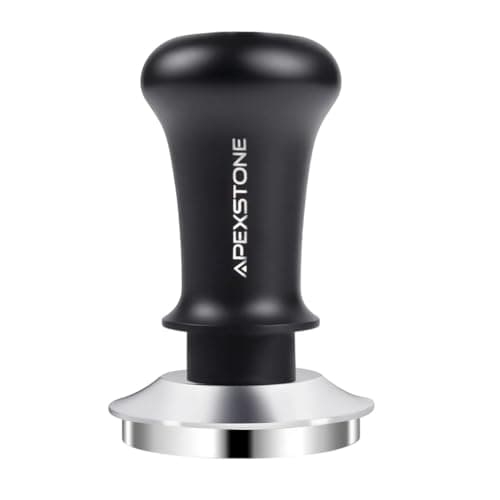
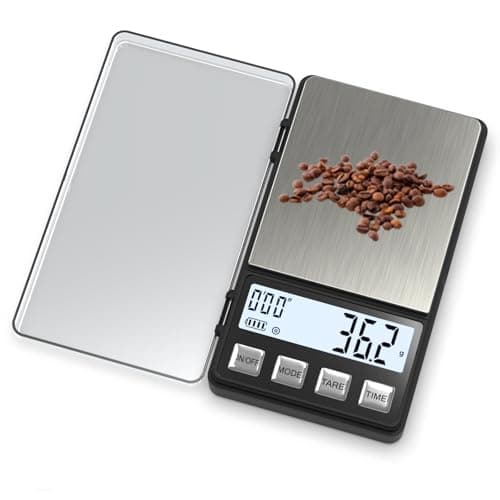
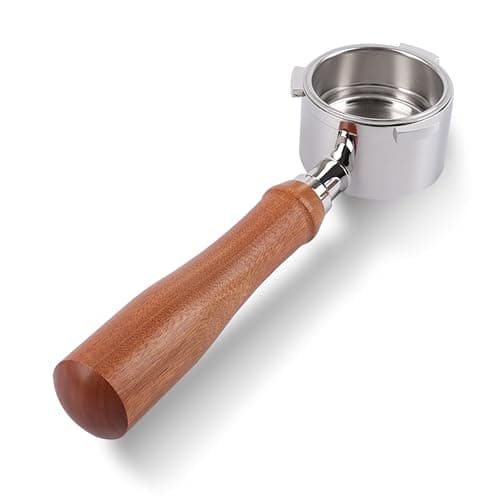
This is a four-part answer, and the order matters more than the parts do: a single-wall basket so dose means something at all, a 51mm tamper so the puck is level, a 0.1g scale so you know what you actually dosed, and — if you want to see what is going wrong rather than guess — a bottomless portafilter. Everything below is sized for 51mm specifically.
Dose by portafilter size
| Portafilter | Typical double dose | Typical single | Common machines |
|---|
| 51mm | ~14–16g | ~7–9g | De’Longhi Dedica family, several budget machines |
| 54mm | ~18–19g | ~9–11g | Breville Bambino, Barista Express, Barista Pro |
| 58mm | ~18–20g | ~9–12g | Gaggia Classic Pro, prosumer and commercial machines |
These are ranges across commonly sold baskets, not a specification for any one basket. The capacity printed on or published for your basket is the number to use.
How to find your 51mm basket’s real dose in three shots
Shot one: dose to the low end of the range.14g in a basket you believe is 14–16g. Tamp level, pull, and then look at the shower screen. A clean screen means headroom to spare.
Shot two: add a gram. Keep going up a gram at a time until the puck starts imprinting on the screen or the portafilter becomes hard to lock in. That point is your ceiling; back off one gram and that is your dose.
Shot three onwards: stop changing dose.Fix it, and adjust grind to bring the shot into a 1:2 ratio in roughly 25–30 seconds. One variable at a time is the whole method — if you change dose and grind together you learn nothing from either.
Signs you are overdosing a 51mm basket
The portafilter is hard to lock in, or you have to force it past its usual position. The puck is already touching the screen.
There is a circular imprint on the shower screen after the shot. Classic overdose, and the tell most people never look for.
The shot chokes even at a coarser grind than you would expect to work. Too much coffee in too little space produces resistance that grind cannot compensate for.
The puck is soupy and sticks to the screen when you knock it out. Water never had room to saturate evenly.
Why going finer is not the answer to a weak 51mm shot
A small basket holds a short puck, and a short puck offers less total resistance than a tall one. The instinct is to grind finer to compensate. Past a point that creates the opposite problem: very fine coffee in a shallow bed compacts unevenly, and water finds a channel through the weakest part rather than passing through the whole puck. The result is a shot that is simultaneously over-extracted where water flowed and under-extracted everywhere else — bitter and sour in the same cup. The fix is distribution, not fineness: a WDT tool stirring the grounds before you tamp does more for a shallow 51mm bed than any grind adjustment, which is also why it is the upgrade we recommend after these four.
The 51mm accessory situation, honestly
51mm is the least-served of the three sizes. There are fewer precision baskets, fewer tampers, and more generic unbranded manufacturing, which means fit tolerance varies between sellers on what is otherwise the same part. That is a real cost of the format and worth knowing before you invest heavily in it. The full list of what fits is on De'Longhi espresso accessories, and if you are still choosing a machine, the under-$300 bracket is where the 51mm-versus-54mm decision gets made.
The 58mm and 54mm numbers, for comparison
This page exists because nearly every published dose figure is a 58mm figure, and a 51mm basket is rated lower. If you are cross-shopping machines, or you own more than one, the other platforms run roughly 18 to 20g for a standard 58mm commercial double and about 16 to 19g for a 54mm Breville double, paired with the same 1:2 brew ratio and 25 to 30 second window. Those, with the headroom test for checking a dose against any basket, are in how many grams of coffee for a double shot.