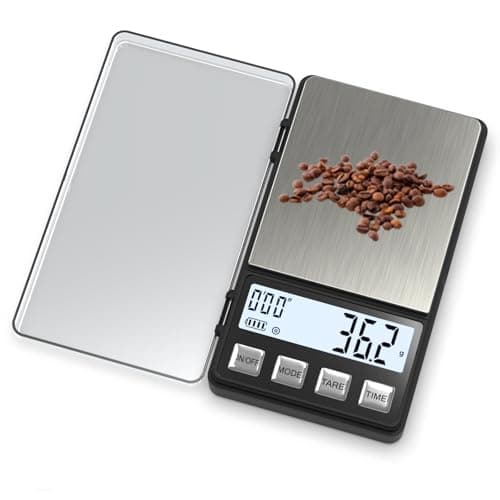
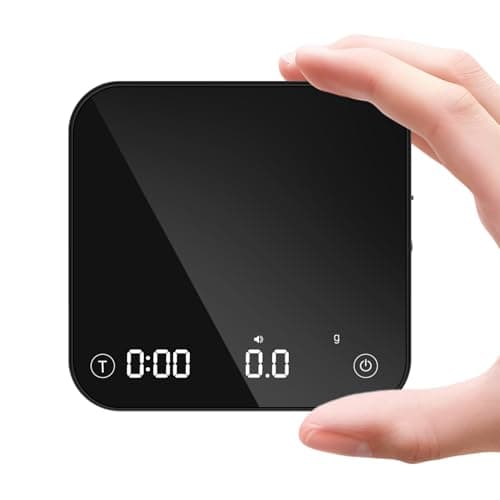
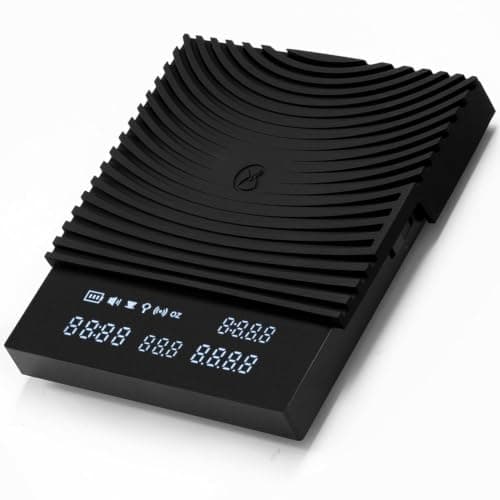
Yes. If your shots are inconsistent and you own one tool to fix it, buy a 0.1g scale with a timer — it costs less than two bags of good beans and it is the only way to know what you actually did. The best overall pick is the Timemore Black Mirror Basic 3 for its response speed and slim body; the honest value answer is the Weightman espresso scale, which has the two specifications that matter for a fraction of the money.
Here is the argument in one paragraph. Espresso is a ratio: a mass of dry coffee in, a mass of liquid espresso out, over a span of seconds. Change any one of those three and the drink changes. Without a scale you are controlling none of them — you are filling a basket by eye and stopping by the look of the stream, which means every shot is a different recipe and nothing you learn carries to tomorrow. With a scale you can hold two variables still and move one, which is the entire process of dialing in.
The specific failure a scale fixes is the one most people misdiagnose. An under-dosed basket leaves headspace, the puck does not hold together under pressure, water runs around the edge, and the shot gushes pale and sour. Nearly everybody's first instinct is to grind finer or tamp harder. Both make it worse, because the problem was never the grind — it was two grams. Weighing in removes that whole category of mystery permanently.
Volume does not substitute, and this is where “a scoop is fine” breaks down. Coffee density varies with roast level and with grind setting: a dark roast is less dense than a light one, and the same scoop of a coarser grind holds a different mass than a finer one. The industry quotes doses in grams for exactly that reason. The same applies on the output side — crema volume varies hugely between fresh and old coffee, so a shot that fills the cup to the same line can be 25g of liquid one week and 40g the next.
What you need, and what you can skip
0.1g resolution: necessary. A 1g scale rounds, and 1g on an 18g dose is a 5% recipe change you cannot see. Any espresso scale worth buying resolves to 0.1g.
A timer: strongly recommended, and the reason to buy a coffee scale rather than a kitchen one. You want grams and seconds in one glance, because a 36g yield in 20 seconds and a 36g yield in 32 seconds are two different drinks.
Fast response: the specification nobody lists and everybody feels. A kitchen scale updates slowly and lags behind the pour, so you overshoot the weight before the number catches up. A good coffee scale tracks the stream, which is how you stop at the right yield rather than past it.
A slim body: practical rather than technical. The gap between a drip tray and the portafilter spouts is small, and plenty of otherwise good scales simply do not fit under a machine with a cup on top of them. Check the height before the brand.
What you can skip: Bluetooth, app connectivity, auto-tare gimmicks, flow-rate graphs. They are pleasant and they change nothing about the coffee. Waterproofing sounds useful and in practice a sheet of cling film over a cheap scale solves the same problem.
Can you use a kitchen scale instead?
For weighing the dose, yes — if it resolves to 0.1g, which most kitchen scales do not. A 1g kitchen scale is better than nothing for dosing and useless for yield. The two real problems are resolution and speed: the cheap kitchen scale in your drawer probably rounds to the gram and updates once a second, which is fine for flour and hopeless for a 25-second extraction. If you already own a 0.1g jeweller's or kitchen scale, start there, add a phone timer, and upgrade when the lag annoys you.
Who genuinely does not need one
Two groups. If you use a super-automatic machine, the machine doses itself from the hopper and you have no access to the puck, so a scale has nothing to weigh — adjust strength in the menu instead. And if you use a pressurized basket with pre-ground coffee and you are happy with the result, a scale will show you your recipe but the basket's pinhole is setting the resistance regardless, so the gain is smaller. Everybody running a non-pressurized basket and a grinder should own one.
What a scale is actually measuring
| Variable | Typical target | What goes wrong without it |
|---|
| Dose in (dry coffee) | Within the basket's stated range, commonly 16-19g for a double | Headspace, a loose puck, water around the edge, sour gushing shots |
| Yield out (liquid espresso) | Roughly twice the dose for a standard double | Under-extraction or over-extraction you cannot repeat or correct |
| Time | About 25-30 seconds for that yield | No way to tell whether grind or dose caused a change |
| Resolution | 0.1g | A 1g scale rounds away a 5% recipe change on an 18g dose |
How to use one, in four shots
Shot one: weigh your dose and write it down. Shot two: keep the dose identical and weigh the yield and the time. Shot three: change only the grind, one step, and record all three numbers again. Shot four: compare. That is the whole method, and it is impossible without a scale because you cannot compare measurements you never took. Our guide to pulling a shot walks the same loop in more detail.
Weigh the cup, not the drink
One practical trick: put the cup on the scale, tare it, then brew. You are now reading yield live, and you can stop the pump at the number rather than at the colour of the stream. If the scale will not fit under the portafilter with a cup on it — a common problem on machines with low drip trays — weigh the cup after instead and use the number to adjust the next shot. Less elegant, same result.
Where a scale does not help
A scale measures, it does not fix. If the grinder cannot reach espresso fineness, weighing tells you precisely how fast your bad shot ran. If the puck is channeling, two identical doses can still produce two different shots — that is a distribution problem, and the tools for it are a needle tool and a bottomless portafilter. The diagnostic order is in why your machine is not building pressure.
Protect it from water, cheaply
Scales die of liquid, not of age. Drips from the portafilter and a splash from the steam wand are the usual culprits. A square of cling film or a thin silicone mat over the top costs nothing and extends the life of a cheap scale enormously, and it is why we would rather buy an inexpensive scale and protect it than pay a premium for a sealed one.