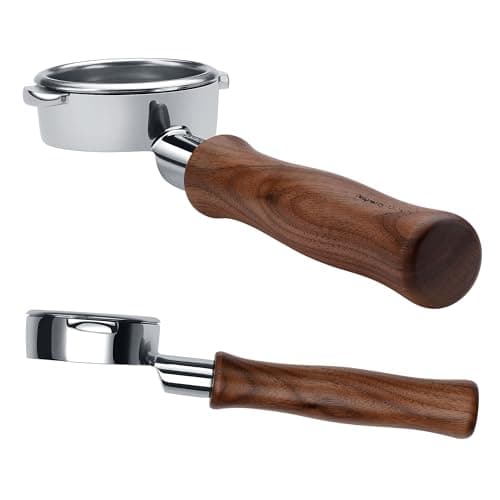
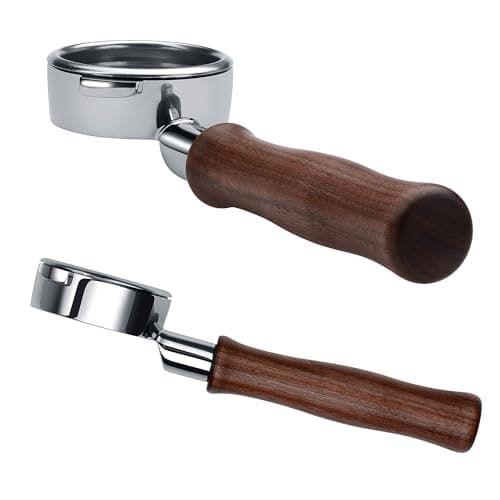
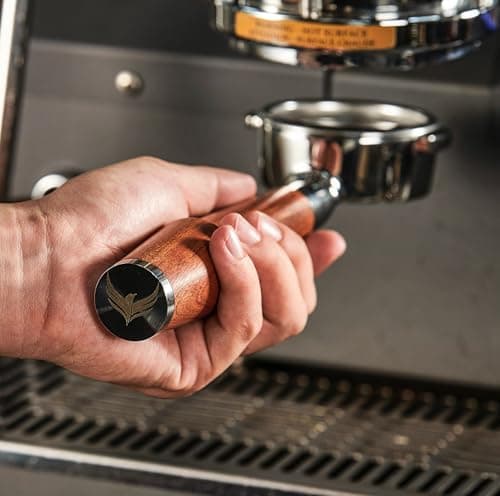
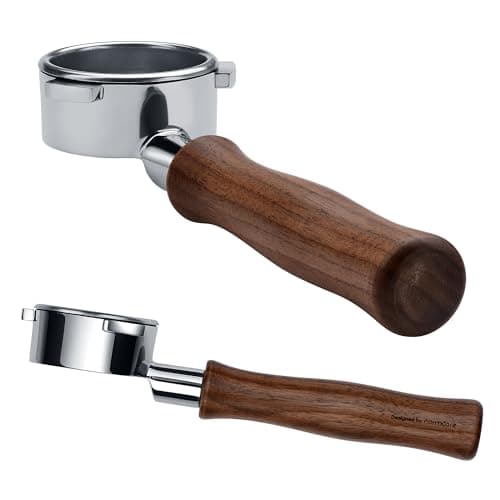
A bottomless portafilter — also called a naked portafilter — has the spouts and the underside removed, so you can watch the espresso come straight off the bottom of the basket. That sounds cosmetic and is in fact the single best diagnostic tool in home espresso, because every fault in your puck preparation becomes visible in real time.
A well-prepared puck produces a curtain of coffee across the whole basket that converges into one dark, steady stream. A puck with a channel produces a jet firing sideways within the first few seconds, then a pale, blonde flow while the shot is still young. On a normal spouted portafilter both of those look identical in the cup, which is why people spend months adjusting grind settings to fix a problem that was never a grind problem.
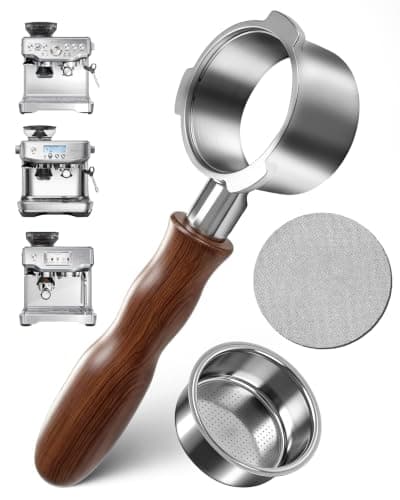
Before anything else, check your basket diameter. This is the one accessory where the wrong purchase is completely unusable, not merely suboptimal. Breville machines use 54mm; Gaggia, Rancilio, E61 and most commercial-style machines use 58mm; some De’Longhi machines use 51mm. A 58mm portafilter will not go anywhere near a Breville. The picks below are grouped by fit for exactly that reason.
Get the size right, or nothing else matters
Portafilter diameter is machine-specific and there is no adapting between sizes. As a rule: 54mm for Breville and Sage machines (Barista Express, Bambino, Barista Pro, Barista Touch); 58mm for Gaggia, Rancilio, Lelit, ECM, Rocket, Profitec and essentially all commercial-lineage machines; 51mm for several De’Longhi models. Beyond diameter, the group type matters too — a 58mm E61 portafilter and a 58mm Gaggia portafilter have different lug geometry and are not interchangeable. Check both before ordering.
How to read the shot
This is the whole reason to own one, so here is what you are looking for.
Good: after a few seconds of nothing, coffee appears across the entire base of the basket as a curtain of fine streams, which converge within a second or two into a single dark, glossy, ropey stream that stays that color until you stop the shot.
Channeling: a thin jet fires sideways or diagonally, sometimes hard enough to hit the drip tray wall. That is water finding a low-resistance path. Cause: uneven distribution, an off-level tamp, or a knock that cracked the puck after tamping.
Early blonding: the stream goes pale and thin much sooner than expected, usually alongside a fast shot. Cause: grind too coarse, dose too low, or channeling upstream of what you can see.
One-sided flow: coffee emerges only from one region of the basket. Cause: almost always an off-level tamp, occasionally an unlevel machine or a worn shower screen.
Fixing what you see
Almost every fault a naked portafilter reveals is a distribution or tamping fault rather than a grind fault, and the fixes are cheap. Stir the grounds thoroughly with a WDT tool before tamping to break up clumps. Tamp perfectly level, once, with no twist and no knock afterwards. Use a tamper that matches your basket diameter — an undersized tamper leaves an uncompressed ring at the wall that is a ready-made channel, which is why 58.5mm tampers exist for 58mm baskets. Dose to the basket’s rated weight so there is no headroom for the puck to move into. Our full sour-or-bitter troubleshooting guide works through the rest.
Precision baskets: the other half of the upgrade
Several picks here include a precision basket, and it is worth understanding why that matters. Stock baskets are stamped, with hole sizes and spacing that vary across the base; precision baskets are laser-cut to consistent hole diameter and even distribution, so flow is uniform across the whole puck. Combined with a naked portafilter, that removes two of the biggest sources of uneven extraction at once — and on a naked portafilter you can actually see the improvement, which is satisfying in a way most upgrades are not.
Practical notes on living with one
Expect mess while you learn: a channeling shot on a naked portafilter sprays, and it will reach your counter. Put a cloth down for the first few weeks. Because there is no spout, the basket is exposed and easy to knock — do not rest it on the counter face-down. And remember it removes the split-shot option: you cannot pull two cups at once, which matters if you routinely make two drinks.
One last point worth being honest about: a naked portafilter is a learning tool, not a permanent requirement. Many owners use one intensively for a few months, fix their prep, then go back to a spouted portafilter for daily convenience and keep the naked one for troubleshooting. That is a perfectly sensible way to use it.