Skip to content
Tamp & Pour

Roundups & reviews · Espresso Machines

Gaggia Classic Pro review

The cheapest machine with a real 58mm commercial group, and the most modded machine in home espresso. What it does brilliantly, and what it asks of you.

By Stephen V.Updated How we review
#ad

We earn a commission when you buy through our Amazon links, at no extra cost to you. It never changes a verdict, and we say so when the cheaper product is the better buy. How this works.

The Gaggia Classic Pro is not the easiest espresso machine to live with, and that is the point. It is the cheapest way to get a genuine 58mm commercial group head into a home kitchen, and 58mm is the size the entire professional accessory world is built around. Buy one and every precision basket, bottomless portafilter, distribution tool and quality tamper on the market fits your machine — which is not true of the 54mm Breville world most beginners start in.

The trade is that it gives you nothing for free. There is no PID from the factory, no assisted tamping, no automatic milk, and no grinder. It is a metal box with a boiler, a pump and a real steam wand, and it will make excellent espresso once you learn how it behaves. This review is about whether you want that relationship with a machine.

01
Gaggia Gaggia Classic Pro

The machine you keep for a decade

Gaggia Classic Pro

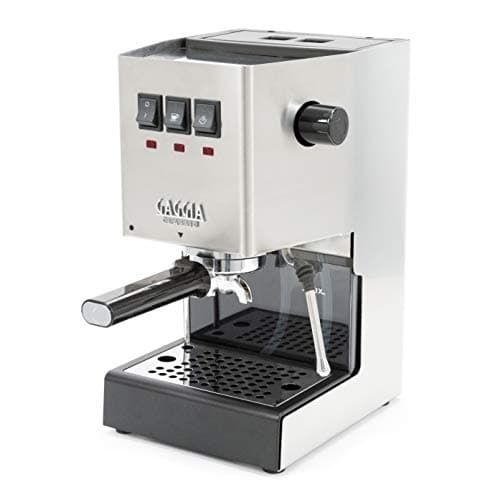
58mm commercial portafilterSingle aluminum boiler3-way solenoid valveRotary commercial-style steam wandNo PID from the factory
7.7/10

The best machine to grow into: a 58mm commercial portafilter, a repairable metal build and the deepest modding community in home espresso — for someone willing to learn its temperature behavior.

Shot quality
8
Steam power
7.5
Build
8.5
Ease of use
6.5
Value
8

Pros

  • 58mm commercial group means every professional basket, tamper, distribution tool and bottomless portafilter fits
  • 3-way solenoid releases pressure after the shot, so the puck comes out dry and knocks straight into a knock box
  • Real rotary steam wand rather than a panarello frothing sleeve — you can learn genuine microfoam on it
  • Simple, metal, repairable, and supported by an enormous community of owners, guides and parts
  • The single most modded machine in home espresso, so its capability grows as your skills do

Cons

  • No PID: brew temperature drifts through the heating cycle, and you manage it by timing rather than by setting it
  • Single boiler means you pull, wait, then steam — no simultaneous brewing and steaming
  • Small drip tray and short group clearance; taller cups do not fit comfortably
  • Steam power is adequate rather than strong, so texturing a large pitcher takes patience
  • No grinder, so the real spend is this plus a grinder

Don't buy this if…

you want good drinks on day one with no study. This machine rewards patience and punishes impatience, and someone who just wants a fast flat white before work will be far happier with a Bambino Plus or a super-automatic.

The 58mm group is the whole argument.Portafilter diameter sounds like trivia and is actually the most consequential spec on this machine. 58mm is the commercial standard, so the aftermarket is enormous and cheap: precision baskets that improve extraction evenness, bottomless portafilters that show you exactly where your puck prep is failing, and tampers at every price. Breville’s 54mm ecosystem is narrower and pricier. If you expect this to become a hobby rather than an appliance, starting on 58mm means you never have to re-buy accessories.

The 3-way solenoid is the quiet quality-of-life feature. When the shot ends, the valve vents the pressure in the group back through a drain, so the puck is left dry and compact rather than a soup you have to scrape out. Almost nothing else at this price does it, and it is the difference between a five-second cleanup and a messy one.

Temperature is the thing you have to learn.Without a PID, the boiler cycles a thermostat on and off around a target, so the actual brew temperature depends on where in that cycle you pull. Owners handle it with “temperature surfing”: wait for the heating light to go out, run a short flush, then pull on a predictable schedule. It is a genuine skill, it becomes automatic within a couple of weeks, and it is the single most common reason people either love this machine or bounce off it.

The mod path is real, not folklore.A PID kit is the most common upgrade and removes the temperature-surfing problem entirely. Other owners fit an OPV adjustment to bring pump pressure closer to nine bars, a bottomless portafilter for diagnosis, and a silvia-style steam wand for better milk. None of this is required — the machine works well as sold — but the fact that a decade-old Classic can be brought to a genuinely modern standard is why so many are still in daily use.

What it will not do.It will not brew and steam at once, so a run of four milk drinks means waiting between them. It will not fit a tall travel mug under the group. And it will not rescue a bad grinder — on 58mm non-pressurized baskets the grind is doing the work, which makes an espresso-capable grinder the very next purchase, not an optional one.

$449.00View on Amazon

Price as of Sep 2, 2026. Prices change — Amazon's at checkout is the one that counts.

#ad · we may earn a commission from this link to Gaggia Classic Pro

What to budget alongside it

Plan the whole setup before buying. A grinder that goes espresso-fine with repeatable adjustment is mandatory, not optional — budget from around $150 for a capable hand grinder or $200-plus for an electric. A 58.5mm tamper matters here specifically: a nominal 58mm tamper in a 58mm basket leaves a thin unsealed ring at the wall, which is a ready-made channel, and 58.5mm closes it. Add a 0.1g scale, a WDT tool and a knock box and you have the complete station for well under $150 of accessories.

Temperature surfing, in practice

Switch on and let it heat for 15 to 25 minutes with the portafilter locked in, so the group head reaches temperature rather than stealing heat from your shot. Watch the heating light: when it goes out, the boiler has reached its upper setpoint. Run a two-to-three-second flush through the group to pull fresh water in, wait a few seconds, then pull. Do it the same way every time and your shots become repeatable — the goal is consistency of routine, not a specific temperature you cannot measure.

Is the PID mod worth it?

If you pull espresso most days and you are comfortable working inside an appliance, yes — it removes an entire variable and makes the machine behave like a much more expensive one. If you are not comfortable with that, do not: the machine makes very good espresso as sold, and a badly executed mod is worse than none. Note that fitting a PID is user modification, so treat any warranty as forfeit and do the work carefully or have someone competent do it.

Cleaning and descaling

The Classic Pro takes standard 58mm backflushing, which is the single most important maintenance job on it: a blind basket and espresso machine detergent once a week clears the oils that build up behind the shower screen and in the 3-way valve. A neglected solenoid valve is the most common failure on these machines and it is entirely preventable. Descale on a schedule matched to your water hardness, using a proper descaler rather than vinegar. Our cleaning supply picks cover exactly what to buy.

Who should buy something else

If you want the grinder in the box and a friendlier learning curve, the Breville Barista Express is the better first machine. If milk drinks are the whole point and you do not want to learn steaming, the Bambino Plus automates it. If you want to press one button and get a cappuccino, a super-automatic is the honest answer. And if you want simultaneous brewing and steaming for a household, that is a dual boiler problem this machine cannot solve.

How we picked

We did not lab-test this gear

Everyone in this category says they tested twenty machines. We have not lab-tested any of these, and we say so. What we did instead: compiled the published manufacturer specifications, read the manuals, ran the math where there was math to run (heat-up time, pressure, dose capacity, grind range, cost per cup), and scored each pick against a published rubric. The scores are judgments from documented research — not measurements we took, because we do not have a lab and we will not pretend we do. Where a number came from someone else's work, we name them in Sources.

Questions

Frequently asked

Is the Gaggia Classic Pro worth it?
If you want to learn espresso properly and keep the machine for years, yes — it is the cheapest route to a 58mm commercial group, it is repairable, and its capability grows with mods. If you want easy results immediately, it is the wrong machine.
Does the Gaggia Classic Pro have a PID?
Not from the factory. Brew temperature is controlled by a cycling thermostat, so owners either learn to time their shots against the heating cycle (“temperature surfing”) or fit an aftermarket PID kit, which is the most common modification.
What is temperature surfing?
Timing your shot against the boiler’s heating cycle so you brew at a consistent point. Wait for the heating light to go out, run a short flush, wait a few seconds, then pull. Doing it identically every time is what makes shots repeatable.
Gaggia Classic Pro vs Breville Barista Express — which should I buy?
The Barista Express if you want one purchase that includes a grinder and an easier start. The Gaggia if you want a 58mm commercial group, a machine you can mod and repair indefinitely, and you are willing to buy a separate grinder.
Can you steam milk and pull a shot at the same time?
No — it is a single boiler, so you pull the shot, switch to steam mode, wait for the boiler to come up, then steam. Fine for one or two drinks, slow for four.
What size tamper does the Gaggia Classic Pro need?
58mm baskets, and a 58.5mm tamper is the better choice — a nominal 58mm tamper leaves a thin ring of uncompressed coffee at the basket wall, which water will channel through.

Keep reading

Receipts

Sources

We do not run a testing lab, and we do not pretend to. Where a measured number came from someone else's work, we name them and link them. Where we could not verify something, we say so on the page rather than quietly leaving it out. Read our full method.