Skip to content
Tamp & Pour

Roundups & reviews · Espresso Machines

The best dual boiler espresso machines

Pull and steam at the same time, with a brew temperature that holds. Ranked on what 'dual boiler' actually means at each price — with live prices and honest cons.

By Stephen V.Updated How we review
#ad

We earn a commission when you buy through our Amazon links, at no extra cost to you. It never changes a verdict, and we say so when the cheaper product is the better buy. How this works.

A dual boiler machine has two separate heated vessels: one held at brew temperature, around 200°F, and one held at steam temperature, well above boiling. That is the entire feature, and it solves two problems at once. You can pull a shot and steam milk simultaneously instead of waiting between them, and the brew boiler never has to swing between two wildly different temperatures, so your shot temperature is far more stable.

Before the picks, one piece of label literacy that will save you money. The phrase “dual boiler” is not regulated, and at the budget end it usually means two thermoblocks— small flow-through heaters, not boilers. Two thermoblocks genuinely do let you brew and steam at the same time, which is a real benefit. What they do not give you is the thermal mass of a true boiler, so temperature stability across a long shot or several drinks is nothing like a prosumer machine. We have ranked both kinds here and labeled each honestly, because a $300 “dual boiler” and a $2,000 one are not the same product at different prices.

The other honest note: this is a category with a genuinely thin bench of reliably-stocked machines, and stock at the prosumer end moves quickly. Every pick below was verified live and in stock, and each card shows the current price.

The short answer

Quick picks

#ad · Live prices from the Amazon Product API, as of Sep 2, 2026. Where we have no verified live price, we show none — a gap beats a number that has rotted.

In detail

The picks, in full

01
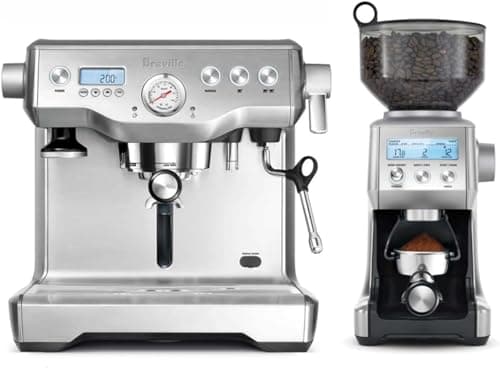
Breville Breville Dynamic Duo (Dual Boiler + Smart Grinder Pro)

Best overall

Breville Dynamic Duo (Dual Boiler + Smart Grinder Pro)

True dual boiler (separate brew and steam boilers)58mm commercial portafilterPID temperature controlBundled with Smart Grinder Pro
8.4/10

The best complete dual boiler setup: Breville's true dual-boiler machine bundled with its Smart Grinder Pro, which removes the awkward 'and now buy a grinder' step at this price.

Temperature stability
9
Steam power
9
Build
8.5
Ease of use
7.5
Value
8

Pros

  • Genuine separate boilers — brew and steam simultaneously with a stable brew temperature
  • 58mm commercial group, so the whole professional accessory market fits
  • PID lets you set brew temperature by the degree rather than manage a cycling thermostat
  • The grinder is in the box, which at this price point is a meaningful saving over buying separately
  • Pre-infusion and adjustable shot parameters give real control

Cons

  • Expensive, and the bundle means you pay for a grinder you may already own
  • Large and heavy — this is a permanent counter installation
  • Two boilers means a longer warm-up and more descaling surface to maintain
  • The bundled Smart Grinder Pro is a good all-rounder rather than a precision espresso grinder

Don't buy this if…

you already own a grinder you like — you would be paying for a second one, and a standalone dual boiler is the better buy in that case.

This is the pick for someone stepping up from a single-boiler machine who wants the whole setup sorted in one purchase. If you are coming from a Gaggia Classic Pro, this is the natural next machine — same 58mm group, none of the temperature surfing.

$1,699.95View on Amazon

Price as of Sep 2, 2026. Prices change — Amazon's at checkout is the one that counts.

#ad · we may earn a commission from this link to Breville Dynamic Duo (Dual Boiler + Smart Grinder Pro)

02
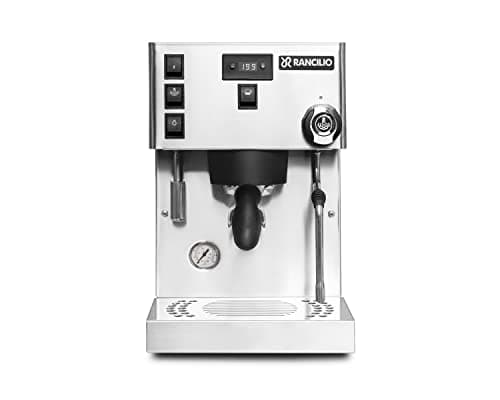
Rancilio Rancilio Silvia Pro X

Best build & steam

Rancilio Silvia Pro X

True dual boiler58mm commercial portafilterPID with independent brew and steam controlCommercial-derived components
8.4/10

The commercial-parts choice: a true dual boiler in a stainless body from a manufacturer that builds cafe machines, with the steam power and build life to match.

Temperature stability
9
Steam power
9.5
Build
9.5
Ease of use
6.5
Value
7.5

Pros

  • Steam power is the strongest here — it textures a full pitcher quickly and does not run out
  • Built from commercial-lineage parts, so it is serviceable for a very long time
  • Independent PID control over both boilers
  • Stainless body and commercial group head, with a weight that keeps it planted

Cons

  • No grinder, so budget for one on top of an already high price
  • Sparse compared with Breville — no touchscreen, no guidance, no automation
  • Long warm-up as both boilers come to temperature
  • Availability moves; this is a low-stock, specialist product

Don't buy this if…

you want the machine to help you. This is a bare, capable tool that assumes you already know what you are doing.

$2,195.00View on Amazon

Price as of Sep 2, 2026. Prices change — Amazon's at checkout is the one that counts.

#ad · we may earn a commission from this link to Rancilio Silvia Pro X

03
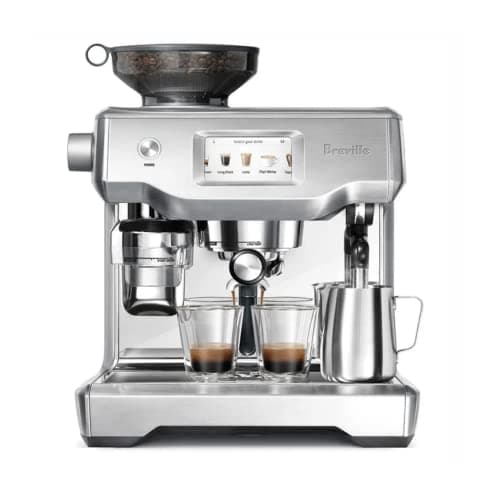
Breville Breville Oracle Touch (BES990)

Best automated dual boiler

Breville Oracle Touch (BES990)

True dual boilerAutomatic grinding, dosing and tampingAutomatic milk texturingTouchscreen drink selection
8.3/10

A dual boiler that also grinds, doses, tamps and steams for you: the most automated machine here, aimed at someone who wants cafe results without any of the craft.

Temperature stability
9
Steam power
8.5
Build
8
Ease of use
9.5
Value
6.5

Pros

  • Automates every difficult step while still using a real portafilter and a real dual boiler
  • Automatic milk texturing to a set temperature and texture, hands-free
  • Touchscreen makes drink selection and adjustment legible to anyone in the house
  • Simultaneous brew and steam, so back-to-back milk drinks are quick

Cons

  • The most expensive machine on this page by a clear margin
  • Heavy automation means you learn very little about espresso
  • More systems means more to service — grinder, tamper mechanism, milk circuit and two boilers
  • Very large footprint

Don't buy this if…

you actually want to make espresso by hand. You are paying a large premium for the machine to do the interesting parts for you.

$2,301.47View on Amazon

$2,799.9518% off

Price as of Sep 2, 2026. Prices change — Amazon's at checkout is the one that counts.

#ad · we may earn a commission from this link to Breville Oracle Touch (BES990)

04
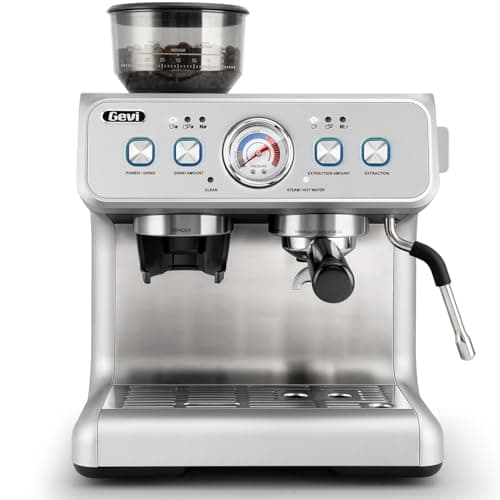
Gevi Gevi Dual Boiler Espresso Machine with Built-In Burr Grinder

Best budget all-in-one

Gevi Dual Boiler Espresso Machine with Built-In Burr Grinder

Twin heating circuits (marketed as dual boiler)Built-in burr grinderSimultaneous brew and steamSteam wand for milk
6.9/10

The budget interpretation: twin heating circuits and a built-in burr grinder for roughly a sixth of the prosumer price — real simultaneous brewing and steaming, without prosumer thermal stability.

Temperature stability
6
Steam power
6.5
Build
6
Ease of use
7.5
Value
8.5

Pros

  • Genuinely lets you brew and steam at the same time, which is the headline benefit most buyers want
  • Grinder included, so it is a complete machine at a budget price
  • Far cheaper than any true dual-boiler machine

Cons

  • Twin thermoblocks rather than true boilers — nothing like prosumer temperature stability across a session
  • Built-in grinder is basic; a standalone burr grinder will out-grind it
  • Build and long-term parts support are not in the same category as Breville or Rancilio

Don't buy this if…

you are buying dual boiler specifically for temperature stability. For simultaneous brew-and-steam it delivers; for thermal mass it does not.

$359.97View on Amazon

Price as of Sep 2, 2026. Prices change — Amazon's at checkout is the one that counts.

#ad · we may earn a commission from this link to Gevi Dual Boiler Espresso Machine with Built-In Burr Grinder

05
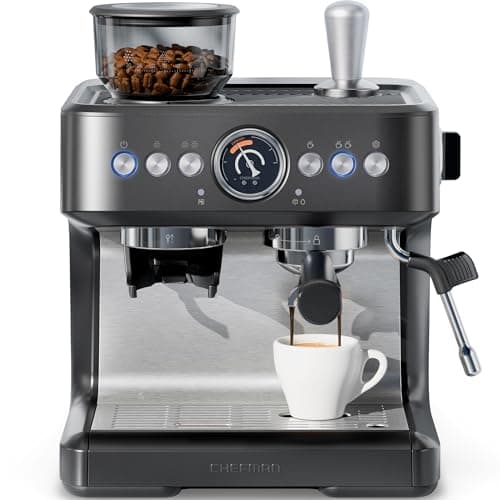
Chefman Chefman Crema Deluxe Espresso Machine with Double Boiler

Cheapest simultaneous brew & steam

Chefman Crema Deluxe Espresso Machine with Double Boiler

Twin heating circuits (marketed as double boiler)Brew and froth simultaneouslyMilk frotherCompact body
6.6/10

The cheapest way to stop waiting between shot and steam: twin heating circuits in a compact body, with the honest caveat that this is a convenience feature rather than a thermal upgrade.

Temperature stability
5.5
Steam power
6
Build
6
Ease of use
8
Value
8.5

Pros

  • Lowest price here for a machine that brews and steams at the same time
  • Compact enough for a normal kitchen, unlike the prosumer machines
  • Simple to operate with no learning curve

Cons

  • Twin thermoblocks, not boilers — do not expect prosumer temperature behavior
  • No grinder included
  • Steam power is modest, so texturing takes patience
  • Not a machine with a long parts and service story

Don't buy this if…

you want the temperature stability that dual boilers are really prized for — at this price you are buying the convenience half of the feature only.

$299.99View on Amazon

$499.9940% off

Price as of Sep 2, 2026. Prices change — Amazon's at checkout is the one that counts.

#ad · we may earn a commission from this link to Chefman Crema Deluxe Espresso Machine with Double Boiler

Boiler, thermoblock, heat exchanger: what the words mean

Single boiler: one vessel that heats to brew temperature for the shot, then climbs to steam temperature for milk. Cheap and compact; you wait between the two, and temperature swings as it cycles. This is the Gaggia Classic Pro and most machines under $600.

Thermoblock / thermocoil:a heated block that warms water as it flows through, with almost no stored volume. Heats in seconds, which is why Breville’s ThermoJet machines are ready almost instantly, but there is little thermal mass to hold temperature under load.

Heat exchanger:one steam boiler with a pipe running through it that heats brew water on demand. Brews and steams simultaneously from a single boiler; needs a “cooling flush” before each shot to purge overheated water.

True dual boiler: two separate vessels, each held at its own temperature by its own PID. Simultaneous brew and steam, plus the thermal mass to hold brew temperature steady through a long shot and across several drinks. This is the top of the consumer ladder and the reason the machines cost what they do.

Do you actually need one?

Be honest about your routine, because this is an expensive feature to buy for the wrong reason. A dual boiler earns its money if you regularly make three or more milk drinks back to back— that is the scenario where a single boiler’s brew-wait-steam cycle becomes genuinely tedious, and where a small boiler runs out of steam mid-pitcher. It also earns it if you chase shot-to-shot temperature consistency at the level where a couple of degrees changes the cup.

It does not earn its money if you make one or two drinks a morning. At that volume a good single-boiler machine plus a genuinely good grinder will produce better espresso than a dual boiler plus a mediocre grinder, for less total money. The grinder is still the higher-leverage purchase, right up until it is not.

What to check before buying at the budget end

If a machine under about $600 is described as dual or double boiler, assume twin thermoblocks unless the listing explicitly states boiler volumes in milliliters. Ask three questions: can it brew and steam simultaneously (usually yes, and that is the real benefit); does it hold brew temperature across four drinks (usually no); and does it have a PID you can set (usually no). Buy it for the first, and do not pay a premium expecting the second and third.

The hidden costs of two boilers

More heated water means more scale. Two boilers, two sets of seals and more plumbing mean a longer descaling routine and more to service eventually, and hard water shortens the interval considerably — a filtered water supply is a genuine consideration at this price. Warm-up is longer too: expect 20 to 30 minutes to full thermal stability on a true dual boiler, which is why owners run them on timers or leave them on. Budget for a proper descaler and weekly backflushing from day one; our cleaning supply picks cover it.

Do not forget the grinder

A dual boiler removes temperature and steam as limiting factors, which means your grinder becomes the limit even more visibly than before. Pairing a $2,000 machine with a $150 grinder is the most common mis-allocation at this level. If you are spending here, spend proportionately on the grind — our single dose grinder ranking and espresso grinder ranking are the right starting points.

How we picked

We did not lab-test this gear

Everyone in this category says they tested twenty machines. We have not lab-tested any of these, and we say so. What we did instead: compiled the published manufacturer specifications, read the manuals, ran the math where there was math to run (heat-up time, pressure, dose capacity, grind range, cost per cup), and scored each pick against a published rubric. The scores are judgments from documented research — not measurements we took, because we do not have a lab and we will not pretend we do. Where a number came from someone else's work, we name them in Sources.

Questions

Frequently asked

What does a dual boiler espresso machine actually do?
It holds two separate vessels at two temperatures — one for brewing, one for steam — so you can pull a shot and steam milk simultaneously, and your brew temperature stays stable instead of swinging between the two.
Is a dual boiler worth it for home use?
If you make three or more milk drinks back to back, or you chase shot-to-shot temperature consistency, yes. For one or two drinks a morning, a good single-boiler machine plus a better grinder produces better coffee for less money.
Are cheap 'dual boiler' machines really dual boiler?
Usually they have two thermoblocks rather than two boilers. That genuinely allows simultaneous brewing and steaming, but it does not provide the thermal mass that keeps brew temperature stable across a session. Buy them for the convenience, not the stability.
Dual boiler vs heat exchanger — what is the difference?
A heat exchanger uses one steam boiler with a pipe running through it to heat brew water on demand, and needs a cooling flush before each shot. A dual boiler has two independently controlled vessels, so brew temperature is set directly and needs no flush.
How long does a dual boiler take to heat up?
Typically 20 to 30 minutes to full thermal stability on a true dual boiler, because there is far more metal and water to bring to temperature. Many owners run them on a timer or leave them on.
Do dual boilers need more maintenance?
Yes. More heated water and more plumbing means more scale and more seals, so descaling is a longer job and hard water shortens the interval. Weekly backflushing and a proper descaler are not optional at this level.

Keep reading

Receipts

Sources

We do not run a testing lab, and we do not pretend to. Where a measured number came from someone else's work, we name them and link them. Where we could not verify something, we say so on the page rather than quietly leaving it out. Read our full method.