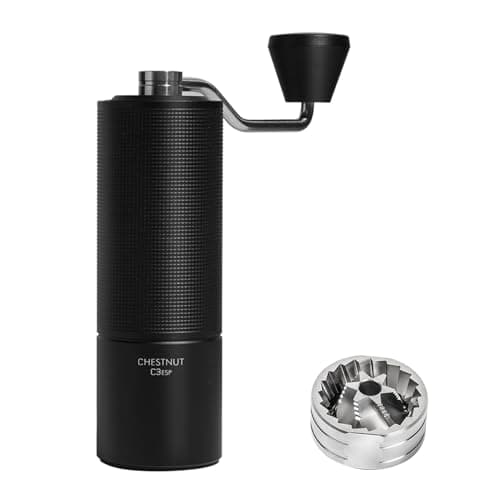
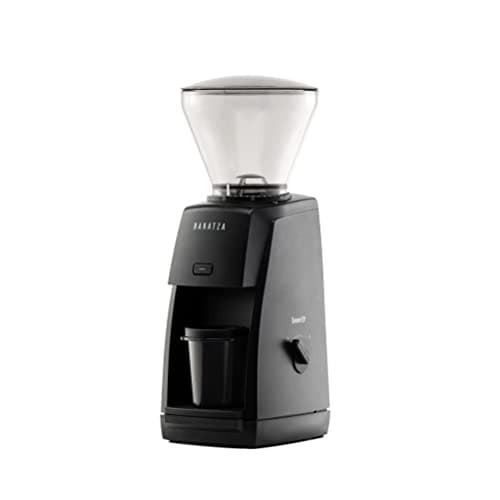
Pair a grinderless Breville with the Baratza Encore ESP. It reaches genuine espresso fineness, adjusts in small enough steps to walk a shot in rather than jump past it, and Baratza sells the parts to keep it running — which is the right first grinder for a Bambino or Bambino Plus. If you pull shots every day and want to stop fighting stepped adjustment, the Eureka Mignon Notte is stepless and doses straight into the portafilter. If your budget is already spent on the machine, the Timemore Chestnut C3 ESP is a hand grinder that will still beat anything pre-ground.
First: does your Breville even need one?
This is where most of the confusion on this question comes from, because the Breville espresso range splits cleanly in two.
Needs a separate grinder: the Bambino (BES450), the Bambino Plus (BES500), and any Dual Boiler bought on its own. These are brew-and-steam machines with a 54mm portafilter and no grinder inside them at all.
Has one built in: the Barista Express (BES870XL), the Barista Express Impress (BES876), the Barista Pro (BES878), the Barista Touch Impress (BES881) and the Oracle Touch (BES990). These grind, dose and in some cases tamp for you, and buying a second grinder for one of them only makes sense if you want to single-dose different beans or you have outgrown the built-in burrs.
If you are not sure which camp you are in, the simplest test is whether there is a bean hopper on top. Our ranking of the Breville range lists which model is which, and machines with a grinder included covers the all-in-one route if you have not bought yet.
What a Breville 54mm basket wants from a grinder
Fine enough to choke the machine.This is the specification that disqualifies most sub-$150 grinders. A grinder that physically cannot go fine enough to stall a shot also cannot be dialled in, because you never get to approach the right point from the slow side. Ask whether a grinder is “espresso-capable” rather than whether it has an espresso setting printed on the dial.
Small adjustment steps. Espresso needs resolution. On a coarse-stepped grinder the shot goes from gushing to choking between two adjacent clicks with nothing usable in between. Stepless grinders remove the problem entirely; a well-designed stepped grinder with many fine steps at the espresso end gets close.
Low enough retention for your habits.Breville’s 54mm baskets hold less than a 58mm commercial basket, so a gram of stale grounds left in a chute is a larger share of your dose than it would be on a bigger machine. If you keep one coffee in the hopper this barely matters. If you rotate bags, it matters a lot, and a single-dose grinder is the structural fix.
A spout or fork that reaches the portafilter. A small thing that becomes a daily thing. Grinders designed around espresso dose directly into the basket; general grinders dose into a bin you then transfer, which costs you grounds and adds static mess.
How we ranked them
On grind consistency, adjustment resolution, retention, build and value, from published manufacturer specifications and decoded feature lists rather than tests we did not run. Every pick keeps the scores it already carries elsewhere on this site, so our pages cannot disagree about the same grinder. The order here is specific to a grinderless Breville: we weight small-step adjustment and portafilter dosing more heavily than we would on a general-purpose grinder page, which is why this list is not in the same order as best espresso grinders.
Below are the four we would actually pair with a Bambino or Bambino Plus.
Which Breville needs a grinder
| Breville model | Grinder inside? | Portafilter | What to buy |
|---|
| Bambino (BES450) | No | 54mm | Any pick on this page |
| Bambino Plus (BES500) | No | 54mm | Any pick on this page |
| Dual Boiler (bought alone) | No | 58mm | Step up to a flat-burr espresso grinder |
| Barista Express (BES870XL) | Yes, 16 grind settings | 54mm | Nothing — unless you want to single-dose |
| Barista Express Impress (BES876) | Yes, with assisted tamping | 54mm | Nothing |
| Barista Pro (BES878) | Yes, 30 grind settings | 54mm | Nothing |
| Barista Touch Impress (BES881) | Yes | 54mm | Nothing |
| Oracle Touch (BES990) | Yes, automatic dosing and tamping | 58mm | Nothing |
What about Breville’s own Smart Grinder Pro?
It is the obvious brand-matched answer and it is a competent grinder: a conical burr set with 60 settings and a portafilter cradle sized for Breville’s 54mm baskets, which makes the workflow tidy. We have not given it a ranked card here for one honest reason — at the time of writing it does not carry a live verified price in our price layer, and we do not rank a product we cannot price. If you find it in stock and the dosing cradle appeals, it is a reasonable choice that sits between the Encore ESP and the Notte in capability. It appears as a pick on best coffee grinders and our grinder-and-tamper pairings.
Stepped versus stepless, on a 54mm basket
A stepped grinder moves in fixed clicks. A stepless grinder rotates continuously, so every grind size in its range is reachable. For espresso the difference shows up at the fine end: you find a coffee that gushes on click 7 and chokes on click 6, and on a stepped grinder there is nothing you can do about it except change the dose or the coffee. On a 54mm basket you have slightly less dose headroom to play with than on a 58mm commercial basket, which makes the adjustment resolution marginally more important, not less. That is the whole case for moving from the Encore ESP to the Notte, and it is only worth money once you are pulling shots often enough to meet the problem.
Retention, and why it matters more here
Every grinder with a chamber and a chute keeps roughly a gram of grounds inside it. On a 58mm double dose that is a small fraction; on a 54mm basket it is a slightly larger one, and if that gram is yesterday’s coffee it is a stale fraction. The practical answers, in order of cost: puff the chute with a bellows, purge a couple of grams before a dose, or buy a single-dose grinder that has almost no chamber to retain anything. If you keep one coffee in the hopper permanently, skip all three — what comes out matches what went in.
What else the pairing needs
A 54mm tamper, because diameter is the one accessory spec that cannot be fudged — see the tamper size guide. A 0.1g scale, because a timed dose on any grinder drifts as the beans age and a scale is how you notice. Optionally a WDT tool, which does more for a 54mm basket than most upgrades at the same price. The full kit for these machines is on Breville espresso accessories.