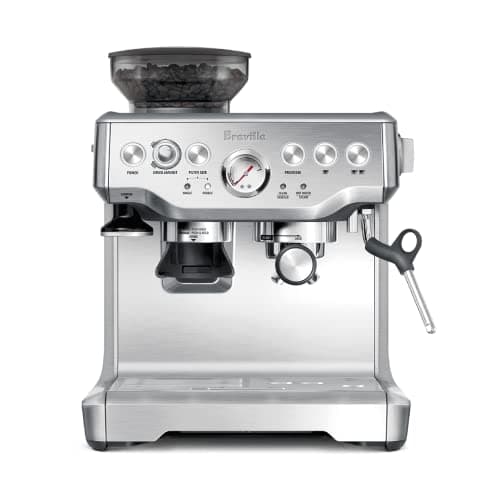
A machine with a grinder built in solves a real problem, and it is not the one the marketing talks about. Home espresso needs two appliances, two power outlets and roughly twenty inches of counter, and for a lot of kitchens that is the actual constraint — not the money. An all-in-one collapses that into one box you fill with beans and one workflow that ends with the portafilter already dosed. If that is your problem, this is your page.
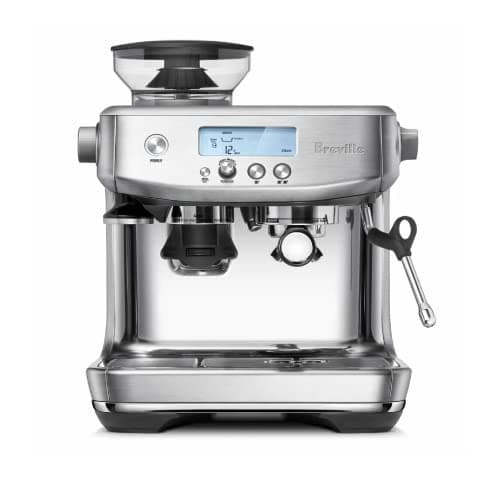
What it does not do is get you a grinder for free. As a rough rule the burr set inside a $700 all-in-one is worth about what a $150–$250 standalone grinder would be, and the rest of the price is the machine. That is not a scandal — it is a genuinely decent grinder, and Breville has fitted Baratza-made burrs to the Barista Pro, which is a real component and not a token one. But it does mean you should compare an all-in-one to machine plus grinder at the same total price, not to the machine alone. At $850 the Barista Pro is competing with a Bambino Plus and a $350 espresso grinder, and that comparison is closer than the box implies.
One important distinction before the list, because it is the most common mix-up in this category. Everything here is a semi-automatic: it grinds and doses for you, then you tamp, lock in and pull the shot yourself. A super-automatic grinds, tamps, brews and often milks a drink at one button press, with no portafilter involved at all. Both have grinders inside; they are completely different relationships with coffee. If you never want to touch a portafilter, you are on the wrong page and the super-automatic roundup is the right one.
How good is the grinder inside, really?
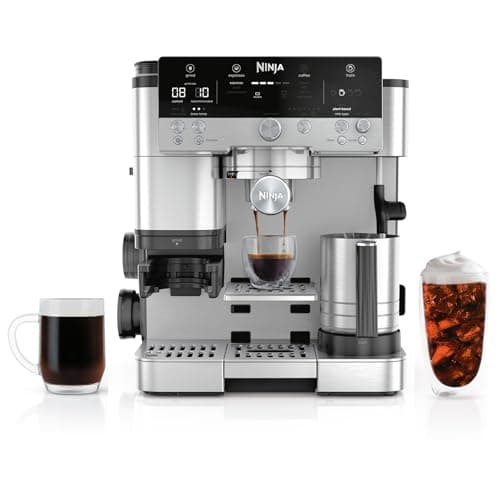
Judge it the way you would judge a standalone: burr type, number of usable steps, and how the dose leaves the machine. All of these use conical burrs, which is the right choice for a compact chassis — conicals are quieter, cooler and more forgiving of the short chute an all-in-one has room for. The number that separates them is settings: the Barista Express gives you 16, the Barista Pro 30, the Ninja 25. That matters because espresso is adjusted in very small increments, and a machine with too few steps eventually leaves you wanting a grind that sits between two clicks — usually on lighter roasts, which need to go finer than most factory ranges comfortably allow.
Grind-by-time versus grind-by-weight
Almost every all-in-one grinds for a set number of seconds and calls that a dose. It is a reasonable approximation and it drifts, because the same three seconds yields a different weight as beans stale, as the hopper empties and as the burrs warm up. That is why we tell Breville owners to keep a 0.1g scale next to the machine and check the dose weekly rather than trusting the dial. The Ninja is the exception here: it weighs the dose on a built-in scale, which is the single most useful automation on this page and the one most likely to spread through the category.
When a separate grinder wins
Three cases, and they are common. First, if you already own a capable grinder, an all-in-one means buying a worse one and paying for it. Second, if you drink light roasts or single-origin coffee that changes every bag, you will run out of adjustment range on an internal burr set faster than on a dedicated one. Third, if you ever want to upgrade: a standalone grinder can be replaced on its own, while an internal one is welded to your machine’s lifespan. The counter-argument is equally real — one box, one plug, one thing to clean, and the dose lands in the portafilter without a dosing cup. Our espresso grinder roundup covers what the separate path costs.
Retention, and why the first shot of the day is different
Any grinder holds a little ground coffee inside the chute between doses. In an all-in-one that retained coffee sits directly above the portafilter, so your first shot of the day contains yesterday’s grounds and your dose reads light. The fix is free: run a very short purge before the first shot, or simply accept that the first shot after a grind-size change is a throwaway. It is also the reason a grind adjustment does not take effect until the chute clears — if you changed the setting and nothing happened, you are still drinking the old grind.
Cleaning is different too
Two appliances in one chassis means two maintenance schedules. The machine side wants backflushing and descaling on the usual cycle — see how to descale an espresso machine for the schedule and what to use. The grinder side wants the burrs cleared of oils periodically, which on a sealed all-in-one usually means grinder cleaning tablets rather than a full strip-down; the method is in how to clean a coffee grinder. Skip either and the symptom is the same — a machine that quietly gets worse without ever breaking.
The most automated version of this idea
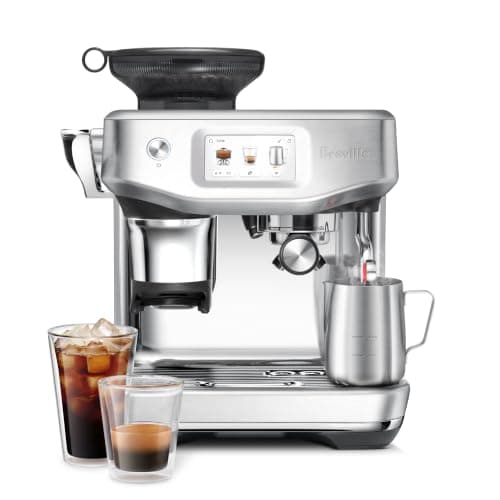
All-in-ones go further than a grinder in the chassis. At the top of the category the machine also tamps the puck and textures the milk, which turns the built-in grinder from a convenience into one part of a fully guided workflow — we take that apart in the Barista Touch Impress review, and rank it against the bean-to-cup machines and dual boilers it competes with on the best espresso machines under $2,000.
How we picked
We did not lab-test this gear
Everyone in this category says they tested twenty machines. We have not lab-tested any of these, and we say so. What we did instead: compiled the published manufacturer specifications, read the manuals, ran the math where there was math to run (heat-up time, pressure, dose capacity, grind range, cost per cup), and scored each pick against a published rubric. The scores are judgments from documented research — not measurements we took, because we do not have a lab and we will not pretend we do. Where a number came from someone else's work, we name them in Sources.