Skip to content
Tamp & Pour

Roundups & reviews · Espresso Machines

Ninja espresso machine review: the Luxe Café Premier

Ninja's espresso machine weighs the dose, tamps it for you and tells you what to change. A hard look at what that automation gets right, and what it takes away.

By Stephen V.Updated How we review
#ad

We earn a commission when you buy through our Amazon links, at no extra cost to you. It never changes a verdict, and we say so when the cheaper product is the better buy. How this works.

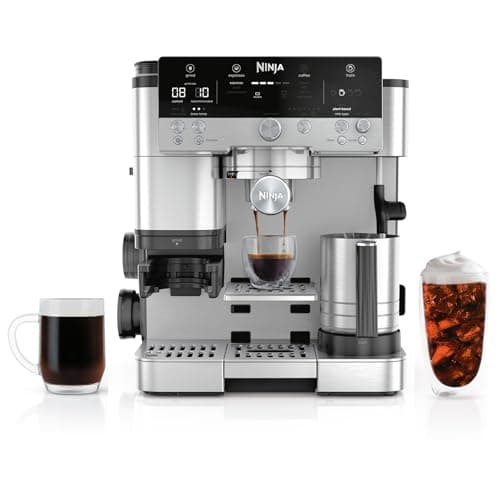
Ninja arrived in espresso late and did something the incumbents mostly had not: it put a scale inside the machine. Almost every home espresso machine with a grinder doses by time, which drifts as beans stale and hoppers empty. The Luxe Café weighs the dose instead, tamps it with an assisted lever, then suggests a grind adjustment after the shot. Those three things attack the three faults that actually spoil home espresso, in the order they occur.

It is also a drip coffee maker and a rapid cold brew machine sharing one hopper and one chassis, which is either the point of the whole product or an odd distraction depending on your household. This review takes both halves seriously.

01
Ninja Ninja Luxe Café Premier (ES601)

A household that drinks espresso and drip

Ninja Luxe Café Premier (ES601)

3-in-1: espresso, drip coffee, rapid cold brewConical burr grinder, 25 grind settingsBuilt-in scale with weight-based dosingAssisted tamper; Dual Froth hands-free milk, 4 presets1,650W; approx. 15.75 x 15.24 x 20.51 in
8.2/10

The most sensibly automated espresso machine at its price: it doses by weight rather than by time, tamps consistently, and coaches your grind — then makes drip coffee and cold brew from the same beans.

Shot quality
7.5
Steam power
8
Build
7.5
Ease of use
9.5
Value
8.5

Pros

  • Dosing by weight is the standout — every other grinder-in-the-box machine at this price doses by time, and time drifts
  • The assisted tamper produces a level puck far more reliably than an untrained hand, which is where most beginner channeling comes from
  • Barista Assist reads the shot and tells you which way to move the grind, which shortens the dial-in from days to minutes
  • Dual Froth textures dairy and plant milks hands-free with four presets, and it is genuinely good rather than merely automatic
  • One appliance covers espresso, a pot of drip and cold brew, from whole beans, which is a serious counter-space argument

Cons

  • Large: Ninja publishes it around 15.75 x 15.24 x 20.51 inches, and it will not slide under standard wall cabinets
  • The guidance that helps a beginner also constrains an enthusiast — you work inside the machine's recipes
  • A newer platform than Breville or Gaggia, with less community knowledge and a thinner parts history
  • Three appliances' worth of subsystems in one box means more that can eventually fail
  • 1,650 watts is a lot for a shared kitchen circuit if a kettle is running too

Don't buy this if…

you want to learn espresso by hand or you already own a good grinder. Half the value here is automation you would be paying for and switching off, and the other half is a grinder you already have.

The scale is the feature. Espresso is a ratio: a dose of ground coffee in, roughly twice its weight of liquid out. Every machine that grinds by time is guessing at the first half of that ratio, and the guess gets worse as the bean bag ages and the burrs warm up. Weighing the dose inside the machine turns a variable into a constant, and it is the reason shots off this machine stay consistent over weeks without you touching anything. Breville owners achieve the same thing with a separate scale and a weekly check; most owners simply never do it.

The assisted tamper earns its place.Channeling — water finding a low-resistance path through the puck and racing through it — is the single most common cause of a sour, thin shot on a machine that is otherwise fine. Uneven tamping is one of its main causes. A lever that applies the same force at the same angle every time removes that variable. It does not replace grind distribution, which is what a WDT tool handles, but it fixes the half most beginners get wrong.

Barista Assist is teaching, not magic.After a shot, the machine tells you whether to go finer or coarser. It is reading flow, not tasting your coffee, so treat it as a fast way to get into the right neighborhood rather than as the final word. Once you are close, taste decides — the framework for that is in why espresso tastes sour or bitter.

The drip half is not an afterthought. Grinding whole beans fresh for drip is a bigger flavor upgrade than most people expect, because pre-ground coffee stales within minutes of grinding. Having one hopper feed both the portafilter and the drip basket means the pot of coffee you make for guests is made from the same fresh beans as your morning shot. Rapid cold brew is the third mode and it is a convenience feature: real cold brew takes twelve hours for chemical reasons, and an accelerated version is a different, lighter drink. Useful; not the same thing. The distinction is in coffee brewing methods.

What you give up. Control, mostly, and headroom. You are working inside a system that has opinions, and the ceiling on shot quality is set by the internal grinder rather than by your skill. There is no upgrade path: you cannot fit better burrs, and a 58mm accessory world does not exist for it. For a lot of households that is exactly the right trade. For someone who intends to keep learning, a Gaggia Classic Pro plus a real grinder is the machine that keeps rewarding you.

$599.00View on Amazon

Price as of Sep 2, 2026. Prices change — Amazon's at checkout is the one that counts.

#ad · we may earn a commission from this link to Ninja Luxe Café Premier (ES601)

Which Ninja espresso machine is which

Ninja sells the Luxe Café in more than one configuration, and the naming is not self-explanatory. The Premier (ES601) reviewed here is the 3-in-1: espresso, drip coffee and rapid cold brew, with the built-in grinder, scale, assisted tamper and Dual Froth system. A Pro series (ES701) sits above it, and a smaller Luxe Café Mini (ES301)below, which trims the feature list and the footprint. Check which functions you are actually buying before ordering — the price gaps track features, not quality tiers, and the Premier is the one most people mean when they search for a Ninja espresso machine.

Measure before you buy

This is the practical failure mode. At roughly 20.5 inches tall it does not fit under a standard wall cabinet with clearance to open the hopper and lift the tank. Measure the gap, not the counter. If your kitchen cannot take it, the honest alternative in the same price band is a Barista Express, which is shorter and does less.

What to buy alongside it

Less than usual, which is part of the appeal. The machine tamps and weighs for you, so a tamper and a scale are both optional. A milk pitcher is still worth owning if you want to pour latte art rather than let the machine texture into a jug, and a WDT toolstill improves distribution before the tamper does its work. For beans, anything fresh with a roast date — the machine grinds for three brew styles, so a versatile medium roast earns its place; ours are in best coffee beans.

Maintenance

Two systems, two routines. Descale on the schedule the machine prompts, using a proper descaler rather than vinegar — the method is in how to descale an espresso machine. Clean the burrs periodically with grinder tablets rather than dismantling anything, since the grinder is not designed to be stripped by the owner. Rinse the frothing system immediately after milk, every time; dried milk is the most common cause of a frother that gradually stops performing.

How we picked

We did not lab-test this gear

Everyone in this category says they tested twenty machines. We have not lab-tested any of these, and we say so. What we did instead: compiled the published manufacturer specifications, read the manuals, ran the math where there was math to run (heat-up time, pressure, dose capacity, grind range, cost per cup), and scored each pick against a published rubric. The scores are judgments from documented research — not measurements we took, because we do not have a lab and we will not pretend we do. Where a number came from someone else's work, we name them in Sources.

Questions

Frequently asked

Is the Ninja Luxe Café a real espresso machine?
Yes — it uses a portafilter and pump-driven extraction, and it grinds, doses and tamps for you rather than dispensing from a pod. It sits between a conventional semi-automatic and a super-automatic: you still handle the portafilter, but most of the variables are managed.
Does the Ninja espresso machine have a grinder?
Yes, a conical burr grinder with 25 settings covering espresso through drip, and it doses by weight using a built-in scale rather than by time — which is the single most useful thing about the machine.
Ninja Luxe Café vs Breville Barista Express — which is better?
The Ninja if you want the machine to handle dose, tamp and milk, and you also want drip coffee and cold brew from the same beans. The Breville if you want a smaller machine, a longer track record and a simpler system with fewer subsystems to fail. Shot quality is close; workflow is completely different.
How big is the Ninja Luxe Café?
Ninja publishes it at roughly 15.75 x 15.24 x 20.51 inches and 1,650 watts. The height is the constraint — measure the clearance under your wall cabinets before ordering, not just the counter depth.
Can it make cold brew properly?
It makes a rapid cold brew, which is a genuinely different drink from twelve-hour cold brew. Slow extraction at low temperature is what produces cold brew’s characteristic smoothness; an accelerated cycle gets you an iced coffee that is lighter and quicker. Good, not identical.
Do you need to buy anything else?
Very little. The tamper and scale are built in. A milk pitcher is worth having if you want to pour art, and fresh beans with a roast date matter more than any accessory you could add.

Keep reading

Receipts

Sources

We do not run a testing lab, and we do not pretend to. Where a measured number came from someone else's work, we name them and link them. Where we could not verify something, we say so on the page rather than quietly leaving it out. Read our full method.