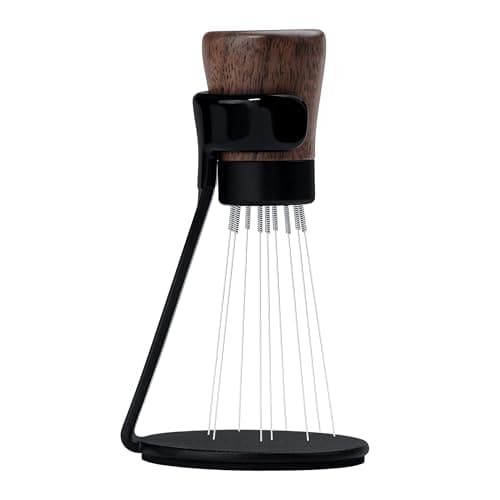
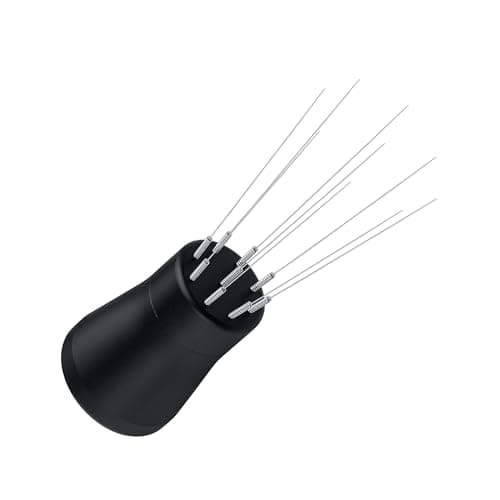
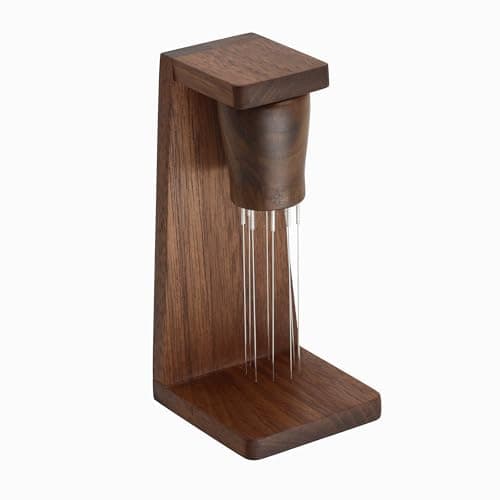
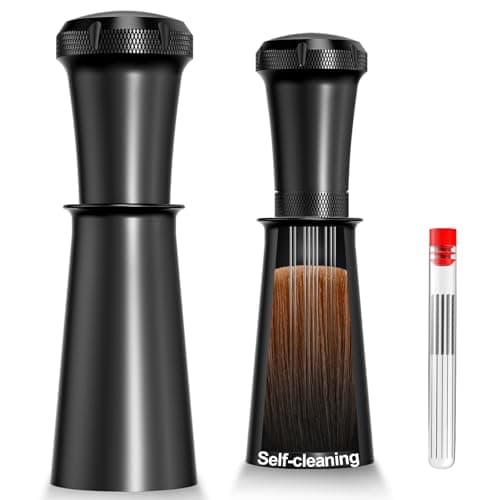
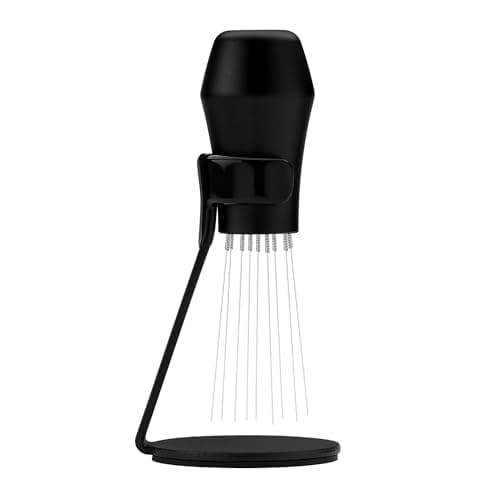
A WDT tool is a set of very thin needles on a handle that you stir through the dry coffee in your portafilter before tamping. It costs less than a bag of good beans and it fixes the single most common cause of a bad shot: channeling. If you own a machine with non-pressurized baskets and your shots are inconsistent for no reason you can identify, this is almost certainly the missing step.
The name is short for Weiss Distribution Technique, after the person who popularized it. The mechanism is simple and worth understanding, because it tells you what to look for in a tool. Ground coffee leaving a grinder arrives in clumps — static-bound lumps of fines that are denser than the coffee around them. When you tamp, those clumps stay dense while the gaps between them stay loose, and when 9 bars of water hits the puck it does what water always does: it finds the loose path and rushes through it. That is a channel. The coffee in the channel over-extracts to bitterness, the coffee around it barely extracts at all, and you get a thin, sour-and-bitter shot from a dose you weighed perfectly.
Stirring with fine needles breaks the clumps and redistributes the fines evenly, so the puck compresses uniformly. It is a fifteen-second step with a bigger effect on shot consistency than almost anything else you can buy at this price. The picks below are ranked on the two things that actually differ: needle gauge and how the tool stores.
Needle gauge is the only spec that matters much
WDT needles run roughly 0.2mm to 0.4mm. Finer needles slip through the coffee bed with less disturbance, which means they break clumps without dragging fines around or leaving trenches behind them; they also bend if you look at them wrong. Thicker needles are close to indestructible and stir more aggressively, which is fine but slightly less delicate. If your grinder produces heavy clumping — common with conical burrs and very fresh, light-roast beans — go finer, around 0.25mm. If you want a tool you can be careless with, 0.3mm or 0.35mm is the sensible choice.
Prong count, and why it matters less than it sounds
Eight to ten prongs is the normal range and any of them work. More prongs means fewer passes to cover the basket but more drag through the bed; fewer prongs means gentler passes but more of them. Nobody has demonstrated a meaningful cup difference between an 8-needle and a 10-needle tool, so treat this as a preference rather than a spec.
The stand is not a gimmick
Bare WDT needles bend against anything — a drawer edge, a dishcloth, another tool. A bent needle stops distributing properly and, worse, can score the inside of a precision basket. A magnetic or weighted stand costs a few dollars in the tool price and roughly doubles the practical life of the needles. Buy the version with the stand unless you have a dedicated slot for it.
How to actually use one
Grind into the portafilter, or into a dosing cup and then into the portafilter. Insert the needles to about two-thirds of the bed depth — not all the way to the basket floor, which just pushes fines down. Stir in small circles for ten to fifteen seconds, working around the basket so every region gets touched, then lift out gently and level the surface. Tamp once, firmly and flat; the tamp pressure matters far less than people think, but level matters enormously. If you want the full sequence, our guide to pulling a shot puts it in context.
Who genuinely does not need one
If your espresso machine uses a pressurized (dual-wall) basket, skip it. Those baskets create artificial back-pressure through a single small hole behind the coffee, so the puck’s own uniformity has very little to do with the shot — redistributing grounds fixes a problem the basket has already worked around. Skip it, too, if you only make milk drinks and are happy with them, since milk hides a great deal of extraction unevenness. WDT is for people pulling espresso through non-pressurized baskets who care what the shot tastes like on its own.
What to pair it with
A WDT tool is one third of good puck prep. The second is a tamper that exactly matches your basket diameter, because a tamper even a millimeter undersized leaves an unsealed ring for water to escape through. The third is a 0.1g scale so your dose is the same every time and you can tell whether a change actually changed anything. Together those three cost less than $100 and fix most home espresso inconsistency.
A WDT tool is not a distributor
The two get shelved together and sold interchangeably, and they do different jobs: a WDT tool stirs the grounds with needles to break up clumps before you tamp, while a distributor (or leveler) rotates on the rim to flatten the surface. One fixes the inside of the puck and one fixes the top of it, which is why owning the wrong one is a common and quiet waste of money. We separate them on espresso distributor vs WDT tool.
The symptom worth stirring for
A WDT tool earns its place when the shot runs fast, pale and sour, because that is channeling and channeling starts with clumps inside the bed that a tamper physically cannot reach. It does not earn its place against puck appearance. A wet or soupy puck on a machine with no three-way solenoid valve is normal, has no effect on the espresso you already poured, and no amount of stirring will change it. Telling those two cases apart before you spend anything is the point of why is my espresso puck wet.
How we picked
We did not lab-test this gear
Everyone in this category says they tested twenty machines. We have not lab-tested any of these, and we say so. What we did instead: compiled the published manufacturer specifications, read the manuals, ran the math where there was math to run (heat-up time, pressure, dose capacity, grind range, cost per cup), and scored each pick against a published rubric. The scores are judgments from documented research — not measurements we took, because we do not have a lab and we will not pretend we do. Where a number came from someone else's work, we name them in Sources.