Buy the Barista Express (BES870XL) if you are choosing your first Breville and do not already own a grinder. It is the cheapest way into the lineup that still arrives complete, and nothing above it makes a meaningfully better shot — the money above it buys speed, automation and tamping help, not better espresso. If you already own a burr grinder, buy the Bambino Plus (BES500) instead and skip straight to good milk in a tiny footprint.
The useful thing to understand about this range is how little varies where it matters. Every machine below uses a 54mm portafilter with non-pressurized baskets, every one runs low-pressure pre-infusion before settling to roughly nine bars at the puck, and every one holds brew temperature digitally. That is why shot-quality scores cluster so tightly on this page: a Bambino and an Oracle Touch, fed the same beans from the same grinder by someone who knows what they are doing, land closer together than the price gap suggests. What you are actually shopping for is which of the four hard jobs — grinding, dosing, tamping, texturing milk — the machine takes off your hands.
The four things that actually separate Breville models
1. Grinder or no grinder. The Bambino and Bambino Plus have none; the Barista and Oracle families have one built in. This is the biggest price lever and the biggest decision. A built-in grinder is convenient and saves counter space, but it is permanently married to the machine — when the machine dies, so does the grinder. A standalone grinder outlives three machines and can be better than anything Breville fits internally.
2. ThermoJet or thermocoil. ThermoJet (Bambino, Bambino Plus, Barista Pro, Barista Touch Impress) reaches extraction temperature in about three seconds. The 1600W thermocoil in the Barista Express takes minutes. For a once-a-morning household the difference is a cup of patience; for a household where four people want drinks at staggered times, it changes how the machine fits into the day.
3. Tamping: yours or assisted. Impress models (Barista Express Impress, Barista Touch Impress) add a lever that levels and compresses the puck at a consistent pressure, with a polishing turn at the end. It does not make a better shot than a good manual tamp — it makes an identical shot every time, which is a different and genuinely valuable thing if you are new.
4. Milk: manual wand or automatic. The Bambino Plus, Barista Touch Impress and Oracle Touch texture milk to a temperature and texture you choose and then stop. The Bambino, Barista Express, Impress and Pro give you a plain wand and expect you to learn. Hands-free milk is the feature people most reliably say they would pay for again — and the one that most reliably stops them learning to pour latte art. Our guide to frothing milk is written for the manual half of that split.
Decoding the names
| Model | Grinder | Heating | Tamping | Milk |
|---|
| Bambino (BES450) | None | ThermoJet, ~3s | Manual | Manual wand |
| Bambino Plus (BES500) | None | ThermoJet, ~3s | Manual | Automatic |
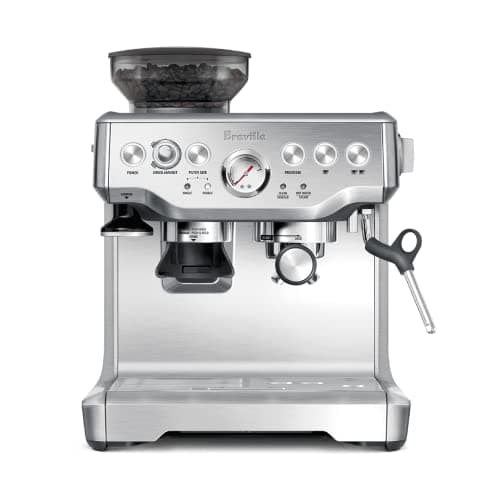
| Barista Express (BES870XL) | Built-in, 16 settings | 1600W thermocoil | Manual | Manual wand |
| Barista Express Impress (BES876) | Built-in, dose assist | Thermocoil | Assisted lever | Manual wand |
| Barista Pro (BES878) | Built-in, 30 settings | ThermoJet, ~3s | Manual | Manual wand |
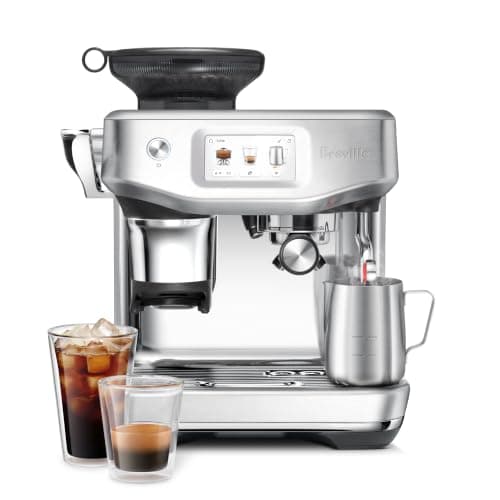
| Barista Touch Impress (BES881) | Built-in, dose assist | ThermoJet, ~3s | Assisted lever | Automatic |
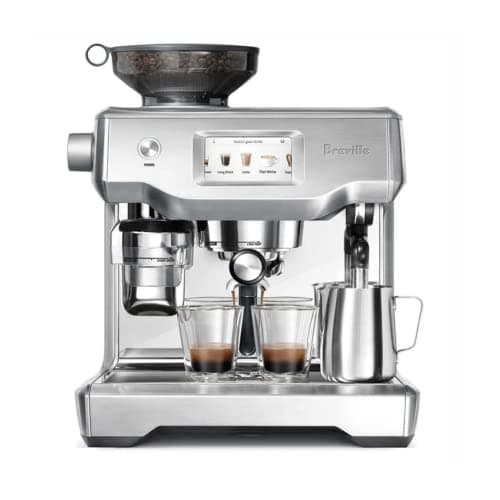
| Oracle Touch (BES990) | Built-in, automatic dosing | Dual boiler | Automatic | Automatic |
Two patterns fall out of that table. “Impress” always means assisted tamping, and “Touch” always means a touchscreen with automatic milk. And only one machine in the range — the Oracle Touch — has two boilers, which is the one spec that lets you brew and steam at the same instant rather than waiting between the two.
How we ranked them
On total value to a home buyer, not on price or feature count. A machine moves up this list when the money it costs buys something a home drinker feels every morning, and down when it charges for automation that removes the part of the process people enjoy. We have not lab-tested these machines; the scores are judgments from Breville’s published specifications, its instruction manuals and aggregated owner reports, scored against our published rubric. Where you see a figure, it came from a document we name in Sources.
The short answer
Quick picks
01Breville Barista Express (BES870XL)The best-value entry into the Breville range and still the one we recommend most: a conical burr grinder, PID temperature control and a 54mm non-pressurized basket in one box, for less than a Bambino Plus plus a decent grinder.
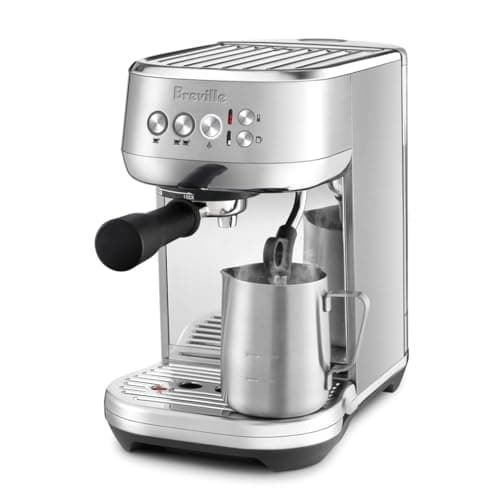
02Breville Bambino Plus (BES500)The best machine here for someone who already owns a grinder and mostly drinks milk: real 54mm shots and hands-free microfoam in under eight inches of counter.
8.2Best for milk drinks and small kitchens 03Breville Barista Pro (BES878)The Barista Express with the wait removed and the grind adjustment doubled: ThermoJet heating and 30 grind settings, at a real premium over the machine it is based on.
7.9Best for a busy household 04Breville Bambino (BES450)The cheapest real Breville: the Bambino Plus with the automatic milk, the stainless portafilter and the three-way valve taken out, which is a fair trade if you want to learn to steam.
7.8Cheapest way into the lineup 05Breville Barista Express Impress (BES876)The Barista Express with the beginner's hardest step automated: an assisted lever that levels and compresses the puck identically every time, plus dose guidance so you stop guessing.
7.9Best for consistency without practice 06Breville Barista Touch Impress (BES881)Everything Breville can automate on a single-boiler machine, in one box: a grinder with dose correction, assisted tamping, automatic milk and a touchscreen that walks you through it.
8.1Best for a household that wants it all handled 07Breville Oracle Touch (BES990)The only true dual boiler Breville makes for the home, and the only one that grinds, doses, tamps and steams automatically — a cafe workflow with the craft removed.
8.3Best automated dual boiler
| # | Product | Best for | Score | Price |
|---|
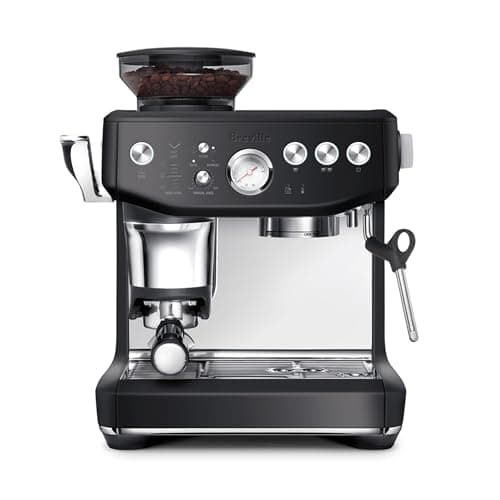
| 01 | Breville Barista Express (BES870XL)The best-value entry into the Breville range and still the one we recommend most: a conical burr grinder, PID temperature control and a 54mm non-pressurized basket in one box, for less than a Bambino Plus plus a decent grinder. | Best Breville overall | | $699.95·Amazon |
| 02 | Breville Bambino Plus (BES500)The best machine here for someone who already owns a grinder and mostly drinks milk: real 54mm shots and hands-free microfoam in under eight inches of counter. | Best for milk drinks and small kitchens | | $499.95·Amazon |
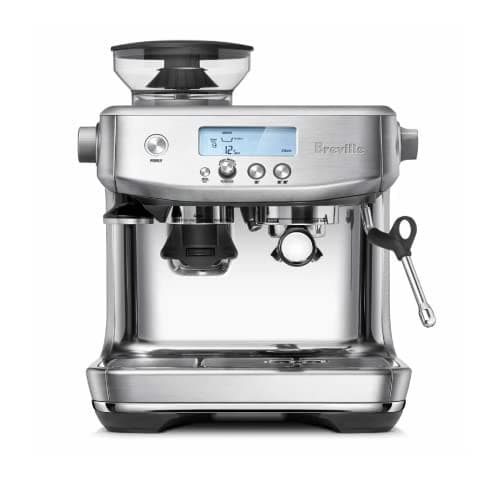
| 03 | Breville Barista Pro (BES878)The Barista Express with the wait removed and the grind adjustment doubled: ThermoJet heating and 30 grind settings, at a real premium over the machine it is based on. | Best for a busy household | | $825.00·Amazon |
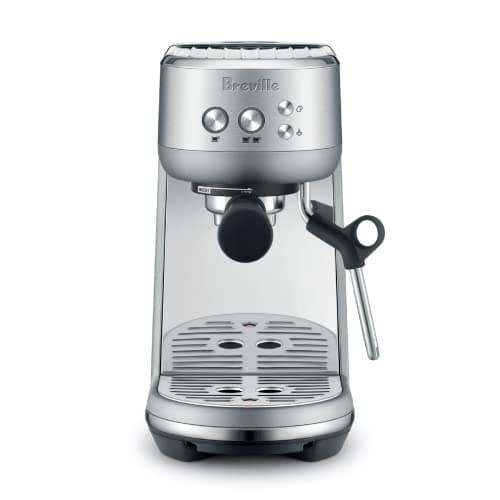
| 04 | Breville Bambino (BES450)The cheapest real Breville: the Bambino Plus with the automatic milk, the stainless portafilter and the three-way valve taken out, which is a fair trade if you want to learn to steam. | Cheapest way into the lineup | | $299.95·Amazon |
| 05 | Breville Barista Express Impress (BES876)The Barista Express with the beginner's hardest step automated: an assisted lever that levels and compresses the puck identically every time, plus dose guidance so you stop guessing. | Best for consistency without practice | | $799.95·Amazon |
| 06 | Breville Barista Touch Impress (BES881)Everything Breville can automate on a single-boiler machine, in one box: a grinder with dose correction, assisted tamping, automatic milk and a touchscreen that walks you through it. | Best for a household that wants it all handled | | $1,439.99·Amazon |
| 07 | Breville Oracle Touch (BES990)The only true dual boiler Breville makes for the home, and the only one that grinds, doses, tamps and steams automatically — a cafe workflow with the craft removed. | Best automated dual boiler | | $2,301.47·Amazon |
#ad · Live prices from the Amazon Product API, as of October 18, 2026. Where we have no verified live price, we show none — a gap beats a number that has rotted.
In detail
The picks, in full
Best Breville overall
Breville Barista Express (BES870XL)
54mm portafilter, non-pressurized basketsIntegrated conical burr grinder, 16 settingsDigital PID temperature control1600W thermocoil, 2L water tankManual steam wand + Razor dose trimmer
The best-value entry into the Breville range and still the one we recommend most: a conical burr grinder, PID temperature control and a 54mm non-pressurized basket in one box, for less than a Bambino Plus plus a decent grinder.
- Shot quality
- 8.5
- Steam power
- 7.5
- Build
- 8
- Ease of use
- 8
- Value
- 9
Pros
- +One purchase gets you from nothing to genuine espresso — no separate grinder to budget for
- +PID holds brew temperature shot to shot, which is the spec that actually stabilizes taste
- +The largest owner community of any home machine: guides, settings, spare parts and repair videos for everything
- +2L tank is the biggest in the Barista family, so it is the least refill-hungry
- +Holds resale value better than anything else here if you later upgrade
Cons
- −Thermocoil heat-up takes minutes, not the three seconds of the ThermoJet models
- −Single heating circuit — you brew, then steam; you cannot do both at once
- −The built-in grinder is good rather than great, and 16 settings is coarse next to the Pro's 30
- −Occupies around 13 inches of counter width, roughly two Bambinos
- −Grinder retention means the first shot of the day carries some of yesterday's coffee
Don't buy this if…
…you already own a real burr grinder. You would be paying for a second, worse grinder — buy a Bambino Plus and keep the one you have.
It wins on arithmetic rather than performance. Nothing above it in this lineup pulls a clearly better shot; what the extra money buys is speed, a finer grind adjustment or a machine that tamps for you. Meanwhile the thing most likely to improve your espresso — a good grinder — is already in the box. The honest caveat is that the included grinder is the first thing serious owners replace, and when they do, the Barista Express becomes a slightly bulky Bambino. Full detail in our Barista Express review.
Best for milk drinks and small kitchens
Breville Bambino Plus (BES500)
54mm portafilter, non-pressurized basketsThermoJet heating, ~3 second heat-upAutomatic milk texturing, 3 temperatures and 3 textures1.4L water tank, 7.7-inch width
The best machine here for someone who already owns a grinder and mostly drinks milk: real 54mm shots and hands-free microfoam in under eight inches of counter.
- Shot quality
- 8
- Steam power
- 8
- Build
- 7.5
- Ease of use
- 9
- Value
- 8.5
Pros
- +Automatic steam wand reaches a set temperature and texture and then stops — genuinely good microfoam with no technique
- +Ready to brew about three seconds after you press the button
- +Under eight inches wide; it fits where no other machine in this list does
- +Pairs with whatever grinder you choose, which is the better long-term setup
- +Cheapest route to cafe-style lattes that still uses a real portafilter
Cons
- −No grinder — the real cost of this machine is the machine plus a grinder
- −Small tank and small drip tray mean frequent refilling and emptying
- −Plastic-heavy body; it does not feel like the money the way the Barista family does
- −Automatic milk is a fixed recipe — if you want to learn to texture by ear, this machine does it for you whether you like it or not
- −No hot water spout, so Americanos mean a separate kettle
Don't buy this if…
…you do not own a burr grinder and do not want to buy one. Paired with a blade grinder this machine is wasted; the Barista Express is the honest answer instead.
It ties the Barista Express on our rubric and loses the top spot only on total cost: by the time you add a grinder capable of feeding it, you have usually spent more. If you have already made that purchase, this is the machine to buy — and the choice between the two is the most common decision in home espresso, which we work through in Bambino Plus vs Barista Express. The deep version is the Bambino Plus review.
Best for a busy household
Breville Barista Pro (BES878)
54mm stainless steel portafilterIntegrated conical burrs, 30 espresso grind settingsThermoJet heating, about 3 seconds to temperatureDigital PID temperature, adjustable in the menu2L (68 fl oz) tank, 250g bean hopper
The Barista Express with the wait removed and the grind adjustment doubled: ThermoJet heating and 30 grind settings, at a real premium over the machine it is based on.
- Shot quality
- 8.5
- Steam power
- 7.5
- Build
- 7
- Ease of use
- 8.5
- Value
- 8
Pros
- +Three seconds to extraction temperature instead of minutes — the upgrade you feel every single morning
- +30 grind settings rather than 16, so dialing in a new bag is less of a lurch between clicks
- +Brew temperature is adjustable in the menu, which the Barista Express does not offer
- +LCD shot timer and volumetric one- and two-shot control
- +A dedicated hot water outlet, so Americanos and tea do not need a kettle
Cons
- −No pressure gauge — the Barista Express's analog dial is a useful learning tool and the Pro drops it
- −The grinder is noisy and the steps between settings are still coarse by standalone-grinder standards
- −The group head and cup tray stay cold, so a flush before the first espresso is effectively mandatory
- −Costs meaningfully more than the Barista Express for no gain in shot quality
- −Same single heating circuit: brew, then steam
Don't buy this if…
…you make one or two drinks a morning and do not mind waiting for the machine. The only thing you would be buying is time you do not need.
The Pro is the right machine for a household where drinks happen at four different times, and the wrong machine for a household where they happen once. Published listings disagree on its tank capacity — the US instruction book says 2L / 68 fl oz, some retailer spec tables say 67 oz — so treat it as approximately two liters. The full account of what the ThermoJet swap gains and costs is in our Barista Pro review.
Cheapest way into the lineup
Breville Bambino (BES450)
54mm aluminum portafilterThermoJet heating, ~3 second heat-upPID control with low-pressure pre-infusionManual steam wand, one-hole tip1.4L (47 fl oz) water tank
The cheapest real Breville: the Bambino Plus with the automatic milk, the stainless portafilter and the three-way valve taken out, which is a fair trade if you want to learn to steam.
- Shot quality
- 8
- Steam power
- 7
- Build
- 7.5
- Ease of use
- 7.5
- Value
- 9
Pros
- +Same ThermoJet heating and the same three-second start as the Plus
- +Manual wand means milk texturing is a skill you own rather than a setting you select
- +The smallest, lightest machine Breville sells that still takes a 54mm basket
- +Noticeably less money than the Plus for the same shot
- +Dose and yield are programmable, so your routine is repeatable
Cons
- −Aluminum portafilter rather than stainless — it holds less heat and feels cheaper
- −One-hole steam tip and no automatic cut-off: steaming well takes practice here
- −No three-way solenoid valve, so the spent puck comes out wet and sloppy
- −No grinder, and the same small tank and tray as the Plus
- −Earlier US editions shipped with dual-wall baskets only; check which baskets are in your box
Don't buy this if…
…milk drinks are the point of the machine for you. The Plus's automatic wand is the single best reason to spend the difference, and most people who skip it wish they had not.
Ranked below its own sibling because the things it removes are the things most buyers end up wanting, but it is the best-value object in the range for a specific person: someone who drinks straight espresso, or who genuinely wants to learn to steam on a plain wand. The model-by-model account of what the Plus adds is in our Bambino review.
Best for consistency without practice
Breville Barista Express Impress (BES876)
54mm portafilter with assisted tamping leverIntegrated conical burr grinder with dose adjustAutomatic grind-amount correction after each shotDigital PID temperature, manual steam wand
The Barista Express with the beginner's hardest step automated: an assisted lever that levels and compresses the puck identically every time, plus dose guidance so you stop guessing.
- Shot quality
- 8.5
- Steam power
- 7
- Build
- 7.5
- Ease of use
- 9
- Value
- 7.5
Pros
- +Removes tamp pressure and tamp level as variables — the two things beginners get wrong most
- +Dose assistance tells you when the basket is correctly filled, so you learn good habits instead of hiding bad ones
- +Shot-to-shot consistency in the first month is noticeably better than the classic Express
- +Everything the Barista Express does well is unchanged
Cons
- −A significant premium over the classic Express for one automated step
- −Same shot-quality ceiling — it makes you consistent, not better
- −The tamping mechanism is another moving part to clean and eventually service
- −Still a thermocoil, so it is no faster to heat than the classic
- −Still a manual steam wand, so milk remains a skill you have to learn
Don't buy this if…
…you already tamp level and consistently, or you would rather spend the difference on a standalone grinder — grind is a bigger lever on your shot than tamp is.
Worth the premium for exactly one reader: someone who knows they will not practice. If you will happily spend two weeks learning to tamp, that money belongs in a grinder instead. The side-by-side against the machine it is based on is in Barista Express vs Impress.
Best for a household that wants it all handled
Breville Barista Touch Impress (BES881)
54mm portafilter, Impress assisted tampingIntegrated burr grinder with automatic dose adjustThermoJet heating, ~3 second heat-upTouchscreen drink guidanceAutomatic milk texturing to set temperature and texture
Everything Breville can automate on a single-boiler machine, in one box: a grinder with dose correction, assisted tamping, automatic milk and a touchscreen that walks you through it.
- Shot quality
- 8.5
- Steam power
- 8
- Build
- 8
- Ease of use
- 9.5
- Value
- 6.5
Pros
- +The only machine short of the Oracle that automates grinding, dosing, tamping and milk together
- +Touchscreen makes the machine legible to everyone in the house, not just the person who bought it
- +Dose correction after each shot nudges you toward the right grind instead of leaving you guessing
- +ThermoJet speed and automatic milk in the same machine — the two best convenience features in the range
Cons
- −Roughly double the price of a Barista Express for the same 54mm shot
- −The more Breville automates, the less you learn and the more there is to service
- −Touchscreens date faster than dials, and this one is the interface for everything
- −Still a single heating circuit, so it is not a dual boiler however much it costs
- −Large footprint and a lot of machine to clean
Don't buy this if…
…you enjoy the process. You are paying a steep premium to have the interesting parts of espresso done for you.
Ranked here rather than higher purely on value: it scores the best ease-of-use number in the lineup and the worst value number. It makes complete sense as a family machine in a busy kitchen, and very little sense as a first machine for someone who wanted a hobby.
Best automated dual boiler
Breville Oracle Touch (BES990)
True dual boilerAutomatic grinding, dosing and tampingAutomatic milk texturingTouchscreen drink selection
The only true dual boiler Breville makes for the home, and the only one that grinds, doses, tamps and steams automatically — a cafe workflow with the craft removed.
- Shot quality
- 9
- Steam power
- 8.5
- Build
- 8
- Ease of use
- 9.5
- Value
- 6.5
Pros
- +Automates every difficult step while still using a real portafilter and a real dual boiler
- +Brews and steams simultaneously, so back-to-back milk drinks are genuinely quick
- +Automatic milk texturing to a set temperature and texture, hands-free
- +Touchscreen makes drink selection and adjustment legible to anyone in the house
Cons
- −The most expensive machine in the lineup by a wide margin
- −Heavy automation means you learn very little about espresso
- −More systems means more to service — grinder, tamper mechanism, milk circuit and two boilers
- −Very large footprint, and heavy enough that it is not moving once it lands
- −At this money, a 58mm single boiler plus a serious standalone grinder is the enthusiast's answer
Don't buy this if…
…you actually want to make espresso by hand. You are paying a large premium for the machine to do the interesting parts for you.
It earns the highest shot-quality judgment on this page — two boilers mean the brew water never has to share a heater with the steam circuit, which is the same reasoning behind the 9 for temperature stability it carries on our dual boiler roundup — and the lowest value judgment. It sits last here because almost nobody shopping for “a Breville” should buy it: if you want this much automation you may be happier with a bean-to-cup machine, and if you want this much thermal stability you probably want to pull the shot yourself. Both alternatives are ranked in best dual boiler machines.
The ladder, in plain money terms
Breville’s range is priced as a staircase and it is worth knowing what each step buys. From the Bambino to the Bambino Plus you are buying automatic milk. From the Bambino Plus to the Barista Express you are buying a grinder — so if you own one, that step is a downgrade. From the Barista Express to the Pro you are buying heat-up speed and finer grind adjustment. From the Express to the Impress you are buying a consistent tamp. From the Pro to the Touch Impress you are buying automatic milk and a touchscreen on top of the grinder. And from anything to the Oracle Touch you are buying a second boiler and total automation. No step on that ladder buys you a better basket, a better pump or a better extraction. That is the most useful sentence on this page.
What Breville does not sell you
A 58mm commercial portafilter. Every machine here is 54mm, which is Breville’s own standard, and it works well — but it means your accessories come from the 54mm shelf rather than the far larger 58mm one, and if you ever move to an E61 machine, none of it follows you. If standard commercial fitment matters to you, the Gaggia Classic Pro is the obvious alternative at Barista Express money, and the trade is a machine that asks more of you in exchange for parts that fit everything — we put it directly against the Bambino Plus in Gaggia Classic Pro vs Bambino Plus. Our Breville accessories guide covers what actually fits the 54mm group.
Which grinder, if the machine has none
If you buy a Bambino or Bambino Plus you have to answer this, and the answer is not “any grinder.” Espresso needs fine, repeatable adjustment near the fine end of the range, which rules out most inexpensive electric grinders and all blade grinders — the mechanism is explained in burr vs blade. Realistically, budget for a dedicated espresso grinder; our ranked list is best espresso grinders, and if the budget is tight, a good hand grinder beats a cheap electric one at this price.
The accessories that actually matter on a Breville
Three, in order. A 0.1g scale, because weighing dose and yield is the cheapest accuracy you will ever buy. A WDT tool, because Breville’s grinders clump and stirring the grounds in the basket fixes channeling that no tamp can. And a correctly sized pitcher if you steam by hand — too large a jug is the most common reason home microfoam fails. The Razor trimmer in the box does the job of a leveler, so you can skip that. Everything else is optional, and puck screens and bottomless portafilters are refinements rather than fixes.
Who should not buy a Breville at all
Two people. If you want to press one button and get a latte without ever touching a portafilter, you want a bean-to-cup machine, not a Breville — the trade-off is laid out in semi vs super-automatic, and the machines themselves are in best super-automatics. And if your budget is genuinely under two hundred dollars, Breville does not play there; machines under $200 is the honest list, with the compromises stated.
A note on prices
Breville discounts heavily and unpredictably, and the gaps between these models move by a hundred dollars or more depending on the week. Every price on this page comes from the live Amazon listing with a timestamp; we do not print a number in the prose, because by the time you read it the number would be wrong. If you are not in a hurry, the discount pattern across the year is in our Black Friday coffee deals tracker.
The top of the range, in detail
If you are looking at the most automated machine Breville makes, read it up before you buy rather than after: our Barista Touch Impress review covers what the assisted tamping lever and the Auto MilQ system actually fix, and makes the honest case that the premium over an Express Impress buys automation rather than a better shot. It also competes in a different set at that price — the $1,000 to $2,000 band is where it has to justify itself against bean-to-cup machines and dual boilers.
How we picked
We did not lab-test this gear
Everyone in this category says they tested twenty machines. We have not lab-tested any of these, and we say so. What we did instead: compiled the published manufacturer specifications, read the manuals, ran the math where there was math to run (heat-up time, pressure, dose capacity, grind range, cost per cup), and scored each pick against a published rubric. The scores are judgments from documented research — not measurements we took, because we do not have a lab and we will not pretend we do. Where a number came from someone else's work, we name them in Sources.
Questions
Frequently asked
Which Breville espresso machine is best overall?+
The Barista Express (BES870XL) for most people, because it is the cheapest machine in the range that arrives complete — grinder included, non-pressurized 54mm basket, PID temperature control. If you already own a burr grinder, the Bambino Plus is the better buy and takes a third of the counter space.
What is the difference between the Barista Express, Pro and Touch?+
All three have a built-in grinder and a 54mm portafilter. The Express uses a 1600W thermocoil and 16 grind settings; the Pro swaps in ThermoJet heating (about three seconds to temperature), 30 grind settings and adjustable brew temperature, and drops the pressure gauge; the Touch Impress adds assisted tamping, automatic milk texturing and a touchscreen on top of the Pro’s speed. None of them makes a better shot than the others on identical beans and grind.
Does Impress mean a better shot?+
No — it means a more repeatable one. The Impress lever levels and compresses the puck at a consistent pressure, which removes the beginner’s two most common errors. A practiced hand with a decent tamper gets to the same place; the Impress just gets there on day one.
Do I need a grinder with a Breville Bambino?+
Yes. Neither Bambino includes one, and the machine is only as good as what feeds it. Budget for a real burr grinder with fine adjustment near the espresso end — see
best espresso grinders. Pairing a Bambino with a blade grinder wastes the machine.
Is the Oracle Touch worth it?+
Only if you want cafe workflow with none of the craft. It is the one true dual boiler Breville sells for the home, so it brews and steams at once and holds temperature better than anything else here — but it costs multiples of a Barista Express for the same 54mm extraction, and at that money an enthusiast would buy a 58mm single boiler and a serious standalone grinder instead.
Are all Breville espresso machines 54mm?+
Every machine on this page is, including the Oracle Touch. That is Breville’s house standard and it works, but it means your tampers, baskets, puck screens and bottomless portafilters come from the smaller 54mm accessory shelf rather than the commercial 58mm one.
Can a Breville pull shots as good as a commercial machine?+
For a single or double shot at home, closer than the price gap suggests — all of these run pre-infusion and settle at roughly nine bars with digital temperature control. What a commercial machine gives you is thermal stability across dozens of back-to-back drinks, which no home machine in this lineup except the Oracle Touch attempts.
Receipts
Sources
We do not run a testing lab, and we do not pretend to. Where a measured number came from someone else's work, we name them and link them. Where we could not verify something, we say so on the page rather than quietly leaving it out. Read our full method.