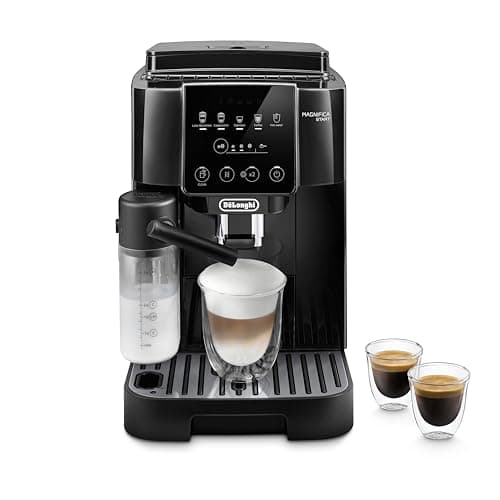
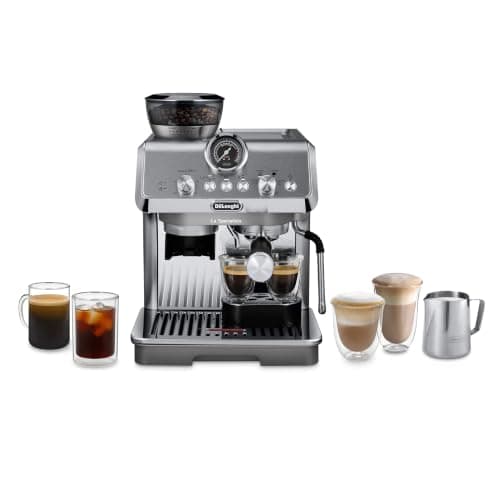
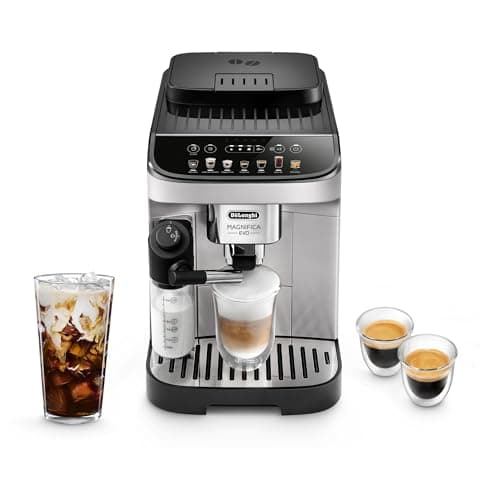
Buy the Magnifica Evo if you want De’Longhi at its best: a bean-to-cup machine that grinds, brews and textures milk at the press of one button, which is the thing this brand does better than anyone at the price. If you want to pull shots by hand rather than press a button, the one to buy is the La Specialista Arte Evo — ranked third below, and third only because our rubric rewards how easily a machine gets a home drinker to a good cup, which is a contest two bean-to-cup machines were always going to win.
The confusing thing about shopping this brand is that “De’Longhi espresso machine” covers three unrelated products. There are bean-to-cup machines (Magnifica, Dinamica, Eletta, Rivelia) that you never touch a portafilter on. There are semi-automatics with a built-in grinder (La Specialista) that work like a Breville Barista. And there are compact pump machines (Dedica, Stilosa) that are cheap, small and come with pressurized baskets. De’Longhi also builds most Nespresso machines, which are a fourth thing entirely and are ranked separately in best Nespresso machines. Choose the family first; the model is the easy part.
The one spec that decides the cheap machines
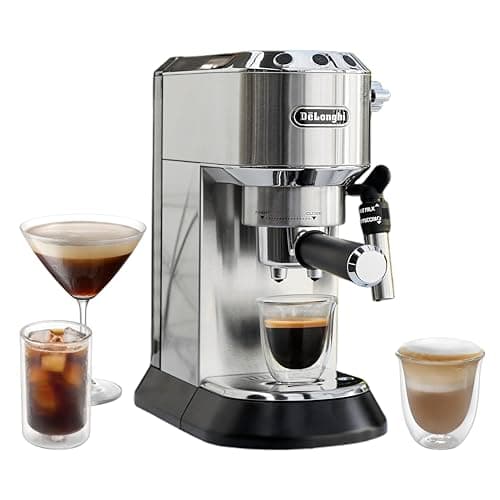
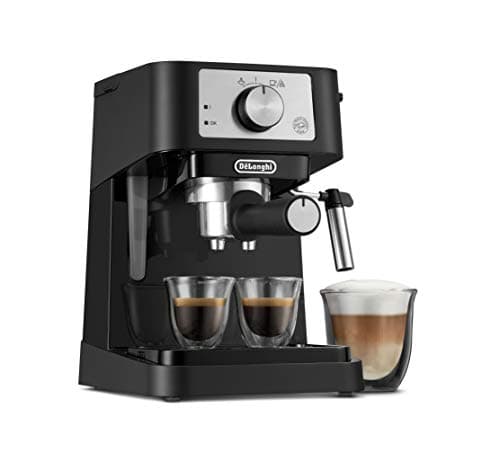
Both the Dedica and the Stilosa ship with pressurized baskets, and this is the most important thing to understand before you spend anything. A normal espresso basket is a metal cup with dozens of fine holes, so the resistance comes from the coffee itself and your grind decides how the shot flows. A pressurized basket has a second chamber behind it with one tiny exit hole, which manufactures back-pressure artificially. The result is that almost any grind produces a slow, foamy pour that looks like espresso — genuinely helpful on day one, and a permanent ceiling afterwards, because once the basket is doing the work, a better grinder changes almost nothing. The full mechanism is in pressurized vs non-pressurized baskets.
The La Specialista Arte Evo is the machine that breaks that pattern: it ships with single-wall (non-pressurized) baskets as well as dual-wall ones, which is why it is the only De’Longhi on this page where buying a better grinder will make your espresso better.
How the families compare
| Family | You do | Machine does | Basket | Buy it if |
|---|
| Magnifica (bean-to-cup) | Fill beans, press a button | Grinds, doses, tamps, brews, textures milk | Sealed brew unit — no portafilter | You want the drink with no process |
| La Specialista (semi-automatic) | Dial in grind, steam the milk | Grinds into the basket and tamps for you | 54mm, single-wall and dual-wall included | You want to make espresso properly |
| Dedica / Stilosa (compact pump) | Everything | Pumps hot water through a pressurized basket | Pressurized only | Budget or counter space is the constraint |
How we ranked them
On total value to a home buyer: what the money buys that you will feel every morning, scored against our published rubric. Because the families are so different, the ranking below mixes them deliberately rather than grouping them — a bean-to-cup machine and a portafilter machine really do compete for the same thousand dollars. We have not lab-tested any of these; the scores are judgments from De’Longhi’s published specifications, retailer spec sheets and aggregated owner reports, and every figure we state comes from a document named in Sources. Where published sources disagree, or where De’Longhi does not publish a figure at all, we say so instead of filling the gap.
Which family is actually right for you
Answer one question honestly: do you want to make espresso, or do you want to have it? If you want to make it, you need a portafilter and non-pressurized baskets, which in this lineup means the La Specialista Arte Evo and nothing else — the Dedica and Stilosa are pressurized, and the Magnificas have no portafilter at all. If you want to have it, a Magnifica is the better machine and the whole question of grind, dose and tamp disappears. The worst outcome is buying a cheap pressurized machine while secretly wanting the first thing, which is the most common mistake in this entire category.
What De'Longhi is genuinely best at
Bean-to-cup machines at mid-market prices. The Magnifica line puts a competent grinder, a sealed brew unit and a real automatic milk system into a machine that costs a fraction of the Swiss equivalents, and it does so reliably enough that it is the default recommendation in that category. Its compact pump machines are honest budget products with a clearly stated ceiling. Where the brand is weakest is the middle: the La Specialista family competes directly with Breville and loses on grind resolution and warranty length while winning on assisted tamping and dual heating.
The 51mm problem
If you buy a Dedica or Stilosa, your accessories come from the 51mm shelf, which is the smallest and thinnest of the three common sizes — far fewer tampers, baskets and bottomless portafilters than 54mm Breville or 58mm commercial. It is not a dealbreaker on a machine with pressurized baskets, because most of those upgrades cannot do anything through one anyway. It is worth knowing before you build a kit around it. Sizes are explained in our tamper size guide, and the parts that actually fit are in De’Longhi espresso accessories.
Maintenance is not optional on a De'Longhi
Every machine here is a thermoblock or a sealed brew unit, and both scale fast in hard water. The bean-to-cup machines prompt you; the pump machines do not, and the usual way a Dedica or Stilosa dies is limescale rather than a fault. Descale on a schedule matched to your water — the method is in how to descale an espresso machine, the bean-to-cup routine is in super-automatic maintenance, and filtering the water in the first place is cheaper than any of it: water filters for espresso machines.
What about Nespresso?
De’Longhi builds a large share of Nespresso’s machines, so a lot of what looks like a cheap De’Longhi espresso machine is actually a capsule machine with a De’Longhi badge on it. That is a different purchase with different economics — no grinder, no portafilter, and a per-drink cost set by Nespresso rather than by your bean supplier. If that is what you are looking at, read best Nespresso machines instead; nothing on this page competes with it on convenience, and it competes with none of it on cost per cup.
A note on prices
De’Longhi discounts aggressively and the gaps between these models move constantly; machines in this lineup routinely sell well below list. Every price here comes from the live Amazon listing with a timestamp rather than from our prose, because a number typed into a sentence is wrong within a week. If you can wait, the seasonal pattern is in our Black Friday coffee deals tracker.
Which Magnifica, specifically
The Magnifica name covers several machines, and the difference that decides your mornings is the milk system: an automatic LatteCrema carafe on some configurations, a manual frothing wand on others. Our De'Longhi Magnifica Evo review spells out which model number is which, what the removable brew unit is worth long term, and when the cheaper Magnifica Start is the smarter buy.
How we picked
We did not lab-test this gear
Everyone in this category says they tested twenty machines. We have not lab-tested any of these, and we say so. What we did instead: compiled the published manufacturer specifications, read the manuals, ran the math where there was math to run (heat-up time, pressure, dose capacity, grind range, cost per cup), and scored each pick against a published rubric. The scores are judgments from documented research — not measurements we took, because we do not have a lab and we will not pretend we do. Where a number came from someone else's work, we name them in Sources.