Skip to content
Tamp & Pour

Roundups & reviews · Espresso Machines

De'Longhi Magnifica Evo review

The machine that made one-touch cappuccinos ordinary. An automatic milk carafe, 13 grind settings and seven recipes, for well under what the premium bean-to-cup brands charge for the same job.

By Stephen V.Updated How we review
#ad

We earn a commission when you buy through our Amazon links, at no extra cost to you. It never changes a verdict, and we say so when the cheaper product is the better buy. How this works.

The Magnifica Evo is the machine most people should look at first when they decide they want coffee rather than a hobby. It is a bean-to-cup super-automatic: beans go in the hopper, milk goes in a carafe, and a cappuccino or latte macchiato arrives at one touch with no wand technique, no tamping and no puck to knock out. What makes it the default recommendation is not that it does this better than anything else — it is that it does it for a few hundred dollars less than the brands that are famous for it.

De'Longhi publishes the important numbers on its own product page: a built-in conical burr grinder with 13 grind settings, the proprietary LatteCrema System milk carafe, and seven one-touch recipes — espresso, coffee, cappuccino, latte macchiato, iced coffee, hot water and a programmable My Latte. Product listings put the water tank at about 60oz (1.8L) and the bean hopper at about 8.8oz (250g). This review is about what those specs feel like to live with, and which two other machines you should price against it before you buy.

01
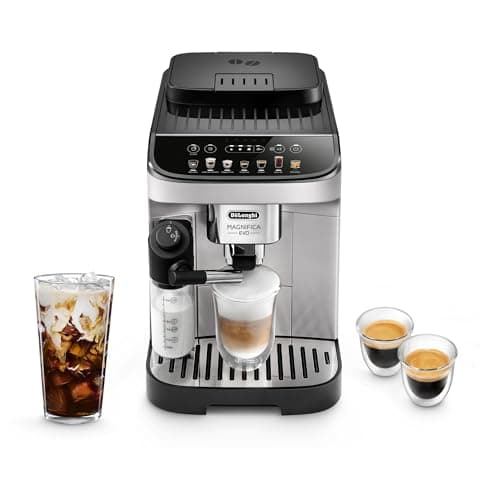
De'Longhi De'Longhi Magnifica Evo (LatteCrema, ECAM29084SB)

The default one-touch machine for most kitchens

De'Longhi Magnifica Evo (LatteCrema, ECAM29084SB)

Conical burr, 13 grind settingsLatteCrema automatic milk system7 one-touch recipes + My Latte60oz tank / 8.8oz bean hopper
8.4/10

The most machine for the money in bean-to-cup: an automatic LatteCrema milk system that pours a hands-free cappuccino or latte macchiato, 13 grind settings, and a price that is frequently discounted well below its list. It does the super-automatic job without the super-automatic markup.

Coffee quality
8
Milk system
8.5
Ease & cleaning
8.5
Drink range
8
Value
9

Pros

  • Automatic LatteCrema carafe froths milk and pours a cappuccino or latte macchiato at one touch, with no wand technique to learn
  • 13 grind settings and adjustable strength give more control than most machines at this price
  • Removable brew group lifts out for rinsing, and it routinely sells below its list price

Cons

  • Mostly plastic build, so it feels like the value machine it is
  • The milk carafe is another part to detach, rinse and store after milk drinks
  • No control over brew pressure or temperature the way an enthusiast semi-auto allows

Don't buy this if…

…you want to learn to pull and steam by hand. The Evo does all of that behind a sealed brew group, so a Breville Bambino or Barista Express is the better teacher.

LatteCrema is the reason to buy it. The milk system is a sealed carafe with an adjustable froth dial that the machine draws from, textures and pours on its own. You fill it, clip it on, press cappuccino, and the drink is built in the cup — then you detach the carafe and put it in the fridge. That workflow is the entire appeal of a super-automatic, and this is the cheapest implementation of it we are comfortable calling good. The foam is dense and hot and consistent; it is not the glossy, pourable microfoam a practiced hand gets from a steam wand, and it is not trying to be. If latte art is the goal, you want a wand and our frother vs steam wand explainer says why.

Thirteen grind settings is more useful than it sounds. Bean-to-cup machines hide the grind, the dose and the puck inside a sealed brew unit, so your only real levers are grind step, strength and volume. Thirteen steps plus adjustable strength is a genuinely wide range for the price — enough to chase a darker, oilier espresso roast finer without choking the machine, or to open it up for a lighter bean. Feed it fresh whole beans from our super-automatic bean picks and the cup improves more than any setting change will manage. Oily, heavily roasted beans are the one category to avoid, because they cake in the chute of every machine in this class.

The removable brew unit is the long-term argument. The brew group lifts out so you can rinse the coffee residue that otherwise turns stale inside the machine. This is the quiet reason some bean-to-cup machines last and others start tasting of old coffee after a year, and it is a spec worth checking on any machine in this category. Pair it with the routine in our super-automatic maintenance guide — especially the part about cleaning the milk circuit properly rather than relying on the auto-rinse, which is what kills the smell before it starts.

Where the price shows. The body is largely plastic. Nothing about that affects the coffee, but it does affect how the machine feels next to a Jura or a Gaggia Cadorna, and it is the clearest place De'Longhi took cost out. The carafe is also one more object in your life: it comes off, it goes in the fridge, and it needs a real wash rather than a rinse on a schedule. And you get no access to brew pressure or temperature, which is simply what a sealed group means — if that bothers you, you want a semi-automatic, not a cheaper super-automatic.

The honest ceiling. No super-automatic will out-pour a well-dialed semi-automatic with a real grinder, because the parts that decide an espresso shot are the ones this machine has sealed away for your convenience. What it will do is make the same good-enough cappuccino every single morning with ten seconds of involvement, which is a trade most households are right to make. Our super-automatic roundup ranks it against the rest of the category, where it wins on value.

$875.00View on Amazon

Price as of October 18, 2026. Prices change — Amazon's at checkout is the one that counts.

#ad · we may earn a commission from this link to De'Longhi Magnifica Evo (LatteCrema, ECAM29084SB)

Which Magnifica Evo you are actually buying

De'Longhi sells the Magnifica Evo in more than one configuration, and the difference that matters is the milk system. The model reviewed here, ECAM29084SB, is the LatteCrema version: an automatic carafe that froths and pours for you. Other Evo configurations ship with a manual frothing wand instead, which costs less and is a completely different daily experience — you steam the milk yourself. If a one-touch cappuccino is why you are buying a bean-to-cup machine, check the listing says LatteCrema before you click, because a manual-wand Evo will disappoint exactly the buyer who wanted automation. The De'Longhi lineup roundup lays out which model is which.

Magnifica Evo vs Magnifica Start

The Start is the cheaper sibling and it is a real option: a soft-touch panel of plain icons, a compact body, and on the auto-milk model a LatteCrema Hot system that froths for you. What you give up is breadth and personalization — fewer recipes, no My Latte programming, a simpler grinder, and a build that feels entry-level. The decision is simple. If you make two drinks and want the cheapest sensible bean-to-cup machine, the Start is enough. If more than one person will use the machine and they order different things, the Evo's recipe list and programmability earn the difference.

Magnifica Evo vs Philips 3200 LatteGo

These two are the value bean-to-cup pair, and they differ on upkeep. The Philips LatteGo milk system is two snap-off parts with no tubes, which rinses in about fifteen seconds; the De'Longhi LatteCrema carafe is a sealed unit with more parts and a fridge-storable design. The Evo gives you more recipes and more grind steps; the Philips gives you the lower-maintenance milk path and ceramic burrs. If the thing most likely to make you stop using a machine is cleaning it, that is a real argument for the Philips — our Philips 2200 vs 3200 comparison covers that family.

What to buy with it

Very little, which is part of the value. Fresh whole beans that are not heavily oiled, a water filter so scale does not end the machine early — see our filter picks — and a proper descaler for the interval the machine asks for. Skip the tamper, the scale and the WDT tool: there is no puck to prepare on this machine, which is the whole point. If you find yourself wanting those tools, you have discovered that you wanted a semi-automatic, and the $1,000 semi-automatic bracket is where to look.

Who should buy something else

If you want to learn espresso, buy a machine that makes you do the work — a Bambino or a Barista Express and a grinder. If nobody in the house drinks milk, you are paying for a carafe you will never clip on, and a black-coffee bean-to-cup machine is cheaper and simpler. And if you want a machine that feels like an appliance built to last twenty years rather than a value product that makes good coffee, the step up is real metal and a real price — the $1,000 to $2,000 band is where that starts.

How we picked

We did not lab-test this gear

Everyone in this category says they tested twenty machines. We have not lab-tested any of these, and we say so. What we did instead: compiled the published manufacturer specifications, read the manuals, ran the math where there was math to run (heat-up time, pressure, dose capacity, grind range, cost per cup), and scored each pick against a published rubric. The scores are judgments from documented research — not measurements we took, because we do not have a lab and we will not pretend we do. Where a number came from someone else's work, we name them in Sources.

Questions

Frequently asked

Is the De'Longhi Magnifica Evo worth buying?
For a household that wants one-touch milk drinks rather than a hobby, yes — it is the best-value implementation of automatic bean-to-cup coffee we rank. It will not out-pour a semi-automatic with a good grinder, and it is not supposed to.
What is the LatteCrema System?
De'Longhi's proprietary automatic milk carafe. It clips on, the machine draws milk from it, textures it and pours it into the cup as part of a one-touch recipe, and the carafe lifts off to live in the fridge between uses.
How many drinks does the Magnifica Evo make?
De'Longhi lists seven one-touch recipes on this model: espresso, coffee, cappuccino, latte macchiato, iced coffee, hot water and a programmable My Latte.
Does the Magnifica Evo have a removable brew unit?
Yes — the brew group lifts out for rinsing, and De'Longhi lists removable, dishwasher-safe parts for cleaning. That matters more than it sounds: residue left inside a sealed brew unit is why some bean-to-cup machines start tasting stale.
Can the Magnifica Evo make iced coffee?
Iced coffee is one of the seven listed recipes on this model. It brews a stronger, cooler extraction designed to be poured over ice rather than diluted by it.
Magnifica Evo or a Breville Barista Express?
They are opposite answers. The Evo makes the coffee for you behind a sealed brew group; the Barista Express hands you a portafilter and a steam wand and asks you to learn. Choose the Evo for convenience, the Breville if you want to improve.

Keep reading

Receipts

Sources

We do not run a testing lab, and we do not pretend to. Where a measured number came from someone else's work, we name them and link them. Where we could not verify something, we say so on the page rather than quietly leaving it out. Read our full method.