Straight espresso on a budget
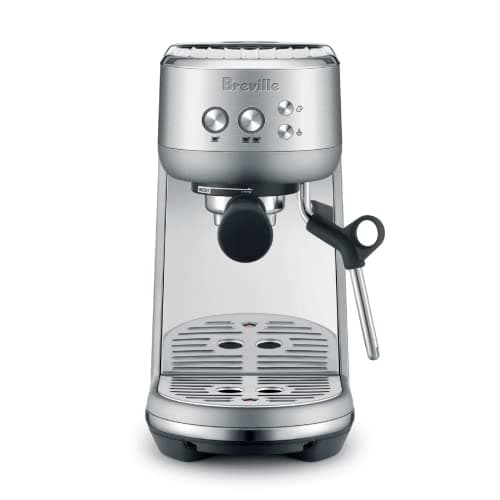
Breville Bambino (BES450)
Breville's real-espresso engine — 3-second heat-up, 54mm baskets, PID control — in its smallest and least expensive body. You steam the milk yourself, and you bring the grinder.
- Shot quality
- 8
- Steam power
- 7
- Build
- 7.5
- Ease of use
- 7.5
- Value
- 9
Pros
- ThermoJet reaches extraction temperature in about three seconds, so it gets used on weekday mornings instead of ignored
- The same 54mm basket size, PID control and low-pressure pre-infusion Breville lists for the Bambino Plus, for noticeably less money
- Manual pre-infusion: hold a shot button and the pump stays at low pressure until you let go, which is real control at this level
- A dedicated hot water button for Americanos and cup warming, where the Plus needs a button combination
- One of the narrowest real espresso machines sold, so it fits counters a Barista Express will not
Cons
- No 3-way valve, so the puck comes out wetter and the group head drips after a shot
- Steaming by hand through a one-hole tip is a genuine skill, and it is slower than a larger machine
- Aluminum portafilter and plenty of plastic in the build, which is how Breville reaches this price
- A small drip tray (Breville's manual says to empty it after each use) and a 1.4L tank that needs frequent refills in a multi-drink household
- The included tamper is plastic, and it is the first thing most owners replace
Don't buy this if…
…lattes are the whole reason you want a machine and you have no interest in learning to steam milk. The Bambino Plus textures milk for you, and that is the feature most milk drinkers are actually paying for.
The shot engine is the reason to buy it. Breville lists a 15-bar pump, but the figure that matters is the 9-bar extraction pressure that follows a low-pressure pre-infusion phase — the pump gently wets and swells the puck before full pressure arrives, which reduces the chance of water punching a channel through it. The PID holds brew temperature steady from shot to shot. Espresso Aficionados’ community documentation lists the target at 93°C (about 199°F), and the instruction book gives you no way to change it; that is the right number for medium roasts and the one real ceiling for anyone chasing very light ones. Breville’s manual also recommends running a short flow of water through the group before you lock the portafilter in, to stabilize temperature. It takes two seconds and it is worth doing every time.
Check which baskets you get. Breville’s current US product page lists both single-wall and dual-wall baskets, in 1 cup and 2 cup sizes. An earlier US instruction book lists only the dual-wall pair, so confirm the box contents on the listing before you buy. The difference is not small. Dual-wall (pressurized) baskets create resistance themselves, so they forgive pre-ground coffee and inconsistent grinders but cap how good the shot can get. Single-wall baskets leave all of the resistance to the puck, which means your grinder controls the shot. We explain the mechanism in pressurized vs non-pressurized portafilters. Breville’s dose guidance is 8–11g for the 1 cup basket and 16–19g for the 2 cup; start with the double, because it is far easier to dial in.
The steam wand works, slowly, and it is entirely up to you. Seattle Coffee Gear and Espresso Aficionados both describe a classic one-hole steam tip, and the instruction book walks through the manual method: tip just below the surface, find the whirlpool, lower the jug to introduce air, then sink the tip and stop at 140–149°F, when the jug is hot to the touch. Reviewed’s write-up lists the steam wand among the Bambino’s cons, and that matches the spec — one hole moves less steam than a multi-hole tip, so texturing takes longer. For a beginner that is not all bad: slower steam gives you more time to find the vortex before the milk is too hot. Note that steam takes a few seconds to stop after you press the button, so lift the jug with that in mind. Our milk frothing guide covers the technique.
What the missing 3-way valve means day to day. On the Bambino Plus, a 3-way valve releases pressure off the puck when the shot ends, which leaves a drier puck and stops the drip. The Bambino does not have one, so expect a wetter, softer puck and a few drips from the group head after the shot. It is a cleanup nuisance, not a flavor problem: knock the puck out promptly, give the group a wipe, and keep a cloth by the machine. Espresso Aficionados notes one side effect enthusiasts actually like — without the valve, the machine can be used for slow “blooming” shots.
Treat the volume buttons as a starting point. The 1 cup and 2 cup buttons stop at roughly 30ml and 60ml by default, and you can reprogram either by holding both buttons for two seconds and then running a shot to the volume you want. Reviewed’s write-up cites testing that found the automatic volume detection inconsistent, which is what you would expect from a system that meters water rather than weighing the espresso in your cup. The fix is cheap: put a scale reading to 0.1g under the cup and stop the shot by weight. Holding a shot button for more than a second also gives you manual pre-infusion — the pump runs at low pressure for as long as you hold it and starts the full extraction when you release.
Price as of Sep 15, 2026. Prices change — Amazon's at checkout is the one that counts.
#ad · we may earn a commission from this link to Breville Bambino (BES450)