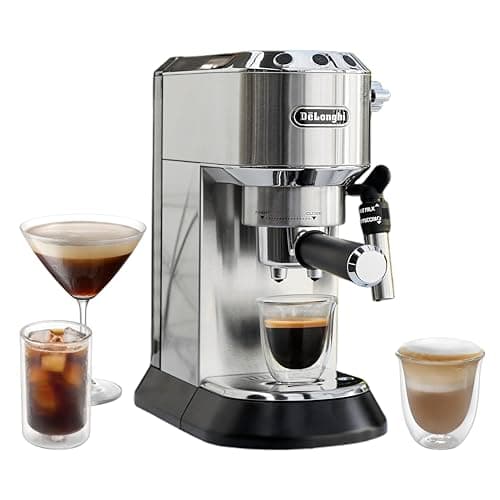
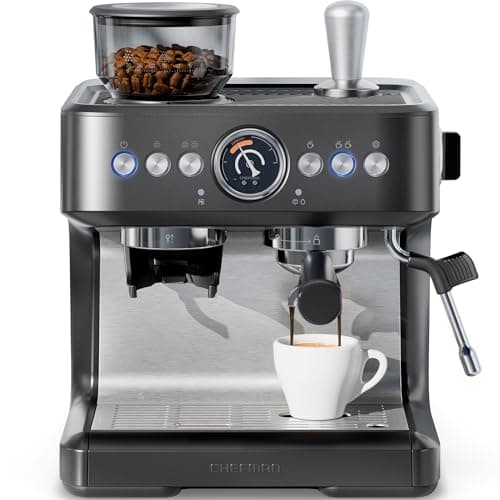
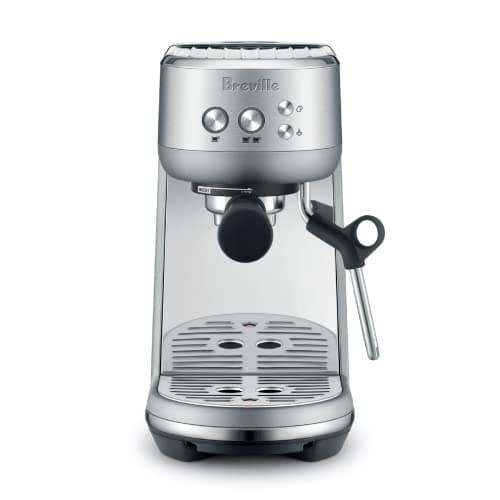
Buy the Breville Bambino (BES450). It is the only machine in this bracket that gives you a real 54mm unpressurized basket and three-second ThermoJet heat-up, which means it is the only one with a ceiling above “fine.” If your constraint is counter width rather than cup quality, the De’Longhi Dedica Deluxe is six inches wide and much more forgiving. And if you want to brew and steam at the same time for the least money, the Chefman Crema Deluxe does that — with a caveat we spell out below.
Under $300 is the most consequential bracket in home espresso, because it is where the basket changes. Below about $150, almost every machine ships a pressurized (dual-wall) basket that manufactures crema with a valve rather than with the coffee. That is genuinely useful if you are grinding with a cheap grinder or buying pre-ground, and it is also a hard ceiling: no amount of skill improves a pressurized shot much. Somewhere in this bracket you can cross over to a single-wall basket, where the grind does the work and the shot gets better as you do.
That crossover is the whole reason this page exists as a separate bracket from the under-$200 rankings below it and the under-$500 rankings above it. Under $200 you are choosing between pressurized machines and deciding which conveniences you want. At $500 the grinder-included machines appear. Under $300 is the narrow band where one machine behaves like the next bracket up and the rest behave like the one below.
The honest arithmetic nobody puts on these pages
A $250 machine is not a $250 setup. Espresso needs a burr grinder that holds a fine, repeatable setting, and a blade grinder will waste every dollar you spend on the machine — it produces boulders and dust at the same time, so the puck cannot resist water evenly. Realistically, if your total budget is $300 for everything, the right answer is a cheaper pressurized machine plus a real grinder, not the best machine you can afford with nothing to grind with. Our budget grinder rankings cover what the cheapest honest option looks like, and the grinder-and-tamper pairings match a grinder to a basket size.
How we ranked them
Five axes from published manufacturer specifications and decoded feature lists — shot quality, steam, build, ease of use and value — rather than tests we did not run. Each pick keeps the scores it already carries elsewhere on this site, so no two of our pages disagree about the same machine. Note that the Chefman is scored on temperature stability rather than shot quality, because that is the axis its headline feature claims and the axis it was first scored on here.
Prices come from our live price layer and every pick sat under $300 at the as-of date shown on the buy buttons. We do not print prices in this text, because a number typed into prose is wrong the week after it is written — if a machine has drifted above the bracket, the button will tell you before we could.
The three decisions in this bracket
1. Pressurized or single-wall basket. Single-wall rewards a good grinder and punishes a bad one. Pressurized forgives everything and caps the result. Be honest about which grinder you own today, not the one you intend to buy.
2. Heat-up time, which is really about whether you use it. A machine that takes several minutes to come to temperature gets used at weekends. One that heats in seconds gets used on a Tuesday. This is the most underrated specification at this price.
3. Width. Two of these machines are unusually narrow, and in a small kitchen that decides it. Measure the gap, including the clearance to fill the tank.
Below are the four we would actually buy under $300, ranked.
The four, side by side
| Machine | Basket | Size | Heat-up | Milk | Grinder included |
|---|
| Breville Bambino (BES450) | 54mm single-wall (unpressurized) | 7.7 in wide | ThermoJet, ~3 seconds | Manual steam wand | No |
| De’Longhi Dedica Deluxe (EC685) | 51mm pressurized | 6 in wide | Thermoblock, fast | Adjustable cappuccino frother | No |
| Chefman Crema Deluxe | Pressurized | Compact | Twin thermoblocks | Frother, brews and steams at once | No |
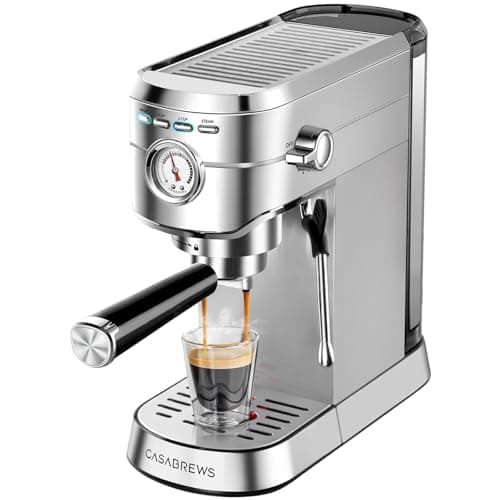
| CASABREWS CM5418 | 51mm, two dual-wall filters | Compact, 34oz tank | Thermoblock | Steam wand | No |
Why the basket is the only spec that sets a ceiling
A pressurized basket has a small valve in its base. Water passes through the coffee at low resistance and the valve creates the back-pressure, which produces a crema-like foam regardless of how badly the coffee was ground. That is forgiveness, and for a household using supermarket pre-ground it is the correct feature. The cost is that the shot stops responding to improvement: finer grind, better distribution and a level tamp barely change the cup, because the coffee was never providing the resistance.
A single-wall basket makes the puck itself the restriction. Now grind size, dose and distribution all matter, the shot can be genuinely excellent, and a bad grinder produces a sour, fast, thin result that no setting fixes. That is the trade at this price, in one paragraph, and we go through the mechanism in detail on pressurized vs non-pressurized portafilters.
Ignore the bar number
Machines in this bracket advertise 15 bar or 20 bar. Espresso is brewed at about 9 bar; the higher figure is the pump’s maximum, and an overpressure valve bleeds the rest away. A 20-bar machine is not brewing twice as hard as a 9-bar one, and the number tells you almost nothing about shot quality. The full explanation is on 15 bar vs 20 bar espresso machines.
What you still have to buy
A burr grinder. Non-negotiable on the Bambino, strongly advised on the rest. See best budget coffee grinders.
A tamper that matches the basket. 54mm for the Bambino, 51mm for the Dedica and the CASABREWS. Diameter is the one spec that cannot be fudged, which is why we wrote the espresso tamper size guide.
A 0.1g scale, eventually. Not on day one, but it is the cheapest consistency upgrade there is — whether you need a coffee scale answers the honest version of that question.
A milk pitcher, if you drink milk drinks.The Bambino’s short wand in particular wants a small one.
When to spend more, and when not to
Spend more if you want automatic milk texturing (the Bambino Plus) or a built-in grinder (the Barista Express), both of which sit in the under-$500 bracket. Do not spend more for a bigger bar number, a bigger-looking stainless body, or a “professional” label — none of those change the cup. And if your total budget including the grinder is at or under $300, spend less on the machine on purpose: a pressurized machine with a good grinder makes better coffee than a single-wall machine with a bad one.