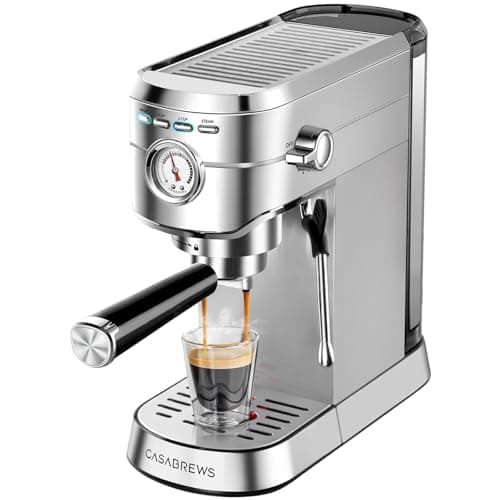
The CASABREWS CM5418 is one of the best-selling espresso machines on Amazon, and the reason is not mysterious: it is a stainless-steel machine with a pressure gauge and a real steam wand at a price where almost everything else is black plastic with a frothing sleeve. It looks like a machine that costs three times as much. The question this review answers is where the gap between looking and being actually falls — because there is one, it is specific, and nobody selling the machine will tell you about it.
The verdict first.If you want milk drinks — lattes, cappuccinos, flat whites — made at home for the least money that still produces something you would happily drink, this is a genuinely good buy and the steam wand is the reason. If you want straight espresso that tastes like a good cafe's, it is not, and no amount of practice, better beans or a better grinder will get it there. That limit is built into the basket, and this page explains exactly why.
CASABREWS publishes the specification in its retail listings: a 20-bar pump, 1450 watts, a 34oz removable water tank, a 51mm portafilter supplied with two dual-wall filters, a steam wand, a built-in pressure gauge, and a body measuring roughly 5.9 inches wide, 12.28 inches deep and 11.97 inches high. Several of those numbers matter a lot more than the headline one, and one of them is the whole story.
The dual-wall basket is the whole review
CASABREWS supplies the CM5418 with two dual-wall filters. A dual-wall — or pressurized — basket has a second floor with a single tiny hole in it. Coffee is brewed in the upper chamber, and the brewed liquid is then forced through that pinhole on its way out. The pressure you see in the cup is not the coffee resisting the water; it is a hole doing an impression of coffee resisting water.
That design is deliberate and, at this price, defensible. It means a coarse grind from a cheap grinder still produces a thick-looking, crema-topped shot instead of a thin brown trickle. It makes the machine forgiving to the point of being almost unfailable. What it cannot do is let the grind actually control extraction, because the resistance that shapes the shot is coming from hardware rather than from the coffee bed. Dial your grinder finer and the shot barely changes. That is the ceiling, and it is why the shot-quality score above sits where it does. The full mechanism, with what changes when you switch, is in pressurized vs non-pressurized portafilters.
On some machines you can simply buy a single-wall basket in the right size and unlock real espresso. That is the standard upgrade on a 54mm Breville or a 58mm Gaggia. On the CM5418 the portafilter is 51mm, a size with far less aftermarket support, and the machine's pump and boiler were specified around pressurized brewing. Treat the CM5418 as what it is — a very well-equipped pressurized machine — rather than a platform you will grow into.
What "20 bar" means, and what it does not
Twenty bar is the maximum pressure the vibratory pump can generate with the outlet blocked. It is not the pressure at the coffee. Espresso is brewed at roughly 9 bars, which is why commercial machines advertise 9 and not 20, and every machine in this class uses a valve to bleed the rest away. A higher number on the box does not mean a stronger or better shot, and between two machines rated 15 and 20 bar there is no shot-quality difference attributable to that figure at all. We wrote that argument out at length in 15-bar vs 20-bar espresso machines, because it is the single most effective piece of marketing in this category.
The pressure gauge on the front is a different thing, and it is genuinely useful. It shows what the machine is seeing during the shot, so you learn what a choked puck and a gushing puck look like on a dial rather than guessing. On a pressurized basket that reading is being shaped by the pinhole rather than purely by your grind — but it still tells you when something has gone obviously wrong, and a learner with a gauge improves faster than one without.
The steam wand is the reason to buy it
The CM5418's best feature is the one that costs nothing to use. It is an articulating steam wand with a tip, not a panarello sleeve — the sleeve design most budget machines use injects air through a plastic shroud and makes stiff, bubbly foam that collapses in a minute. A bare wand lets you control where the tip sits in the milk, which is the entire technique behind microfoam: a short stretch near the surface to introduce air, then the tip buried to roll the pitcher and break the bubbles down.
That matters because a latte is mostly milk. A well-textured pitcher of milk with a merely decent shot under it makes a drink most people are happy with; a perfect shot under flat, bubbly milk does not. If milk drinks are what you are buying this machine for — and for most people at this price, they are — the wand is doing the heavy lifting and this machine has the right kind. Technique is in how to froth milk, and the pitcher matters more than people expect: see milk frothing pitchers.
The honest limits: it is a single thermoblock, so brewing and steaming share one heater and you wait for the machine to come up to steam temperature after pulling a shot, then purge back down before the next one. The CM5418 automates that second step, which is a real convenience. Steam power is modest, so a large pitcher takes a while — texture 6 to 8oz of milk at a time and it behaves well.
Living with it: size, tank and cleaning
At roughly 5.9 inches wide this is one of the narrowest espresso machines you can buy with a real wand attached, which makes it a sensible choice for a small kitchen, a dorm or an office corner — the same case made in compact espresso machines. The 34oz tank is generous for the footprint and comes out for refilling. Cleaning is simple because there is very little to clean: wipe and purge the wand after every single use (milk residue inside a wand tip is the fastest way to ruin a cheap machine), knock the puck out, rinse the baskets, and descale on your water's schedule. Dual-wall baskets need more attention than single-wall ones because that pinhole clogs; a soak in cleaning solution every few weeks is not optional.
What a grinder changes here, and what it does not
Our standing advice is that a grinder improves your coffee more per dollar than a machine does. On this machine that advice needs a caveat. With a pressurized basket, grind consistency still helps — you get a cleaner flavor and fewer fines — but it does not unlock the step change it would on a single-wall basket, because the basket, not the puck, is controlling resistance. So: pre-ground coffee works fine here, which is genuinely part of the appeal, and a modest budget burr grinder is a sensible companion rather than an urgent one. Save the serious grinder money for the machine that can use it.
Who should buy it, and what to buy instead
Buy the CM5418 if your budget is firmly in the entry bracket, you mostly drink milk-based coffee, and you want the best-equipped, best-looking machine in that bracket. On those terms it is very hard to beat, and it is the reason it sits as a pick on the best espresso machines under $200.
Do not buy itif straight espresso is the point, if you already own a good grinder, or if you expect to upgrade baskets later. At the next bracket up, a Gaggia Classic Pro gives you a 58mm commercial portafilter and a genuine path to non-pressurized brewing — see the Gaggia Classic Pro review — and a Breville Bambino gives you a 54mm basket with fast heat-up and automatic milk texturing. Both cost considerably more, and both are the right answer for a different buyer. The honest framing of this machine is that it is excellent value inside a limit, and the limit is not negotiable.