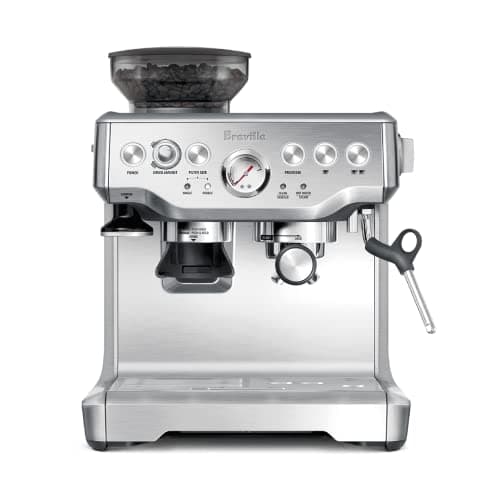
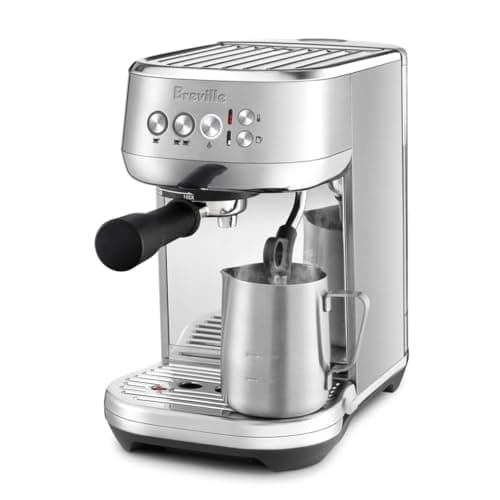
This is the most common decision in home espresso, and it is not really a better-versus-worse question. The Barista Express includes a conical burr grinder and leaves the milk to you. The Bambino Plus leaves the grinder to you and does the milk automatically. Whichever gap you are less willing to fill yourself is the machine you should buy.
Both pull genuine espresso through 54mm non-pressurized baskets with digital temperature control, so shot quality is close enough that it should not decide this. What differs is what comes in the box, how much counter it occupies, and what your realistic total spend ends up being.
The short answer
Buy the Barista Express if you do not own a grinder and want one purchase to get you brewing, and you have the counter space. Buy the Bambino Plus if you already own a burr grinder, or you mostly drink lattes and want the milk handled, or your counter is genuinely tight. If you own a grinder and drink milk drinks and your kitchen is small, the Bambino Plus is not close — it is the obvious answer.
Side by side
| | Bambino Plus (BES500) | Barista Express (BES870XL) |
|---|
| Grinder | None — buy separately | Built-in conical burr, grinds into the portafilter |
| Milk | Automatic wand, temperature-sensed | Manual steam wand — your technique |
| Portafilter | 54mm, non-pressurized baskets included | 54mm, non-pressurized baskets included |
| Heat-up | ~3 seconds (ThermoJet) | Minutes (1600W thermocoil) |
| Width | ~7.7 inches | ~13.2 inches |
| Water tank | 1.4L | 2L |
| Best for | Lattes, small kitchens, existing grinder owners | One-purchase starts, straight espresso, learning by hand |
Do the total-cost math before you decide
The sticker prices mislead. The Barista Express costs more up front but arrives complete. The Bambino Plus costs less up front and then needs a grinder, and a grinder good enough to justify a Bambino Plus is not a $50 purchase — a capable espresso hand grinder is around $100–$200 and a decent electric espresso grinder starts near $200. Add that to the Bambino Plus and the two machines land in similar territory, at which point the decision is genuinely about milk versus grinder rather than money.
There is one important exception: if you buy the Bambino Plus and a standalone grinder, that grinder will almost certainly be better than the one inside the Barista Express, and it will survive every future machine you own. Grinders outlive espresso machines. If you expect this to become a long hobby, the Bambino Plus plus a good grinder is the path with the better ending — it just costs more on day one.
Counter space is a real spec
The Barista Express is about 13 inches wide and needs clearance above for the hopper; the Bambino Plus is under 8 inches wide. In a kitchen with a single free stretch of counter next to a wall cabinet, that difference decides the purchase more often than any performance argument. Measure before you buy, including height with the hopper in place.
Milk is a skill, and skills have a cost
Manual steaming is learnable and genuinely satisfying, and the Barista Express’s wand is good enough to learn on. But be honest about whether you want to learn it. If the person making the coffee mainly wants a flat white before work, the automatic wand is not a shortcut, it is the feature. If you want to understand what you are doing and eventually pour latte art by hand, the manual wand teaches you faster.
What both of them still need
Neither machine ships with a tamper worth keeping, so add a properly sized 54mm tamper. Both benefit enormously from a 0.1g scale to weigh dose in and shot out. And both are hostage to the beans: fresh whole beans with a printed roast date, ground immediately before brewing, matter more than the difference between these two machines.
How we picked
We did not lab-test this gear
Everyone in this category says they tested twenty machines. We have not lab-tested any of these, and we say so. What we did instead: compiled the published manufacturer specifications, read the manuals, ran the math where there was math to run (heat-up time, pressure, dose capacity, grind range, cost per cup), and scored each pick against a published rubric. The scores are judgments from documented research — not measurements we took, because we do not have a lab and we will not pretend we do. Where a number came from someone else's work, we name them in Sources.