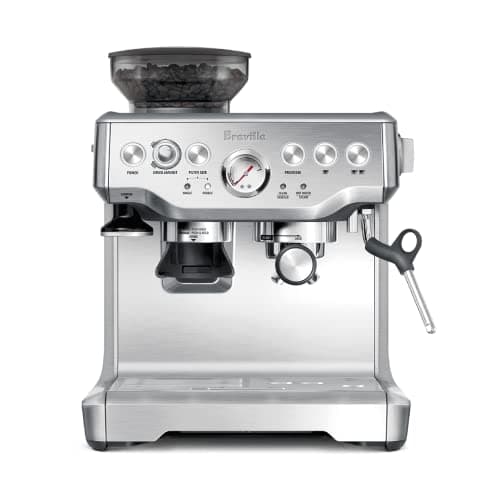
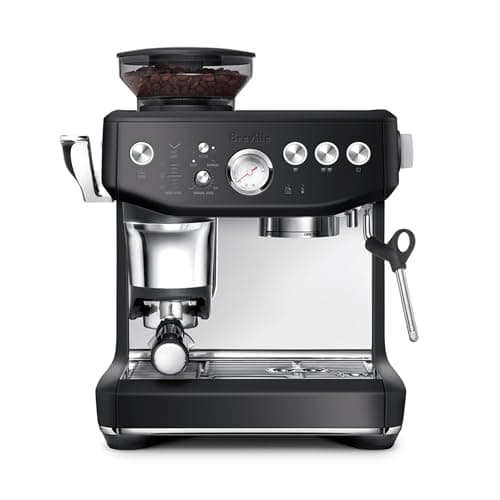
These are the same machine with one difference that costs real money. Both are Breville Barista Express machines: a 54mm portafilter, a built-in conical burr grinder, PID temperature control and a manual steam wand, in one box. The Impress adds an assisted tamping mechanism — you pull a lever, and the machine levels and compresses the puck at a consistent pressure, then applies a small polishing turn.
That is the entire upgrade, and whether it is worth it depends on one question: is your puck prep the thing holding your shots back? For a lot of beginners it genuinely is. For anyone who has already learned to tamp level, it is a premium for a step they have solved.
The short answer
Buy the Impress if you are new to espresso, if inconsistent shots are frustrating you, or if the machine is shared with people who will not learn to tamp carefully. Buy the classic Barista Express if you are willing to learn puck prep, or if you would rather put the price difference into a better grinder — which will do more for your espresso than assisted tamping will.
Side by side
| | Barista Express (BES870) | Barista Express Impress (BES876) |
|---|
| Tamping | By hand, with the supplied tamper | Assisted lever — levels, tamps and polishes |
| Dosing | Timed grind, adjusted by you | Assisted dosing with an automatic top-up prompt |
| Grinder | Built-in conical burr | Built-in conical burr |
| Portafilter | 54mm, non-pressurized baskets included | 54mm, non-pressurized baskets included |
| Temperature | Digital PID | Digital PID |
| Steam wand | Manual | Manual |
| Shot quality ceiling | Same | Same |
| Consistency for a beginner | Depends on your technique | Noticeably higher |
| Price | Lower | Meaningfully higher |
What the Impress mechanism actually does
Three things, in one lever pull. It levels the grounds across the basket before compressing them, which is the step a hand tamp cannot do — a hand tamp compresses whatever distribution you gave it, including any high side. It tamps at a consistent pressure, so shot-to-shot variation from how hard you pressed disappears. And it applies a small polishing turn at the end, which smooths the puck surface.
The dose assistance is the underrated half. It measures the fill and prompts you to add a small top-up if the basket is under-dosed, which is the other common beginner error — too little coffee leaves headroom, the puck expands and moves during the shot, and water channels around it.
What it does not do
It does not improve your maximum shot quality. Both machines have the same grinder, the same baskets and the same temperature control, so a skilled user gets the same result from either. It also does not distribute the grounds — leveling the surface is not the same as breaking up the clumps that form inside the bed as coffee leaves the grinder. If you are getting channeling on an Impress, a $20 WDT tool is still the fix, and it is the fix on the classic too.
The alternative use of the money
This is the argument we would make to most buyers. The price gap between these two machines is roughly the cost of a decent standalone espresso grinder. The Barista Express’s built-in grinder is capable but is the component enthusiasts upgrade first, and grind quality has a larger effect on the cup than tamp consistency does — a perfectly tamped puck of unevenly ground coffee still channels.
So: classic Barista Express plus a WDT tool, a proper 54mm tamper and, later, a standalone grinder will out-perform an Impress used alone. The counter-argument is time and temperament: that path requires you to learn a skill, and the Impress simply removes the problem today. Both are legitimate.
Learning to tamp, if you buy the classic
It takes about two weeks. Grind into the basket, stir the grounds with a WDT tool or a straightened paperclip for ten seconds to break up clumps, level the surface, then set the tamper flat and press straight down until the puck stops compressing. Do not twist, do not tamp twice, and do not knock the portafilter afterwards — a knock cracks the puck. Level matters enormously; pressure barely matters at all, which is the fact most beginners have backwards. Our guide to pulling a shot covers the full sequence.
What both machines still need
Neither ships with a tamper worth keeping, and on the Impress the supplied hand tamper becomes largely redundant anyway. Both benefit from a 0.1g scale to weigh the shot out, a knock box, and a 12oz milk pitcher for the manual steam wand. And both are hostage to bean freshness in exactly the same way — whole beans with a printed roast date, ground immediately, matter more than the difference between these two machines.
If you want the tamping lever and the milk automated too
There is a third machine in this family, and it is the one to look at if your objection to the Express is the steam wand rather than the tamp. The Barista Touch Impress keeps the assisted tamping lever, adds a prompted touchscreen and adds automatic milk texturing with settings for dairy and plant milks — so both of the steps beginners fail are handled. It costs substantially more than either machine here, which is exactly the trade we weigh up in the Barista Touch Impress review.