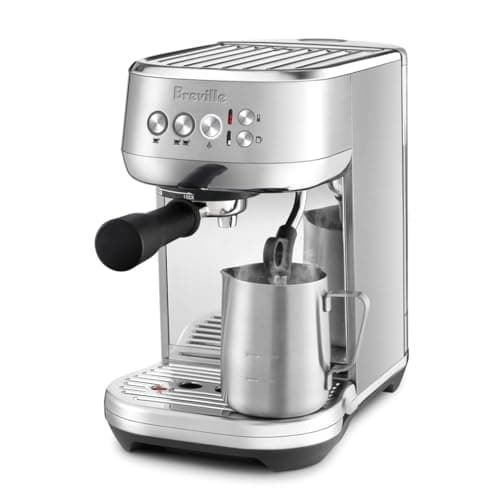
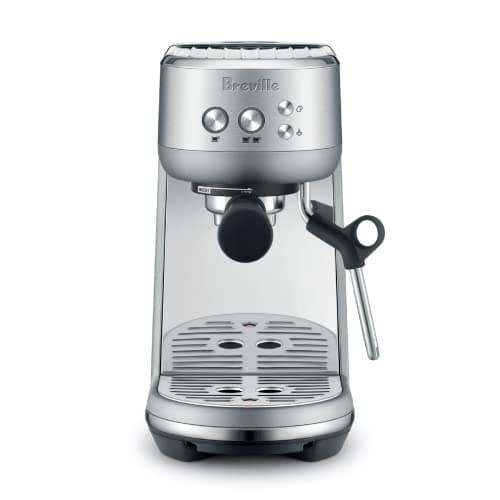
Buy the Bambino if you drink espresso, cortados or Americanos, if you are willing to learn to steam milk, or if your counter is shallow. Buy the Bambino Plus if milk drinks are the reason you are buying a machine at all and you would rather not spend a month learning microfoam. There is no version of this question where the Plus makes better espresso, because Breville publishes the same shot specifications for both.
That last point is worth getting straight before anything else, because the naming implies a hierarchy the spec sheets do not support. On Breville’s own US product pages, both machines are listed with the ThermoJet heating system reaching optimum extraction temperature in three seconds, a 54mm portafilter dosed at 18 g, a 15 bar Italian pump, and low-pressure pre-infusion followed by a 9 bar extraction. Same heater, same basket size, same dose, same pump, same pressure profile. Whatever the premium on the Plus buys, it is not the coffee in the cup.
What you are actually choosing: the milk
The Bambino has a manual steam wand. You put the tip in the pitcher, open the steam, and you are responsible for the two things that make microfoam: where the tip sits relative to the milk surface, which decides how much air you fold in, and when you stop, which decides the temperature. Get either wrong and you get bubbly, flat or scorched milk. It is a real skill with a real learning curve, and the honest timeline is weeks rather than days.
The Bambino Plus automates that step. Breville describes its steam wand as hands-free and publishes three adjustable milk temperatures and three milk texture levels, with steam quoted at 266°F. You drop the wand in, pick a temperature and a texture, press the button and walk away; the machine introduces air for the chosen texture, heats to the chosen temperature, and stops itself.
It is worth being precise about what that does and does not mean, because automatic milk gets oversold in both directions. What it genuinely removes is the judgment: you cannot overheat the milk and you cannot forget to stop. What it does not do is adapt. It runs a program, and the program assumes you have filled the pitcher to a sensible level with the kind of milk it was written around. Underfill the jug and there is not enough liquid for the texture setting to work with; overfill it and you get warm milk with foam sitting on top rather than folded through. Non-dairy milks — oat, almond, soy — froth differently from whole dairy, and the automatic routine will not notice that it is behaving differently today.
The other thing it does not do is beat a competent human. Someone who has put in the weeks will pour better latte art off the Bambino’s manual wand than the Plus will hand them, because they are reading the milk in real time and the program is not. That is precisely why the Bambino, not the Plus, is the pick on our best espresso machines for latte art page: an automatic wand is the right answer for someone who wants the drink, and the wrong answer for someone who wants the craft.
The 1.3 inches nobody mentions
This is the difference that decides more purchases than anyone admits, and it is published on both product pages where almost nobody looks. Breville lists the Bambino at 11.9 × 6.1 × 13.5 inches(W × D × H) and the Bambino Plus at 11.9 × 7.4 × 14.3 inches. Identical width, but the Plus is about 1.3 inches deeper and 0.8 inches taller.
On a wide, deep counter that sounds trivial. It is not trivial if the machine lives under a wall cabinet, because the height figure is before you account for lifting the water tank lid, and it is not trivial on a shallow counter or a narrow rolling cart, because 7.4 inches of depth plus clearance for the portafilter swing and the steam wand arc is a real footprint. If you are shopping this pair specifically because space is the constraint — which is the most common reason people compare them — measure before you decide, and know that the Bambino is genuinely the smaller machine rather than the same machine with fewer buttons. Both still rank among the smallest real espresso machines you can buy; see best compact espresso machines for how they sit against everything else at that size.
The 3-way valve, and the wet puck
The Bambino Plus has a 3-way solenoid valve; the Bambino does not. The valve releases the pressure sitting behind the puck at the end of the shot and vents it to the drip tray, so the puck comes out drier and the group head stops dripping almost immediately. Without one, that residual pressure stays in the basket, so the puck is wetter and sloppier to knock out and the group dribbles for a few seconds after you stop.
How much this matters is a question of temperament rather than coffee quality. It changes nothing about extraction — the shot has already left the basket — and a wet puck is a cleanup issue, not a flavor one. If you have already read something alarming about soupy pucks, understand the mechanism before you spend money to fix it: why is my espresso puck wet goes through the causes, and most of them are not the valve. A knock box solves the practical half of the problem for a small fraction of the gap between these two machines.
Portafilter, and what is in the box
Breville lists the Bambino Plus with a 54mm stainless steelportafilter. The Bambino’s is the lighter aluminum unit. More metal holds more heat, which in principle gives a marginally more stable basket temperature on the first shot of the day — and in practice, on a machine with ThermoJet heating and a 54mm basket, this sits a long way down the list of things that decide whether your espresso is any good.
The published in-box lists also differ, and that is more useful than the portafilter metal. Breville lists the Bambino Plus as shipping with a 54mm tamper, the Razor precision dosing tool, a 16 fl oz stainless steel milk jug, single-wall and dual-wall 1- and 2-cup baskets, a cleaning tool and a cleaning disc. The Bambino’s list covers the 1- and 2-cup single-wall and dual-wall baskets, a milk jug, a portafilter, a tamper, a steam wand tip cleaning tool and descaling powder — the Razor and the cleaning disc are not on it. None of those cost much separately, but if you are tallying what the price gap buys, the accessories are part of the honest answer, and a distribution tool is one of the cheaper upgrades either machine takes — see espresso distributor vs WDT tool.
What the price gap could buy instead
Neither machine includes a grinder, and this is where the comparison stops being about Breville and starts being about your setup. Both ship with single-wall baskets, which only work with coffee you grind yourself to an espresso-fine, finely adjustable setting. A Bambino paired with a cheap blade grinder makes worse coffee than a Bambino Plus paired with a good burr grinder, and a Bambino Plus paired with a blade grinder makes worse coffee than either paired properly. The grinder is not an accessory to this purchase; it is the other half of it.
The gap between these two machines sits in the same bracket as a genuinely capable entry espresso grinder, and that is the trade worth thinking hardest about. If you are choosing between the Plus and a grinder you already own, or the Bambino and your first grinder, both are reasonable. If you are choosing between the Plus with pre-ground supermarket coffee and the Bambino with a real grinder, the second makes better coffee, and it is not close. Our best espresso grinders and the Breville-specific pairings in best grinders for Breville espresso machines cover both routes, including the hand grinders that punch above their price.
Who should buy neither
Two groups should step out of this comparison entirely. If you do not own a grinder and do not want to buy one, an all-in-one with a built-in grinder is the machine you actually want — the Barista Express is the obvious candidate, and Bambino vs Barista Express works through that trade in full. And if the Bambino is already at the top of your budget rather than the bottom, look a bracket down before you stretch: the De’Longhi Dedica Deluxe is a narrower machine with pressurized baskets that tolerate pre-ground coffee, which is the honest buy for someone not ready to fund a grinder yet.
The two machines side by side
| | Bambino (BES450) | Bambino Plus (BES500) |
|---|
| Heating | ThermoJet, extraction temp in 3 seconds | ThermoJet, extraction temp in 3 seconds |
| Basket and dose | 54mm, 18 g | 54mm, 18 g |
| Pump and pressure | 15 bar pump, 9 bar extraction after pre-infusion | 15 bar pump, 9 bar extraction after pre-infusion |
| Milk | Manual steam wand | Hands-free: 3 temperatures, 3 textures, 266°F steam |
| 3-way valve | No | Yes |
| Portafilter | Aluminum | Stainless steel |
| Dimensions (W × D × H) | 11.9 × 6.1 × 13.5 in | 11.9 × 7.4 × 14.3 in |
| In the box (Breville’s published list) | Baskets, jug, portafilter, tamper, wand tip tool, descaling powder | Baskets, 16 fl oz stainless jug, tamper, Razor tool, cleaning tool, cleaning disc |
| Grinder | Not included | Not included |
Every row above comes from Breville’s own US product pages for the two machines, read side by side. Three figures Breville does not publish on either page are worth naming so you know they are missing rather than assume we left them out: water tank capacity, weight and wattage. Both pages state only that ThermoJet uses up to 32% less energy annually than a Thermoblock system. We do not have a lab, so there are no measurements of our own here — what you get is the published spec sheets compared honestly and the mechanisms behind them explained.
Decide it on what you drink, in one line
Espresso, cortado, Americano or macchiato: Bambino. A latte, flat white or cappuccino most days, hands-off: Bambino Plus. Latte art as a hobby you intend to get good at: Bambino, because an automatic wand cannot teach you anything and a manual one will. That is genuinely the whole decision, and every other row in the table above is a tiebreaker rather than a reason.
Three things the extra money does not fix
The Plus does not add a grinder, it does not add a bigger water tank, and it does not add a pressure gauge. The first is the one that costs you cup quality, and it is why we keep putting the grinder conversation in front of the machine conversation. The second is a daily annoyance on both — these are small bodies with small tanks, and a household of two will refill often. The third matters only if you like to diagnose shots by watching pressure, in which case you are looking at the wrong pair of machines and should read best dual boiler espresso machines.
What both machines need from you
Single-wall baskets, which both ship with, only work with freshly ground coffee at an espresso-fine setting you can adjust in small steps. If you are not there yet, both machines also include dual-wall (pressurized) baskets, and using those with pre-ground coffee is a legitimate starting point rather than a failure — it is exactly what they are for, and pressurized vs non-pressurized portafilters explains the ceiling you are accepting. Beyond the grinder, the short budget list is the same for both: a 54mm tamper, a milk jug you like if the included one does not suit, and water you have thought about. Scale is what kills small espresso machines, and what water to use in an espresso machine is the cheapest insurance either of these takes.
If you want the long version on either machine
This page is about the choice between them. Each machine also has its own full review, which goes into what only matters once you own it — routine, cleaning, descaling, failure modes, and the specific grinders that suit a 54mm basket: Breville Bambino review and Breville Bambino Plus review. If you have not settled on Breville at all, De’Longhi vs Breville compares the two brands’ philosophies rather than two models.