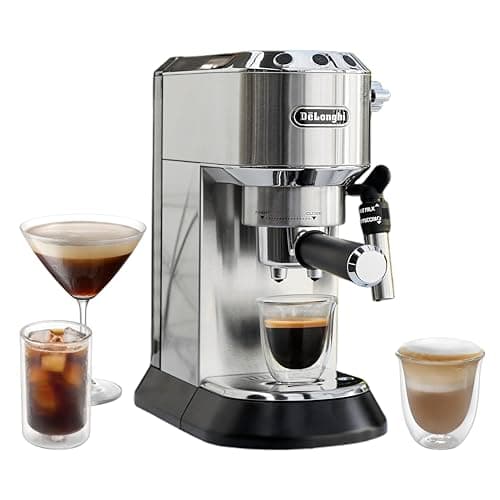
The Dedica Deluxe is the machine people buy when the counter decides. It is 5.9 inches wide — narrower than most cutting boards — and De’Longhi’s own product page leans on exactly that: “thanks to its 15 cm width, Dedica is the slimmest pump coffee maker around.” That is the manufacturer’s superlative about its own product rather than something we have verified across every machine on sale, but the underlying number is published and it is genuinely unusual.
The rest of this review is about the thing the width distracts from. The Dedica ships with pressurized baskets, and that single design decision sets both its great strength — it will make you a drinkable shot on day one with supermarket coffee and no grinder — and its ceiling, which you will meet sooner than you expect if the hobby takes. We do not have a lab, so there are no brew-temperature readings or taste scores of our own here. What you get instead is De’Longhi’s published specifications read carefully, the places its own listing disagrees with itself reported rather than tidied up, and a direct answer on who should buy it.
What it is, in specifics
De’Longhi’s US listing for the EC685M publishes a 15 bar pump, Thermoblock heating, 1300 W nominal on 120 V, a 35 oz removable water tank with a level indicator, and a body measuring 5.9 × 13 × 12 inches(W × D × H). It brews from ground coffee or E.S.E. pods, ships with three filter baskets and a tamper, carries an adjustable manual milk frother De’Longhi markets as a Premium Adjustable Frothing Wand, and shuts itself off twenty minutes after the last brew. The warranty is listed as one year, with a second year on product registration.
Two of those figures do most of the work. The first is the width: 5.9 inches is the reason this machine exists, and it is achieved by standing the components up vertically and running the machine deep rather than wide. Which brings the second: at 13 inches deep it is not a small machine overall, it is a narrow one. If your constraint is a shallow counter rather than a narrow gap, the Dedica does not solve your problem, and you should be looking at our best compact espresso machines roundup instead, where footprint is ranked as area rather than as a single headline number.
Where De’Longhi’s own specs disagree
Three things are worth flagging, because you will find all three quoted at you as fact somewhere.
Cup clearance.The feature copy on De’Longhi’s page says the removable drip tray lets you use mugs and glasses up to 12 cm tall. The specification summary on the same listing gives the maximum cup height as 4.5 inches, which is about 11.4 cm. Those are not the same number. Treat the clearance as “about four and a half inches” and measure your travel mug if it is close, because it is close for a lot of travel mugs.
The European machine is a different listing.Search for this machine and you will land as often on the EU “Dedica Style EC685.M” page as the US Dedica Deluxe. That listing specifies a 1.1 L tank, 220–240 V and a two-year warranty. It is the same family and the same body, but if you are buying in the US, the US figures are the ones that apply to the machine in the box, and the warranty difference is real.
There is no published warm-up time.Thermoblock machines heat fast, and plenty of write-ups print a figure in seconds. De’Longhi does not publish one on either the EC685M or the white EC685W listing, so we are not going to invent one or pass on someone else’s stopwatch. What the mechanism supports is the general claim: a thermoblock heats a small volume of water on demand instead of bringing a boiler up to temperature, so it is ready in well under a minute from cold rather than in the ten to fifteen minutes a boiler machine wants.
The pressurized basket is the whole story
The Dedica’s baskets are pressurized — dual-wall, with a small restrictor hole that creates back-pressure mechanically. On an unpressurized (single-wall) basket, the resistance that builds the nine bars of extraction pressure comes from the coffee itself: the grind has to be fine enough and even enough to hold the water back. On a pressurized basket, the restrictor does that job, so the grind barely matters.
That is a genuine feature, not a cheat. It is why the Dedica produces a thick-looking, crema-topped shot from pre-ground supermarket coffee on the first morning, with no grinder in the house and no technique learned. For a large number of buyers that is exactly the right trade, and pretending otherwise is coffee snobbery rather than advice.
The cost is the ceiling, and it is worth stating plainly. Because the restrictor is doing the work, a better grinder does not buy you a better shot on this machine — the improvement a good grind makes on a single-wall basket simply has nowhere to land here. The foam on top is largely produced by the pressure chamber rather than by the extraction, so it looks like crema and behaves less like it, dissipating faster and carrying less aroma. Pressurized vs non-pressurized portafilters goes through the mechanism in full, and why does my espresso have no crema is the other half of the same lesson.
A practical note on accessories, because it trips people up: De’Longhi does not publish a basket diameter for the EC685, and the Dedica family uses the smaller size that our espresso tamper size guide assigns to most De’Longhi machines, which is 51mm rather than Breville’s 54mm or the commercial 58mm. Measure the inside of your basket before you buy a tamper or a puck screen. If you want the dosing arithmetic for that size, espresso dose for a 51mm portafilter has it.
The milk, and what “adjustable” means
The frothing wand is manual and adjustable: it has positions for cappuccino froth and for flat hot milk, and the adjustment changes how much air the wand pulls in. It is a pannarello-style sleeved wand rather than a bare steam tip, which means it aerates aggressively and makes a stiff, bubbly foam easily — good for a traditional cappuccino, and the wrong tool for the glossy microfoam a flat white or latte art needs. A sleeved wand pulls air through a fixed hole whether you want it to or not, so you cannot control the air-to-steam ratio the way a bare wand lets you.
If milk drinks are the main event, be honest with yourself about which milk drink. A cappuccino with a dry foam cap: the Dedica is fine. Latte art: buy a machine with a bare wand and expect to practice, which is the argument in best espresso machines for latte art. Milk you do not have to think about at all: that is an automatic wand, and Bambino vs Bambino Plus is the comparison that settles whether it is worth paying for. Either way, how to froth milk covers the technique the sleeve does not do for you.
E.S.E. pods: a feature almost nobody uses
De’Longhi lists E.S.E. pod compatibility, and it is worth two sentences because it sounds more useful than it is. E.S.E. pods are 44mm paper-wrapped coffee discs — a real standard, not a proprietary capsule, and genuinely tidy. They are also much harder to find on a US supermarket shelf than K-Cups or Nespresso capsules, so treat pod support as a nice option if you happen to like them rather than as a reason to choose this machine. If pods are actually what you want, you want a pod machine: best pod coffee makers ranks those on their own terms.
Living with it
The twenty-minute auto shut-off is the single most useful thing about owning a Dedica that nobody mentions in a spec list: a thermoblock that heats on demand plus a timer that kills it means the machine is genuinely a press-and-go appliance rather than something you plan your morning around. The 35 oz tank is small, so expect to refill it every few days if two people are drinking; it is removable, which makes that a ten-second job rather than a jug and a funnel.
The thing that will actually end this machine’s life is scale. A thermoblock has narrow passages and no large boiler to hide deposits in, so hard water is more consequential here than on a bigger machine, and descaling on schedule is not optional. What water to use in an espresso machine is the cheapest insurance you can buy for it, and how to descale an espresso machine is the routine. Our how long do espresso machines last page is blunt about what neglect costs at this price point.
Who should buy something else
If you already own a burr grinder, or will buy one. The pressurized basket means your grinder is wasted on this machine. A Bambino at 54mm with single-wall baskets turns that grinder into better coffee; the Dedica cannot. That is the trade, and the De’Longhi vs Breville comparison is really a comparison of this one decision.
If you want latte art. The sleeved wand will not get you there, and no accessory fixes it without replacing the wand assembly.
If what you actually want is a cup of coffee rather than espresso. A thirteen-inch-deep espresso machine making 2 oz at a time is a strange way to get a mug of black coffee. For that money a drip machine or a press makes a better one, and our best coffee makers under $100 roundup covers the bracket below this machine entirely. The question is answered properly in is making espresso at home worth it.
The published specification, in one place
| Specification | De’Longhi’s published figure (US, EC685M) |
|---|
| Pump pressure | 15 bar |
| Heating system | Thermoblock |
| Power | 1300 W nominal, 120 V |
| Water tank | 35 oz, removable, with level indicator |
| Dimensions (W × D × H) | 5.9 × 13 × 12 in |
| Coffee formats | Ground coffee or E.S.E. pods |
| Baskets | Three filter baskets plus a tamper, pressurized |
| Milk | Adjustable manual frothing wand (sleeved) |
| Auto shut-off | 20 minutes after the last brew |
| Max cup height | 12 cm in the feature copy, 4.5 in in the spec summary — the page disagrees with itself |
| Warranty | 1 year, plus 1 additional year on product registration |
| Warm-up time | Not published |
Every row comes from De’Longhi’s own US product listing for the EC685M, read this week. Where the listing gives two figures we have printed both rather than picked one, and where it gives none we have said so. None of these are measurements of ours.
What you still have to buy
Less than with most espresso machines, which is a real part of the Dedica’s appeal. Because the baskets are pressurized you can genuinely start with a bag of pre-ground coffee, and the tamper is in the box. The short list, in the order it is worth spending on:
- Better coffee, not better gear.The one upgrade that reliably improves a pressurized shot is fresher coffee. A bag roasted this month from a roaster rather than a supermarket shelf does more here than any accessory — see best coffee beans for espresso.
- A milk pitcher. A small one, because the sleeved wand is short and a large jug makes it awkward: best milk frothing pitchers.
- Descaler. Not optional on a thermoblock. The cleaning and descaling supplies page covers what to use and what not to.
- A 51mm tamper, only if you move to the single-wall basket. With the pressurized baskets the included tamper is enough, because tamp pressure matters far less when a restrictor is creating the back-pressure.
Notice what is not on that list: a grinder. On most espresso machines it would be the first line. Here it would be money that cannot reach your cup, and that is the clearest way to state both what this machine is for and what it is not.
Dedica vs the obvious alternatives
Three machines come up every time someone shortlists this one.
The De’Longhi Stilosasits below it and is the same basic proposition with a cheaper body and a cruder frother. If the Dedica’s width is not the reason you are buying, the Stilosa makes a similar shot for less; our Stilosa review is honest about how little separates them on coffee and how much on feel.
The Breville Bambino sits above it and is a different kind of machine: 54mm single-wall baskets, so the grind is doing the work and a grinder is mandatory rather than pointless. If you will fund a grinder, it is the better long-term buy, and Bambino vs Bambino Plus covers which of the two Brevilles to pick once you get there.
A bean-to-cup machine is what some Dedica shoppers actually want: grinder included, one button, milk handled. It costs several brackets more and gives up any involvement in the shot, which is the trade examined in semi-automatic vs super-automatic.
Is the shot “real” espresso?
Yes, in the sense that matters: it is a pump-driven extraction at real pressure through a bed of coffee, not a steam-pressure toy, and the published 15 bar pump has more than enough headroom for the nine bars an extraction wants. It is also, in the sense enthusiasts argue about, a compromised one — because the pressure is partly manufactured by a restrictor hole rather than entirely by the coffee, you are not tasting what your grind and dose are doing. Both of those statements are true at once, and which one matters to you is the actual buying decision here rather than a technicality.