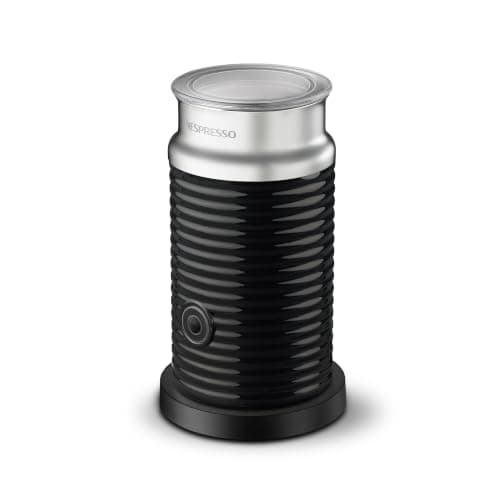
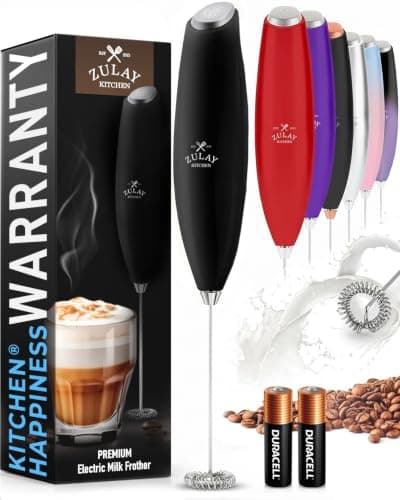
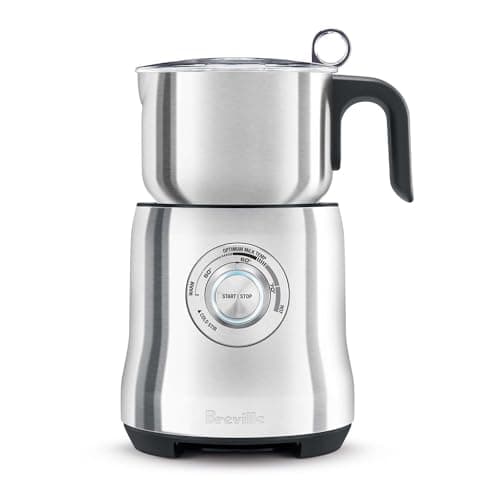
If you own an espresso machine with a working steam wand, use the wand — it is the only one of the two that produces pourable microfoam, so it is the only one that makes a flat white or latte art possible. Buy an electric frother anyway if you want cold foam for iced drinks (a wand cannot make it at all), if you want milk hands-free while the shot brews, or if your machine has a pannarello sleeve rather than a real wand. The best all-round frother here is the Breville Milk Café; the best cheap answer is the Zulay handheld whisk, which costs less than a bag of coffee.
The reason this question keeps getting answered badly is that “frothed milk” describes two physically different results. One is foam sitting on top of hot milk. The other is milk and air combined into a single glossy liquid that pours like paint. Both get called frothing, and only one of them is what a cappuccino in a good cafe is made of.
How a steam wand textures milk
A steam wand injects dry steam under the surface of cold milk. Two things happen at once. The jet drags air into the milk in a fine, controlled stream — that is the stretch phase. Then, once you submerge the tip, the jet sets the whole pitcher spinning, which breaks the bubbles down and folds them into the body of the milk — the texture phase. The result is microfoam: no visible bubbles, a glossy wet-paint surface, and a liquid you can pour through to make a pattern.
The two phases are why a wand needs practice. You are controlling how much air goes in, and then how thoroughly it gets folded back, by ear and by hand, in about twenty seconds. Our guide to frothing milk is the step-by-step version, and the short answer is that it takes a couple of weeks to stop making bubbly milk.
How an electric frother textures milk
A jug frother heats the milk and spins a whisk or a disc through it. Air is beaten in mechanically rather than injected, so the bubbles are formed all at once and there is no separate folding phase. The foam that results is uniform, stable and sits as a layer — good for a cappuccino where the foam is supposed to be a distinct cap, and wrong for a flat white where the foam is supposed to be in the milk rather than on it.
This is a design limit rather than a quality gap. A spun foam cannot be a poured foam, because the mechanism never folds the air back into the liquid. A $200 frother and a $10 whisk differ in temperature control, foam fineness and cleaning — not in whether they can produce microfoam. Neither can.
The three things a frother does that a wand cannot
1. Cold foam. A steam wand works by injecting steam, so it heats the milk by definition. There is no cold setting and there cannot be. If you drink iced lattes or cold-foam cold brew, a frother with a cold mode is not a compromise — it is the only tool that does the job.
2. Hands-free operation. A wand needs your hands and your attention for the whole twenty seconds. A jug frother runs while you pull the shot, which on a single-boiler machine that cannot brew and steam at once is a genuine time saving.
3. Consistency without skill. A frother makes the same medium foam every time, for anyone. That is worth a lot in a household where not everyone wants to learn, or where the alternative is a pannarello sleeve — the perforated plastic shroud fitted to many entry machines, which pre-mixes air and steam and produces stiff, bubbly foam no matter how good your technique is.
The one thing a wand does that no frother can
Pourable microfoam, and therefore latte art, and therefore a proper flat white. If that matters to you, nothing in this category substitutes for it, and the honest advice is to practise on the wand you already own rather than spend money on a frother. If it does not matter to you — and for a lot of people it genuinely does not — a frother is a better tool for a worse-sounding reason: it is easier, and the drink you actually make every day is the one that counts.
Which to use, by drink
Flat white, latte with art: wand only. Cappuccino with a distinct foam cap: either; a frother is easier. Iced latte or cold foam: frother only. Hot chocolate, matcha, milk for kids: frother, comfortably. Macchiato: either, since the foam is a dollop rather than a pour.
Below are the three frothers we would actually buy, chosen to cover the three honest reasons to own one rather than to fill a list. If you want the full ranking of the category instead, it is on best milk frothers.
Steam wand vs electric frother, side by side
| | Steam wand | Electric jug frother | Handheld whisk |
|---|
| How air gets in | Injected as steam, then folded in | Beaten in by a spinning disc | Beaten in by a whisk |
| Foam type | Microfoam — pourable, glossy | Uniform medium foam, sits as a layer | Airy, coarse, collapses quickly |
| Latte art | Yes | No | No |
| Cold foam | Impossible — steam heats by definition | Yes, on models with a cold mode | Yes (milk stays whatever temperature it was) |
| Hands-free | No | Yes | No |
| Skill needed | A couple of weeks of practice | None | None, beyond keeping the tip submerged |
| Heats the milk | Yes | Yes | No — you heat it separately |
| Counter space | Already on the machine | A dedicated appliance | A drawer |
Pannarello sleeves are the exception worth knowing about
Many entry machines and some bean-to-cup models fit a pannarello — a perforated plastic shroud over the steam tip that pre-mixes air with the steam. It makes foam reliably and it makes only stiff, bubbly foam, because the air is introduced before the jet ever touches the milk and there is no stretch-then-texture control. If your machine has one, you are not failing at latte art because of technique. Two honest options: remove the sleeve if your machine allows it and learn on the bare tip, or accept the situation and buy a frother. The Gaggia Brera is a well-known example of a machine where this comes up, which we note in our Gaggia rankings.
Temperature is the variable nobody mentions
Milk is sweetest somewhere around 130–140F and starts tasting cooked past roughly 155F, as lactose and proteins change. A steam wand gives you continuous control: you stop when the pitcher is uncomfortably warm to hold. Most frothers have one fixed preset, which is usually set high enough to feel satisfyingly hot and a little past where the milk tastes best. That is the real quality difference between a cheap jug frother and an adjustable one — not the foam, the temperature. Which milk you use matters too, and we cover that on best milk for frothing.
If you are going to use the wand, two things help
A correctly sized pitcher. Too big and the jet cannot set the milk spinning; too small and it overflows as the milk expands. A 12oz pitcher suits one or two drinks on most home machines — see best milk frothing pitchers.
Purging and wiping, every time.Milk bakes onto a hot wand in seconds and then blocks the tip, which is the most common reason a wand “stopped working.” Wipe immediately, then purge a short burst of steam to clear the tip. It takes three seconds and it is the difference between a wand that lasts and one that sputters.
So: which should you buy?
You have a working steam wand and want better milk: buy nothing. Buy practice, and a pitcher if yours is the wrong size.
You have a wand and drink iced lattes: buy the Aeroccino 3 for the cold mode. It is not redundant; it does a thing the wand cannot.
You have a pod machine or a pannarello:buy a frother. The Milk Café if milk drinks are daily, the Aeroccino 3 if they are frequent and simple.
You are not sure you care: buy the handheld whisk, find out for under ten dollars, and upgrade later with information instead of guesswork.