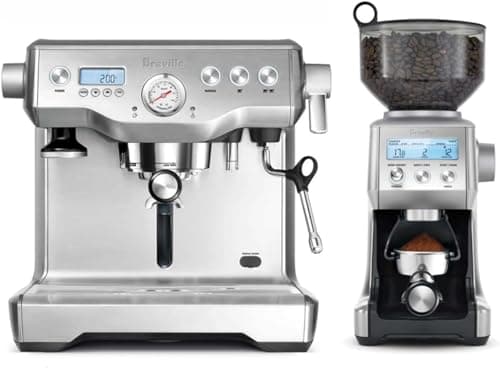
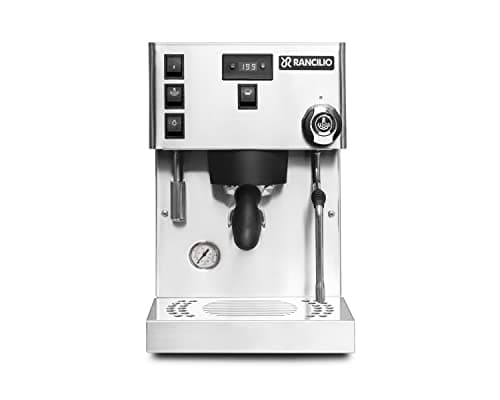
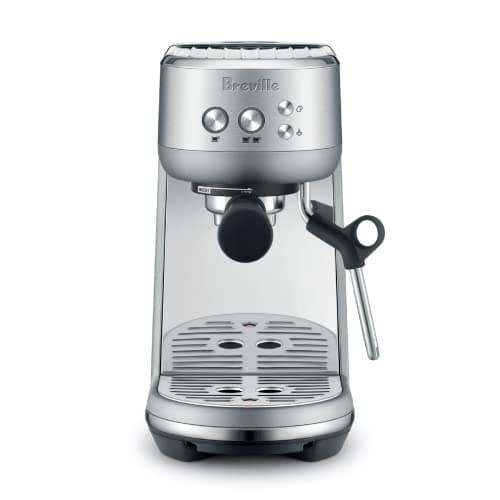
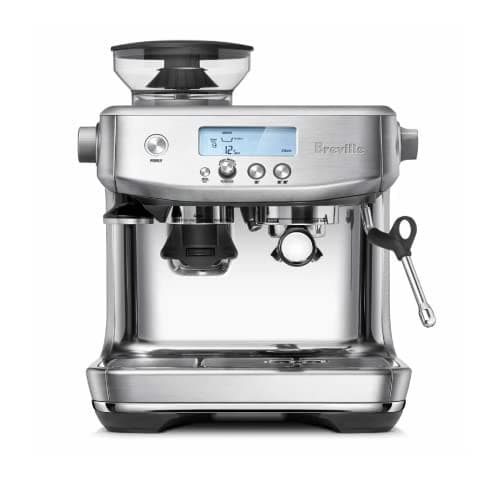
The verdict: the Breville Barista Pro is the best espresso machine with PID for most people, because its brew temperature is both PID-controlled and adjustable from the machine's own menu, it is ready in about three seconds, and it includes a grinder. If you want PID over an actual boiler rather than over a flow-through heater, buy the Breville Dual Boiler bundle or the Rancilio Silvia Pro X. The budget pick is the Breville Bambino, the cheapest machine on this site with factory PID control at all — it just does not let you change the number.
A PID is a controller, not a part you can see. A plain thermostat switches a heater on below a threshold and off above it, so the water temperature saws up and down around the target and the shot you pull depends on where in that swing you started. A PID watches the error, the rate of change and the accumulated drift, and modulates the heater so the temperature settles on the target and stays there. That is the whole claim, and it is worth caring about because brew temperature is one of the three variables — with grind and dose — that decides whether espresso tastes sour, bitter or correct.
So the ranking asks two questions most lists skip. First: can you read and set the number, or is the PID simply holding a factory value? Both are real PID control and only one of them lets you fix a sour shot with temperature. Second: what is the PID regulating? A brass boiler is a mass of water that holds heat through a shot. A thermoblock or Breville ThermoJet heats water as it flows through, with almost no stored volume, so its output tracks flow rate moment to moment and the PID is correcting a faster-moving target. Both are honest uses of the term. They do not behave the same.
One structural note stated up front: this list is Breville-heavy, and that is a fact about the market rather than a preference. Breville is the only manufacturer shipping factory PID across an entire home range. Gaggia, De'Longhi and most of the sub-$500 field ship thermostats, and the commercial-lineage brands put PID only on their upper machines. The final section names the popular machines that do nothave one, because "PID" is the most commonly mis-assumed spec in home espresso. Specifications, pros and cons are carried over unchanged from each pick's existing entry on this site, and prices are live from the price layer with the date they were read.
The short answer
Quick picks
01Breville Barista Pro (BES878)The best PID machine for most kitchens: digital PID control that you can actually adjust from the menu, a three-second heat-up, and a grinder in the same box.
7.8Best overall PID machine 03Rancilio Silvia Pro XIndependent PID control over both boilers, in a commercial-parts stainless body: the most serious temperature control here, and the least help with everything else.
7.8Best for independent brew and steam control 04Breville Barista Touch Impress (BES881)PID temperature plus assisted tamping and automatic milk, driven from a touchscreen: the machine that automates the two steps beginners get wrong while keeping the temperature settable.
7.7Best guided PID machine 05Breville Barista Express (BES870XL)The cheapest way to get PID temperature and a grinder in one box - the machine that made both standard at a home price.
7.3Best PID with a grinder included 06Breville Bambino (BES450)The budget pick: the cheapest machine with factory PID temperature control and low-pressure pre-infusion, in Breville's smallest body. You bring the grinder and steam the milk yourself.
| # | Product | Best for | Score | Price |
|---|
| 01 | Breville Barista Pro (BES878)The best PID machine for most kitchens: digital PID control that you can actually adjust from the menu, a three-second heat-up, and a grinder in the same box. | Best overall PID machine | | $629.95·Amazon |
| 02 | | Best PID over a true boiler | | $1,699.95·Amazon |
| 03 | Rancilio Silvia Pro XIndependent PID control over both boilers, in a commercial-parts stainless body: the most serious temperature control here, and the least help with everything else. | Best for independent brew and steam control | | $2,195.00·Amazon |
| 04 | Breville Barista Touch Impress (BES881)PID temperature plus assisted tamping and automatic milk, driven from a touchscreen: the machine that automates the two steps beginners get wrong while keeping the temperature settable. | Best guided PID machine | | $1,419.99·Amazon |
| 05 | | Best PID with a grinder included | | $494.95·Amazon |
| 06 | Breville Bambino (BES450)The budget pick: the cheapest machine with factory PID temperature control and low-pressure pre-infusion, in Breville's smallest body. You bring the grinder and steam the milk yourself. | Budget pick | | $299.95·Amazon |
#ad · Live prices from the Amazon Product API, as of November 22, 2026. Where we have no verified live price, we show none — a gap beats a number that has rotted.
In detail
The picks, in full
Best overall PID machine
Breville Barista Pro (BES878)
54mm portafilterThermoJet heating, ~3 second heat-upDigital PID temperature, adjustable from the menuBuilt-in conical burr grinder
The best PID machine for most kitchens: digital PID control that you can actually adjust from the menu, a three-second heat-up, and a grinder in the same box.
- PID adjustability
- 9
- Thermal mass
- 6
- Steam
- 7
- Completeness
- 9
- Value
- 8
Pros
- +The PID target is user-adjustable from the machine's own menu, which is the difference between having PID and being able to use it
- +Three-second heat-up, so there is no warm-up routine standing between you and a shot
- +Grinder included, and adjustable from the same interface as the shot
- +A clear digital display that tells you what temperature and shot time you actually got
Cons
- −The PID is regulating a ThermoJet rather than a boiler, so there is almost no stored thermal mass behind it
- −54mm baskets rather than the commercial 58mm standard
- −The integrated grinder spends budget a standalone grinder would spend better
- −Steam is good for one or two drinks, not for a pitcher after pitcher morning
Don't buy this if…
…you want PID over a real boiler, or you already own a grinder you like - in which case a Bambino Plus plus that grinder is better value.
Who it is for: the reader who wants temperature to be a setting rather than a mystery, without buying a boiler machine. Specifications, pros and cons are carried over unchanged from our Breville Barista Pro review, which documents the menu adjustment. It wins because it is the cheapest machine here where the temperature target is yours to move, and moving brew temperature is the standard fix for a shot that is reliably sour or reliably bitter — see why is my espresso sour or bitter.
Best PID over a true boiler
Breville Dynamic Duo (Dual Boiler + Smart Grinder Pro)
58mm commercial portafilterTrue dual boilerPID temperature controlSmart Grinder Pro included
PID over real boilers, with a 58mm group and a grinder in the bundle: the machine that brews and steams at once and holds the brew temperature while it does.
- PID adjustability
- 9
- Thermal mass
- 9.5
- Steam
- 9
- Completeness
- 9.5
- Value
- 6
Pros
- +A true dual boiler means brewing and steaming happen at the same time, with the brew boiler held at its PID target throughout
- +PID over a boiler regulates a mass of water, which is a fundamentally steadier thing to control than a flow-through heater
- +58mm commercial group, so the professional accessory market fits
- +The bundle includes a grinder that is a genuine match for the machine rather than an afterthought
Cons
- −The most expensive way onto this page by a wide margin
- −Large and heavy - it needs dedicated counter space and plumbing-free but real clearance
- −Long warm-up compared with a ThermoJet, which is the cost of thermal mass
- −More machine than a one-drink-a-day household will ever use
Don't buy this if…
…you make one coffee a morning. Dual-boiler simultaneity is a solution to back-to-back milk drinks, and you will be paying for a problem you do not have.
Who it is for: the household making several milk drinks back to back that wants the brew temperature held while the steam boiler works. Specifications, pros and cons are carried over unchanged from its entry on our best dual boiler espresso machines ranking. It scores highest on this page and places second, because the page is ordered for the reader who wants PID rather than the reader who wants everything: on hardware it is the clear winner and the price is the only reason it is not first.
Best for independent brew and steam control
Rancilio Silvia Pro X
58mm commercial portafilterTrue dual boilerPID with independent brew and steam controlCommercial-derived components
Independent PID control over both boilers, in a commercial-parts stainless body: the most serious temperature control here, and the least help with everything else.
- PID adjustability
- 9.5
- Thermal mass
- 9.5
- Steam
- 9.5
- Completeness
- 5
- Value
- 5.5
Pros
- +Independent PID control over both boilers - brew temperature and steam pressure are set separately
- +Steam power is the strongest of any machine here, and it does not fade across a pitcher
- +Built from commercial-lineage parts, so it is serviceable for a very long time
- +Stainless body and a commercial group head heavy enough to stay planted
Cons
- −No grinder, so budget for one on top of an already high price
- −Sparse next to Breville - no touchscreen, no guidance, no automation
- −Long warm-up as both boilers come to temperature
- −Availability moves; this is a low-stock, specialist product
Don't buy this if…
…you want the machine to help you. This is a bare, capable tool that assumes you already know what you are doing.
Who it is for: the experienced home barista who wants brew and steam set independently and nothing else. Specifications, pros and cons are carried over unchanged from its entry on our best dual boiler espresso machines ranking. It is the most capable temperature control on the page and it sits third because it is also the least complete machine here: no grinder, no guidance and a price that assumes both are solved problems for you already.
Best guided PID machine
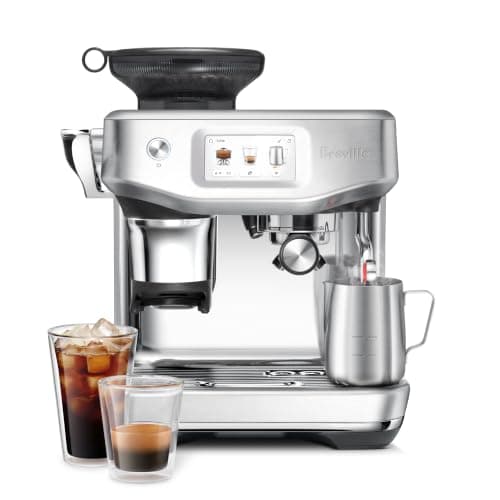
Breville Barista Touch Impress (BES881)
54mm portafilterDigital PID temperature, adjustable in the menuAssisted tampingAutomatic milk texturing, touchscreen guidance
PID temperature plus assisted tamping and automatic milk, driven from a touchscreen: the machine that automates the two steps beginners get wrong while keeping the temperature settable.
- PID adjustability
- 9
- Thermal mass
- 6
- Steam
- 7.5
- Completeness
- 9.5
- Value
- 6.5
Pros
- +PID temperature is adjustable from the touchscreen alongside grind, dose and milk settings
- +Assisted tamping removes the most variable manual step in home espresso
- +Automatic milk texturing to a chosen temperature and texture, repeatably
- +The guidance is genuinely useful rather than decorative - it tells you what to change after a bad shot
Cons
- −Expensive, and much of the price is automation rather than thermal hardware
- −A ThermoJet rather than a boiler, so the PID is regulating a flow-through heater
- −54mm baskets, and a large footprint
- −A touchscreen is one more thing that can fail on a machine you hope to keep
Don't buy this if…
…you want to learn espresso by hand. This machine is designed to take the two hardest steps away from you, which is the opposite of what a learner wants.
Who it is for: the reader who wants good drinks on day one and a settable temperature for when they start caring about the shot. Specifications, pros and cons are carried over unchanged from our Breville Barista Touch Impress review.
Best PID with a grinder included
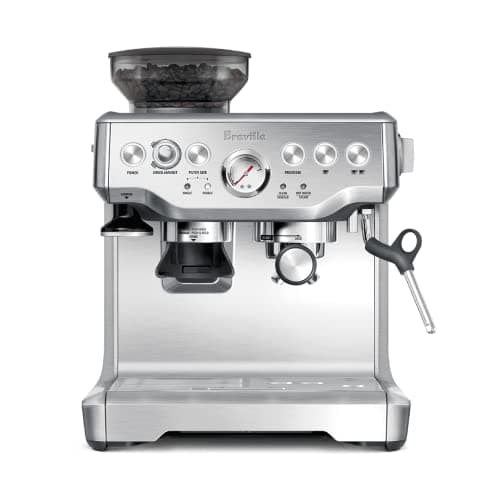
Breville Barista Express (BES870XL)
54mm portafilterDigital PID temperatureBuilt-in conical burr grinder1600W thermocoil, 2L tank
The cheapest way to get PID temperature and a grinder in one box - the machine that made both standard at a home price.
- PID adjustability
- 6.5
- Thermal mass
- 6
- Steam
- 7
- Completeness
- 9
- Value
- 8
Pros
- +PID temperature control plus a grinder for less than most machines here cost without one
- +The built-in grinder is good enough that many owners never replace it
- +Dose, grind and shot volume adjustable from the machine, so the whole loop is in one place
- +The most widely documented machine in home espresso, which makes problems easy to diagnose
Cons
- −A thermocoil rather than a boiler, and less temperature adjustability than the Barista Pro's menu
- −Slower to heat than the ThermoJet machines above it
- −Large footprint - the deepest machine on this page
- −Integrated grinder cleaning is more involved than cleaning a standalone grinder
Don't buy this if…
…you already own a grinder, or you want to set the brew temperature yourself. The Barista Pro is the machine where that number is yours.
Who it is for: the reader who wants PID and a grinder on one receipt. Specifications, pros and cons are carried over unchanged from our Breville Barista Express review. It sits below the Barista Pro for one reason only: the Pro's temperature target is adjustable from the menu and this one's is not, and on a page about PID that is the deciding spec.
Budget pick
Breville Bambino (BES450)
54mm portafilterThermoJet heating, ~3 second heat-upPID control with low-pressure pre-infusionManual steam wand
The budget pick: the cheapest machine with factory PID temperature control and low-pressure pre-infusion, in Breville's smallest body. You bring the grinder and steam the milk yourself.
- PID adjustability
- 5
- Thermal mass
- 6
- Steam
- 6.5
- Completeness
- 6
- Value
- 9
Pros
- +The cheapest factory PID on this site, which is the entire reason it is the budget pick
- +The same 54mm baskets, ThermoJet heating and pre-infusion Breville lists for the Bambino Plus, for noticeably less
- +Three-second heat-up in the smallest footprint of any machine here
- +A manual steam wand, so milk texturing is something you can actually learn on it
Cons
- −The PID holds a factory target with no user adjustment documented in the instruction book
- −No grinder and no automatic milk - this is a shot engine and nothing else
- −A ThermoJet has almost no thermal mass, so output temperature tracks flow rate
- −Light body, small tray, and steam that suits one drink rather than four
Don't buy this if…
…you want to change the brew temperature, or you want milk texturing handled for you. The Barista Pro answers the first and the Bambino Plus answers the second.
Who it is for: the reader who already owns a grinder and wants the cheapest machine that controls temperature properly. Specifications, pros and cons are carried over unchanged from our Breville Bambino review and the Bambino vs Bambino Plus comparison, which is the page to read if automatic milk is the question.
What PID actually does
PID stands for proportional-integral-derivative, which is a description of the maths rather than of the hardware. A thermostat is a switch: heater on below the setpoint, off above it, so the real temperature oscillates around the target and the size of that oscillation is the error you live with. A PID controller measures how far off it is, how long it has been off, and how fast it is moving, then modulates power so the temperature arrives at the setpoint and stays. In espresso terms, it is the difference between a brew temperature that is roughly right and one that is the same every shot.
The two questions that separate PID machines
1. Can you set the number?
This is the distinction that decides this page's order. Every machine here has factory PID control. Only some let you move the target: the Barista Pro and the Barista Touch Impress expose it in the menu, the dual-boiler machines expose it directly, and the Bambino and Barista Express hold a factory value with no user adjustment documented. Both are legitimate. The reason it matters is practical: if your shots are reliably sour, the standard fixes are a finer grind or a hotter brew temperature, and on a machine with a locked target you only have the first.
2. What is the PID regulating?
A PID over a brass boiler is controlling a mass of heated water that holds temperature through a shot on its own. A PID over a thermoblock or a Breville ThermoJet is controlling a heater that water flows through, with almost no stored volume, so output temperature depends on flow rate from moment to moment. The controller is doing more work and has less inertia helping it. Our best single boiler espresso machines page goes through that distinction in detail, because it is the one most lists skip.
The machines people wrongly assume have PID
Worth naming, because this is the most mis-assumed spec in home espresso. The Gaggia Classic Pro does not have one; it has a thermostat, and the aftermarket PID kit is the most common first mod precisely because of that. The base Rancilio Silvia uses a manual thermostat — only the Pro X above has PID. The De'Longhi Dedica and Stilosa have no temperature control to speak of. And no house-brand machine advertising "NTC temperature control" or a bar rating is making a PID claim, whatever the listing implies.
Can you add a PID later?
Only to a boiler machine. A PID needs a vessel whose temperature it can regulate and a probe it can read, so the Gaggia Classic Pro and the Rancilio Silvia take documented kits and a ThermoJet or thermoblock machine does not. If "I will upgrade it later" is part of your plan, buy a boiler machine now — our best semi-automatic espresso machines page sorts the field by exactly that.
What PID will not fix
A stable temperature makes your other variables repeatable; it does not make them right. If the grind is wrong the shot is wrong at every temperature, which is why the honest advice on every page of this site is to spend on the grinder before the temperature control. PID is what turns a dialed-in recipe into a repeatable one — it is not what dials it in.
How we picked
We did not lab-test this gear
Everyone in this category says they tested twenty machines. We have not lab-tested any of these, and we say so. What we did instead: compiled the published manufacturer specifications, read the manuals, ran the math where there was math to run (heat-up time, pressure, dose capacity, grind range, cost per cup), and scored each pick against a published rubric. The scores are judgments from documented research — not measurements we took, because we do not have a lab and we will not pretend we do. Where a number came from someone else's work, we name them in Sources.
Questions
Frequently asked
What is the best espresso machine with PID?+
The Breville Barista Pro, for most people, because its PID target is adjustable from the machine's own menu, it heats in about three seconds and it includes a grinder. If you want PID over a true boiler rather than a flow-through heater, the Breville Dual Boiler bundle and the Rancilio Silvia Pro X are the machines to look at.
Does PID actually make better espresso?+
It makes espresso more repeatable, which is usually what people mean. Brew temperature is one of the three variables that decide whether a shot reads sour, bitter or balanced, and a thermostat lets that variable move between shots. PID holds it still. It will not improve a shot whose grind is wrong.
Does the Gaggia Classic Pro have a PID?+
No. It uses a thermostat, which is why fitting an aftermarket PID kit is the most common first modification owners make. The machine's brass boiler is what makes that possible — a PID needs a vessel to regulate, and a thermoblock machine has none.
Can I add a PID to any espresso machine?+
No, only to machines with an actual boiler. The Gaggia Classic Pro and the Rancilio Silvia take documented kits. Breville's ThermoJet and thermocoil machines cannot, because there is no body of water whose temperature a controller could hold.
Is PID the same as temperature control?+
Not quite. Every machine has some temperature control; PID is a specific kind that settles on a target instead of switching around it. Listings sometimes describe an NTC sensor or "smart temperature" as though it were the same thing. Ask instead whether the machine states a PID and whether the target is adjustable.
Do I need a PID if I only make milk drinks?+
Less than you would for straight espresso, honestly. Milk masks a lot of what temperature instability does to a shot. If every drink you make is a latte, steam capability and milk texturing are worth more of your budget than PID, which is what our
espresso machines with milk frothers page is about.
Receipts
Sources
We do not run a testing lab, and we do not pretend to. Where a measured number came from someone else's work, we name them and link them. Where we could not verify something, we say so on the page rather than quietly leaving it out. Read our full method.