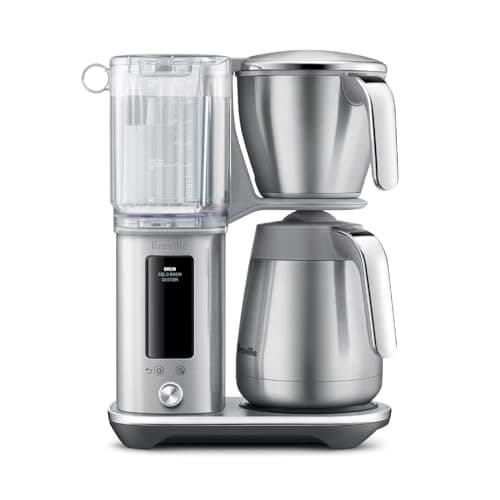
The Luxe Brewer is the machine for the person who does not believe a drip coffee maker should make all the decisions. Almost every machine in this category gives you one button and a brew it has chosen for you; this one lets you move the bloom volume, the bloom time, the brew temperature and the flow rate, and then remembers what you set. If you have ever read an argument about extraction and wanted to test it on your own counter rather than take a side, this is the drip machine built for that.
It is also Breville’s answer to a question it created itself. The Precision Brewer — the machine that made adjustable drip a mainstream idea — is listed as discontinued on Breville’s own site, and the Luxe Brewer is what replaced it. So this review has two jobs: say what the Luxe Brewer is on its own published specifications, and say honestly what changed in the swap, including the things Breville has stopped printing. We do not have a lab, so there are no brew-temperature readings or taste scores of our own here. What you get is Breville’s own documentation read carefully, the gaps in it named rather than filled, and a direct answer on who should buy something else.
What it is, in specifics
Breville’s US listing for the BDC465 publishes three brew modes — One Touch, Cold Brew and Custom Brew — and states that the machine brews to SCA Golden Cup standards. Custom Brew is the reason the machine exists: it exposes bloom volume, bloom time, brew temperature and flow rate, and Breville states it “will automatically remember your settings for next time.” The water tank is 60 fl oz (12 cup), removable, with measuring lines and an integrated Claro Swiss water filter. The thermal version’s dual-wall carafe is published as keeping the brew above 150°F / 65°C for up to four hours. Cold Brew is a preset that brews at higher concentration and is ready in up to 30 minutes depending on volume. Delayed start is programmable up to 24 hours ahead. The body measures 16.1 × 10.2 × 6.8 inches(W × D × H). In the box: a cone filter basket insert, a mesh basket filter, a 10-pack of flat-bottom filter papers, a water hardness strip, a coffee measuring scoop, and the water filter with its adapter.
Two of those figures do most of the work, and it is worth being precise about which. The first is the carafe claim, because it is the only retention figure in this category with a threshold temperature attached to it — “above 150°F for up to four hours” is a falsifiable statement in a market full of machines that say “stays hot for hours” and leave it there. Technivorm, for comparison, publishes one hour for the Moccamaster’s thermal carafe, with no threshold. Those two claims are not comparable and we have not tried to reconcile them, but Breville’s is the more specific of the two and that counts for something.
The second is the width. At 16.1 inches this is a wide machine, wider than it is tall, and the counter problem it creates is a real one if your coffee station lives under a wall cabinet. Our thermal carafe coffee maker ranking notes it as the biggest footprint in that group, and if space is your binding constraint this is the first thing to measure.
Where Breville stops publishing
Three gaps, and we are naming them so you know they are missing rather than assume we left them out.
No wattage and no weight.Neither figure appears on Breville’s page for this machine. That is unusual for a drip brewer, where wattage is a rough proxy for how quickly the element can bring a full tank up to temperature, and it means you cannot compare this machine to the Moccamaster’s published 1400 W on that axis at all.
No numeric brew-temperature range— which is the odd one, because brew temperature is a thing this machine explicitly lets you adjust. Breville tells you that you can move it and does not tell you between what and what. The Golden Cup standard that Breville cites puts the window at roughly 195–205°F, and Technivorm publishes 196–205°F for its own element, but Breville prints no range of its own for the Luxe Brewer, so treat the adjustment as relative rather than as a dial calibrated in degrees you know.
No carafe capacity, separately from the tank. The 60 fl oz figure is the removable water tank. Drip machines lose some water to the grounds and to the system, so the carafe yield is slightly less than the tank volume, and Breville does not publish what it is.
There is also a wording distinction worth flagging, because it is the one place this machine is weaker than its cheaper rivals on paper. Breville says the Luxe Brewer brews to SCA Golden Cup standards. The OXO Brew 8-Cup and the Bonavita BV1901TS carry the SCA Certified Home Brewermark, which is a third-party certification, and the Moccamaster carries an ECBC certification plus SCA Golden Cup approval. “Brews to the standard” is a manufacturer’s claim about its own product; a certification mark is somebody else’s verification of it. Both may be perfectly true. They are not the same kind of evidence, and a reviewer who prints them as interchangeable is doing you a disservice.
Custom Brew is the whole story
Everything else on this machine is competent. Custom Brew is why you would pay for it, so it deserves a plain explanation of what each control actually does to your coffee.
Bloom volume and bloom time. Fresh coffee holds carbon dioxide from roasting, and CO2 pushes water away from the grounds. A bloom wets the bed with a small amount of water first and waits, letting the gas escape so the main pour can actually soak in. Breville lets you set both how much water the bloom uses and how long the pause lasts. This matters most with coffee roasted in the last week or two, which is exactly when most drip machines brew worst; with a bag that has been open a month, it does very little, because the gas is already gone.
Brew temperature. Hotter water extracts faster and pulls more of everything, including bitterness; cooler water extracts more slowly and leaves acidity forward. Light roasts are dense and generally want the top of the window; dark roasts are brittle and soluble and often taste better slightly cooler. This is the control that turns a sour light-roast cup sweet, and it is the main reason to buy this machine over a certified one-button brewer.
Flow rate. How fast the water arrives sets how long the bed stays saturated and how much the grounds get agitated. Slower flow means longer contact and more extraction; faster flow means a shorter, lighter brew. On a flat-bottom bed, flow rate is also the difference between water spreading across the whole bed and water punching a channel through it.
The honest caveat: all three controls are only worth anything if your grind is consistent, because an inconsistent grind swamps the differences they make. If you are still brewing pre-ground coffee or grinding in a blade grinder, the controls on this machine will mostly reveal noise. Fix the grind first — burr vs blade grinder explains why, and our brew grinder ranking has the machines that make Custom Brew mean something.
Both basket shapes, and why that is a real feature
The Luxe Brewer ships with a flat-bottom basket and a cone insert, plus a reusable mesh filter. That is not a packaging detail; the bed shape changes the brew as much as some of the Custom Brew settings do. A flat bed is shallow and even, so water passes through most of the coffee at a similar rate — forgiving, consistent, the shape most certified machines use. A cone concentrates the bed in the middle and deepens it, so water travels further through more coffee, which raises extraction and rewards a finer grind but punishes an uneven one by channeling.
In practice: flat bottom for medium and dark roasts and for anyone who wants reliability, cone for light roasts and for anyone who already brews pour-over and wants the drip machine to taste like their pour-over setup. Being able to change your mind without buying anything is genuinely unusual at this price.
The Cold Brew preset, honestly assessed
Breville publishes that Cold Brew brews at a higher concentration and is ready in up to 30 minutes depending on water volume. Thirty minutes against the twelve to twenty-four hours a steeped cold brew wants is a large claim, and the mechanism it implies is extraction by agitation and contact rather than by time.
Here is the part to be clear-eyed about: a 30-minute cold extraction and an overnight steep are not the same drink. Long steeping is what produces the particular low-acid, heavy, chocolatey character people buy cold brew for; a fast cold extraction gets you something cleaner, brighter and closer to iced coffee. Neither is wrong, but if overnight cold brew is specifically what you want, a dedicated steeper from our cold brew maker ranking costs a fraction of this machine and does that job better. Treat the preset as a bonus that is genuinely convenient, not as a reason to choose the Luxe Brewer.
Luxe Brewer vs the discontinued Precision Brewer
This is the comparison most people arrive looking for, and it needs care because one half of it is a machine Breville no longer sells. Breville’s page for the Precision Brewer (BDC400) lists it as discontinued and points to support and replacement options. What that page does still document is the machine’s shape: six brew presets including Gold, Fast, Strong, Iced and Cold Brew; a My Brew mode adjusting bloom time, brew temperature and flow rate; thermocoil heating with PID control; a 60 oz capacity; flat-bottom and cone baskets; and a body measuring 12.4 × 6.7 × 15.7 inches.
Read the two listings side by side and the continuity is obvious: the same 60 oz capacity, the same both-basket-shapes approach, the same core idea of a user-adjustable bloom, temperature and flow. The visible changes are a consolidation of the preset list into One Touch / Cold Brew / Custom Brew, the addition of the bloom volumecontrol alongside bloom time, the integrated Claro water filter in the tank, and a reorientation of the body from tall-and-narrow to wide-and-low — 12.4 inches wide and 15.7 tall becomes 16.1 wide and 6.8 tall, which is a completely different counter problem.
One thing Breville prints for the old machine and not the new one: the Precision Brewer’s page names thermocoil heating with PID controlas the temperature mechanism. The Luxe Brewer’s page does not name its heating system at all. That is not evidence that the hardware changed — it is evidence that the documentation did, and we are not going to assume the one from the other.
The practical answer: if you find a Precision Brewer in stock at a real discount and you do not need a thermal carafe, it is still a very good machine and the saving is genuine. Buy the Luxe Brewer if you want the thermal carafe with its four-hour claim, the bloom-volume control, or simply a machine that will still have parts support in five years — which is the quiet argument for the current model over the discontinued one, and it is the stronger argument of the two.
Living with it
The 24-hour delay start is the feature that decides whether this machine fits your morning, and it is the thing the two best-brewing thermal machines on the market refuse to offer. A thermal carafe plus a timer means the coffee is made before you are awake and is not sitting on a plate getting worse while it waits. If that sentence describes what you want, your shortlist is much shorter than you think.
The in-tank Claro water filter is a real maintenance saving rather than a gimmick, because scale is what kills drip machines and filtered water is cheaper than descaling. It does not replace descaling — nothing does — but it slows the clock. Our what water to use guide applies to drip machines as directly as it does to espresso, and the water hardness strip in the box exists so you can find out what you are dealing with on day one.
The carafe needs washing, not rinsing. A thermal carafe’s narrow neck and brew-thru lid make it easy to leave a film of coffee oil inside, and that film goes rancid and taints every pot afterward. Take the lid apart if it comes apart; the lid holds more residue than the carafe does.
Who should buy something else
If you want one button and a correct cup. The adjustment is most of what you are paying for here, and if you will never touch it, you are buying menus. The Bonavita BV1901TS carries an actual SCA certification with a pre-infusion bloom and costs substantially less; it is on our thermal carafe ranking for exactly this buyer.
If brew quality is the only thing you care about. The Moccamaster KBGT publishes its temperature window as a number, carries an ECBC certification, brews a full carafe in four to six minutes and comes with a five-year warranty. It has no timer and nothing is adjustable, and for a large number of serious coffee drinkers that is the point. Our Moccamaster review makes that case properly.
If you need twelve cups for a household or an office. This is a 60 oz tank. A 12-cup programmable with a thermal carafe costs less than half as much, and the gap in brewing refinement matters less when the pot is being emptied by six people. The best coffee makers ranking covers that end, and best coffee makers under $100 covers the bracket below it entirely.
If you still grind in a blade grinder.Spend this money on a grinder instead and buy a cheaper brewer. That is not a rhetorical flourish — it is the single most reliable advice on this site, and it is explained from first principles in burr vs blade grinder.