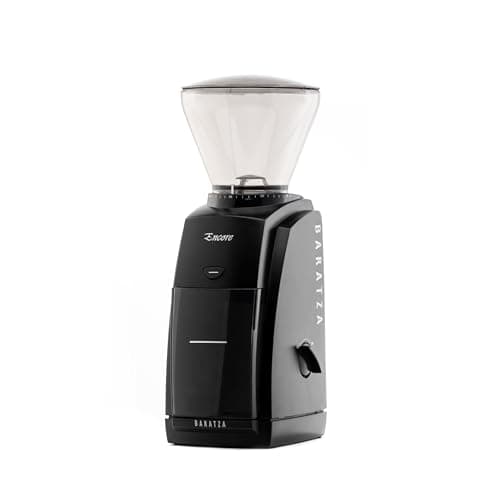
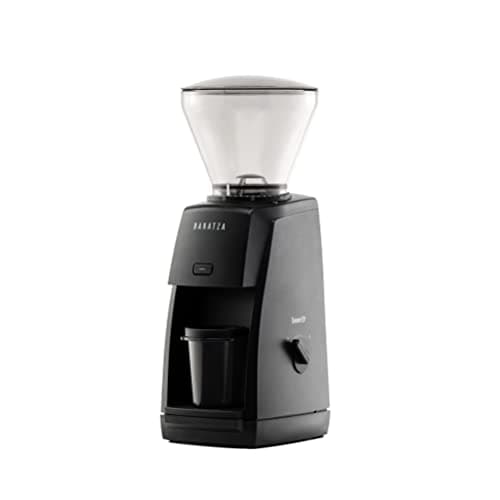
These two grinders share a body, a motor and a price bracket, and the difference between them is not cosmetic. The Encore uses Baratza’s long-standing filter burr set with an adjustment range mapped from cold brew down to fine drip. The Encore ESP uses a different burr set and a re-mapped range that reaches genuine espresso fineness, at the cost of some coarse-end range.
That is the whole decision, and it is not reversible by adjustment. If you buy the standard Encore and later want espresso, its finest setting still passes water through an espresso basket too quickly to build pressure — you get a fast, thin, sour shot no matter what you do. Choose on where you expect to be in two years, not on what you brew this week.
The short answer
Buy the Encore if you brew drip, pour-over, French press or cold brew and are confident espresso is not coming. It is cheaper and its coarse end is better mapped for immersion brewing. Buy the Encore ESP if you own or might buy an espresso machine. The premium is modest, and it is the only one of the two that can do both jobs.
Side by side
| | Encore | Encore ESP |
|---|
| Burr set | Filter-tuned 40mm conical | Espresso-capable 40mm conical |
| Settings | 40 steps, filter range | 40 steps, re-mapped to include espresso |
| Espresso | No — cannot go fine enough | Yes, on non-pressurized baskets |
| Coarse end | Better — true cold brew coarse | Slightly reduced |
| Best at | Pour-over, drip, press, cold brew | Espresso first, filter comfortably |
| Price | Lower | Modestly higher |
| Parts & repairability | Fully documented | Fully documented |
Why the standard Encore cannot be made to do espresso
Espresso needs the coffee bed to resist about nine bars of pressure for 25 to 30 seconds. That resistance comes from particle size: fine enough, and the puck holds water back long enough to extract properly. The Encore’s burrs and adjustment range were designed for filter, and its finest setting lands around a moka-pot grind — fine, but not fine enough. Water passes through in well under 20 seconds, so the shot is thin and sour regardless of dose, tamp or technique.
This is a hardware limit, not a skill limit, and it is why we repeat the warning on every page where the Encore appears. The ESP exists precisely because Baratza could not solve it with a setting change either — it needed different burrs.
What the ESP gives up
Not much, but it is worth naming. Re-mapping 40 steps to include the espresso range means the steps at the coarse end are spread differently, and the very coarsest setting is a little less coarse than the standard Encore’s. If cold brew is a weekly ritual for you, that is a real if small consideration — see our cold brew maker picks for how coarse that method actually wants.
Neither is a precision espresso grinder
Be clear about the ESP’s ceiling. It is stepped, and espresso frequently wants a setting between two clicks — one runs a little fast, the next chokes. You work around it by adjusting dose slightly, which is a legitimate technique but a workaround nonetheless. If you are pulling espresso daily and chasing consistency, a stepless grinder from our single dose ranking is the next real step up. The ESP’s job is getting you to genuinely good espresso cheaply, and it does that.
The repairability argument applies to both
Baratza publishes parts and repair guides for the burrs, motor, gearbox and switch on both machines. Burrs are the only true consumable, and a re-burred ten-year-old Encore performs like a new one. That changes the value calculation against sealed grinders that become landfill when one component fails, and it applies equally whichever of these two you buy.
If you already own the standard Encore
Baratza sells the ESP burr set separately, and fitting it is a documented user-level job. That is a genuinely cheaper route to espresso capability than buying a second grinder — though if you are pulling espresso seriously, the money is usually better spent stepping up to a stepless grinder than upgrading a stepped one.
How we picked
We did not lab-test this gear
Everyone in this category says they tested twenty machines. We have not lab-tested any of these, and we say so. What we did instead: compiled the published manufacturer specifications, read the manuals, ran the math where there was math to run (heat-up time, pressure, dose capacity, grind range, cost per cup), and scored each pick against a published rubric. The scores are judgments from documented research — not measurements we took, because we do not have a lab and we will not pretend we do. Where a number came from someone else's work, we name them in Sources.