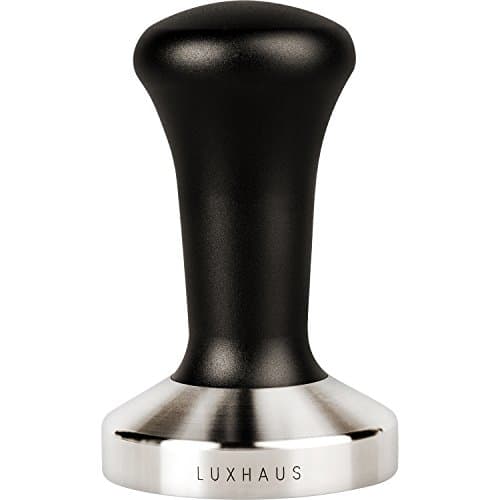
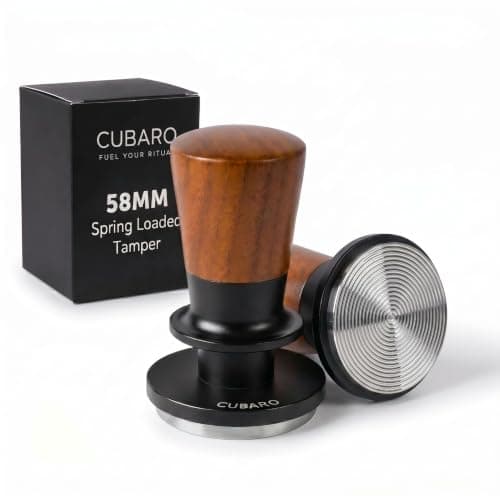
Here is the answer before the reasoning. A calibrated tamper does not make better espresso than a plain flat tamper of the same diameter. What it buys is repeatability — one fewer variable while you are learning, and a shared reference if more than one person pulls shots in your house. That is genuinely worth something. It is not worth a large premium, and it is worth nothing at all if the base is the wrong size for your basket.
The reason we are that blunt is that the pressure question has actually been tested. Kaffeemacher ran 150 extractions across three tamping pressures — 10kg, 15kg and 20kg, fifty shots each — and measured shot time and TDS with a refractometer. Average extraction times landed between 23.54 and 24.24 seconds; average TDS landed between 7.82 and 8.05 percent. They found no statistically significant difference between the groups on either measure, and concluded that within that range tamping pressure has “no or only a marginal influence” on the shot. They did not test below 10kg, and they suggest a minimum of around 6kg — so pressing firmly still matters, but pressing to a specific number does not.
Which reframes the whole purchase. A calibrated tamper is not an extraction upgrade; it is a consistency aid for the human holding it. If your shots vary for no reason you can see, the click removes one suspect from the lineup, which is worth real money when you are new. If you have been tamping the same way for a year, it removes a suspect you had already cleared. What has not changed is the thing that does move the needle: the base has to match your basket. A calibrated tamper in the wrong diameter is worse than a plain one in the right diameter, every time. Settle that first in the tamper size guide.
What the research actually says, and what it does not
The Kaffeemacher experiment is the most useful thing published on this question because it has a sample size worth arguing with: 150 shots, three pressure groups, both shot time and refractometer TDS measured. Their conclusion is narrow and we will not stretch it. Within 10kg to 20kg, pressure did not significantly change the shot. They explicitly did not test below 10kg and they recommend a floor of around 6kg, which means “tamp firmly” is still real advice — a limp tamp is a genuine fault. What the study undermines is the idea that a specific number is the target, and that is exactly the idea calibrated tampers are sold on.
It also does not say tamping is unimportant, because pressure is not the only thing a tamp does. A tamp that is tilted leaves one side of the puck denser than the other, and water takes the loose side. That is a real and common fault, it is visible on a bottomless portafilter, and it is the reason self-levelling heads are a more interesting feature than calibrated springs. We do not have a lab and we did not measure any of this ourselves; we are reading someone else's work and saying whose.
So who should buy calibrated
Three cases, and they are all about people rather than physics. First, if you are new: the click removes a variable while you are trying to isolate a fault, and being able to say “the tamp was the same” is worth the money for a few months even if it turns out the tamp was never the problem. Second, if more than one person pulls shots — a household tamps at wildly different pressures and a spring is the cheapest way to make the two comparable. Third, if you have a physical reason a firm consistent press is difficult, in which case the spring is doing something genuinely useful.
Everyone else should buy a good solid tamper in the right diameter and put the difference toward the grinder, which is the only piece of gear in this hobby that reliably changes the cup. That argument in full is in best espresso grinders.
What to look at instead of the spring
Diameter first and by a distance: 58.5mm for a 58mm basket, 53.3mm for a Breville 54mm basket, 51mm for a De'Longhi. Then base flatness, which is what actually transmits pressure evenly — a convex or ripple base is a preference, not an upgrade. Then weight, because a heavy tamper does more of the work for you than a light one at any pressure setting. The spring comes fourth on that list, which is roughly the inverse of how the category is marketed. And if you want the actual channeling fix rather than the tamping one, it is upstream of all of this: breaking up clumps before you tamp, covered in WDT tool vs tamper.
How we picked
We did not lab-test this gear
Everyone in this category says they tested twenty machines. We have not lab-tested any of these, and we say so. What we did instead: compiled the published manufacturer specifications, read the manuals, ran the math where there was math to run (heat-up time, pressure, dose capacity, grind range, cost per cup), and scored each pick against a published rubric. The scores are judgments from documented research — not measurements we took, because we do not have a lab and we will not pretend we do. Where a number came from someone else's work, we name them in Sources.