Skip to content
Tamp & Pour

Guides & explainers · Learn

Coffee to water ratio, by brewing method

One ratio does not fit every brewer. Here are the working numbers for each method, why they differ, and the one piece of arithmetic that lets you scale any of them to the vessel you actually own.

By Stephen V.Updated How we review
#ad

We earn a commission when you buy through our Amazon links, at no extra cost to you. It never changes a verdict, and we say so when the cheaper product is the better buy. How this works.

The short answer for brewed coffee is 1 gram of coffee to 16 grams of water — a 1:16 ratio, which is about 60g of coffee per litre and sits inside the range the Specialty Coffee Association uses for its brewing standards. Start there for drip, pour over and French press. Cold brew is much stronger because it gets diluted (1:8 and up). Espresso is a different number entirely (about 1:2) because it is a concentrate, not a brewed cup. Everything below is the detail and the arithmetic.

One thing to get out of the way: weigh it, do not scoop it. A level tablespoon of whole beans and a level tablespoon of fine grounds contain very different amounts of coffee, and “one scoop per cup” is unreliable for the same reason — the same volume of a light roast weighs more than a dark roast, because darker beans are less dense. Volume measures are the single biggest source of inconsistency in home coffee, and a cheap scale removes it permanently.

The ratios, by method

Each of these is a working starting point, not a law. The ranges exist because roast level, grind and personal taste all move the right answer.

Drip / automatic coffee maker — 1:15 to 1:17.Call it 60g of coffee per litre of water. For a standard 12-cup machine, where the carafe markings are 5oz “cups” rather than 8oz mugs, that means roughly 10g of coffee per carafe cup. This is the method where people most often under-dose, because the scoop supplied with the machine typically holds less than the grounds the markings assume.

Pour over — 1:15 to 1:17, most often 1:16. A very common single-mug recipe is 22g of coffee to 350g of water, or 15g to 250g for a smaller cup. Pour over is also where ratio interacts most with technique: the same 1:16 brewed with a slow, even pour tastes different from a fast, sloppy one, so change one variable at a time.

French press — 1:12 to 1:15.Stronger than pour over, deliberately. A press has no paper filter, so more oils and fines stay in the cup, giving more body at the same ratio; and the immersion brew extracts less efficiently than a percolation brew, so a higher dose compensates. For a 34oz (1L) press, about 60–80g of coffee. Start at 70g and adjust.

Cold brew — 1:8 for a concentrate, 1:15 to drink as-is. This is the ratio people get wrong most often, because cold brew is usually made as a concentrate and then diluted 1:1 with water or milk when serving. If you follow a 1:8 recipe and drink it neat it will be overwhelming. If you want to brew it ready-to-drink, use roughly 1:15 and skip the dilution. Cold water extracts far less efficiently than hot, which is why the dose is so much higher and the steep so much longer.

AeroPress — 1:12 to 1:16, depending on the recipe. It brews as a concentrate that you can dilute, so both the strong-and-diluted and the brew-to-drink approaches work. A common starting point is 15g to 220g of water.

Moka pot — filled, not measured.The genuine exception. A moka pot is designed around its own geometry: fill the basket level with ground coffee without tamping, and fill the base to just below the safety valve. The pot sets the ratio, which lands in concentrated territory. Trying to impose a 1:16 ratio on one will not work, and if yours tastes harsh the problem is grind or heat rather than dose — see best coffee beans for a moka pot.

Espresso — 1:2, in about 25 to 30 seconds. Not a brewed-coffee ratio and not comparable to the numbers above: espresso is a concentrate produced under roughly 9 bar of pressure. The convention is called a brew ratio— an 18g dose yielding about 36g of liquid espresso. Shorter and more concentrated is a ristretto (around 1:1.5), longer is a lungo (1:3 or more). Full detail in how many grams of coffee for a double shot and ristretto vs lungo.

The arithmetic, so you can scale any of them

Every ratio above is the same calculation, and it works because 1 millilitre of water weighs 1 gram. So water volume and water weight are interchangeable, and you never need a separate measuring jug.

To find the coffee dose:divide the water weight by the second number of the ratio. For 500g of water at 1:16 → 500 ÷ 16 = 31g of coffee.

To find the water:multiply the coffee by the second number. For 20g of coffee at 1:15 → 20 × 15 = 300g of water.

Two practical cautions when you scale. First, mind what a “cup” means: a US customary cup is 8 fl oz (about 237ml), but the markings on a drip machine carafe are usually 5 fl oz (about 148ml), and a mug is commonly 10–12 fl oz. These are not the same unit and mixing them up is the most common reason a recipe comes out wrong. Second, the brewed coffee you pour will weigh less than the water you started with, because the grounds retain roughly two grams of water per gram of coffee. That retention does not change the ratio you dose at — always calculate from the water you add, not the coffee you end up with.

How to adjust, and in which direction

Ratio controls strength— how much dissolved coffee is in the water. Grind size and brew time control extraction— how much of each particle got dissolved. They are different problems with different symptoms, and confusing them is why people chase their own tail.

Weak and watery, but not sour:a strength problem. Use more coffee — move from 1:17 toward 1:15.

Sour, thin, and finishes quickly: under-extraction, not strength. Grind finer or brew longer. Adding coffee will make a stronger sour cup.

Bitter, harsh, drying: over-extraction. Grind coarser or brew shorter. Reducing the dose will not fix it, and it is the standard first wrong move.

Correct strength, boring: that is usually the beans or their freshness, not the ratio. The sour-versus-bitter diagnosis for espresso specifically is in why is my espresso sour or bitter, and the grind size chart is the other lever.

You need a scale, and it is the cheapest thing here

None of this works with a scoop. What you want is 0.1g resolution, a tare button and ideally a timer so you can track grams and seconds together. Any of the three below does the job; which one depends on whether you brew espresso, filter, or both.

The short answer

Quick picks

  • 01
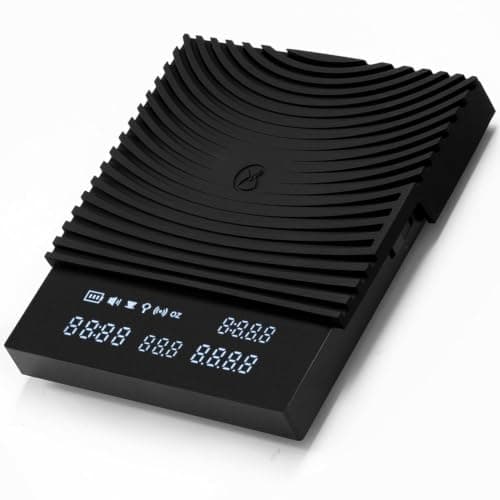
    Timemore Timemore Black Mirror Basic 3
    Timemore Black Mirror Basic 3

    The one to buy if you brew more than one way: 0.1g precision and a fast readout in a body slim enough for a drip tray and steady enough for a dripper.

    8.6Best if you brew both espresso and filter
  • 02
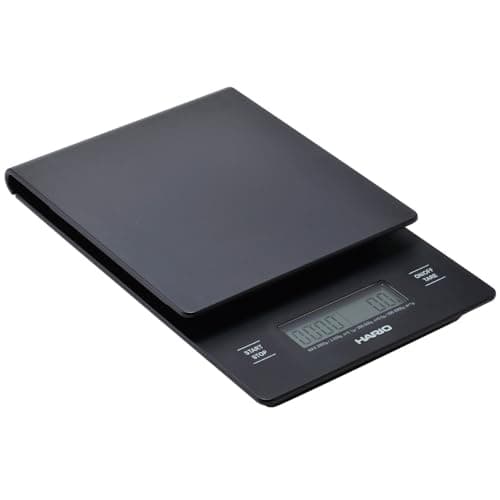
    Hario Hario V60 Drip Scale
    Hario V60 Drip Scale

    The filter-first choice: the same 0.1g resolution and timer on a platform big enough to hold a dripper sitting on a server without overhanging.

    8.2Best for pour over and French press
  • 03
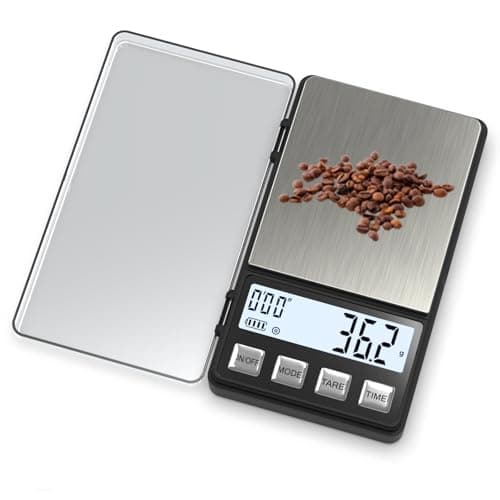
    Weightman Weightman Espresso Scale
    Weightman Espresso Scale

    The cheap one that ends the guessing: 0.1g and a timer for a fraction of the others, which is all the accuracy any ratio on this page actually requires.

    9.0Cheapest way to stop scooping

#ad · Live prices from the Amazon Product API, as of October 18, 2026. Where we have no verified live price, we show none — a gap beats a number that has rotted.

In detail

The picks, in full

01
Timemore Timemore Black Mirror Basic 3

Best if you brew both espresso and filter

Timemore Black Mirror Basic 3

0.1g precisionBuilt-in timerSlim, low-profile bodyUSB-C rechargeable
8.6/10

The one to buy if you brew more than one way: 0.1g precision and a fast readout in a body slim enough for a drip tray and steady enough for a dripper.

Accuracy (0.1g)
9
Response speed
9
Timer & features
8.5
Build
8.5
Value
8

Pros

  • 0.1g resolution with a readout that keeps pace as the shot pours
  • Built-in timer lets you track grams and seconds together to dial in
  • Slim enough to sit under a portafilter, yet fine for pour-over too

Cons

  • Costs more than a basic budget scale with similar headline specs
  • Platform is compact, so very large brewers can overhang it

Don't buy this if…

…you only ever brew drip in an automatic machine and never weigh anything — a precision timer scale is overkill if you don't measure your coffee.

Who it is for:the household that owns a press and an espresso machine, or a V60 and an AeroPress, and does not want two scales. Response speed is the spec that matters for the espresso half of that: at 1:2 in 25 seconds you are reading a number that is changing fast, and a slow scale shows you where the shot was rather than where it is. The compact platform is the trade — its own cons note that very large brewers can overhang it, which is a real consideration if you brew into a big Chemex. The full category ranking is best coffee scales.

$59.00View on Amazon

Price as of October 18, 2026. Prices change — Amazon's at checkout is the one that counts.

#ad · we may earn a commission from this link to Timemore Black Mirror Basic 3

02
Hario Hario V60 Drip Scale

Best for pour over and French press

Hario V60 Drip Scale

0.1g resolutionBuilt-in timerLarger platformFrom the V60 brand
8.2/10

The filter-first choice: the same 0.1g resolution and timer on a platform big enough to hold a dripper sitting on a server without overhanging.

Accuracy (0.1g)
9
Response speed
8
Timer & features
8
Build
8
Value
8

Pros

  • 0.1g accuracy with a timer, ideal for tracking a pour-over recipe
  • Larger platform comfortably holds a dripper on top of a server or mug
  • From Hario, the brand behind the V60 itself, so it is built for the job

Cons

  • Larger footprint is harder to fit under a low espresso portafilter
  • Response speed is good but a touch behind the fastest espresso scales

Don't buy this if…

…you need a scale that tucks under a low portafilter — the larger platform suits pour-over better than a tight espresso drip tray.

Who it is for:the reader who brews filter coffee and no espresso. Both of its listed cons are espresso complaints — it does not tuck under a low portafilter, and its response is a touch behind the fastest espresso scales — and neither costs you anything when the thing on the scale is a dripper and a server you are pouring into over three minutes. What you gain is platform area, which is the practical difference between weighing a brew and balancing one. It is also the easiest way to use the scaling arithmetic above in real time: tare with the dripper on top, pour to your target water weight, watch the timer.

$46.11View on Amazon

$60.0023% off

Price as of October 18, 2026. Prices change — Amazon's at checkout is the one that counts.

#ad · we may earn a commission from this link to Hario V60 Drip Scale

03
Weightman Weightman Espresso Scale

Cheapest way to stop scooping

Weightman Espresso Scale

0.1g resolutionBuilt-in shot timerSlim enough for a drip trayCosts a fraction of any other stage
9.0/10

The cheap one that ends the guessing: 0.1g and a timer for a fraction of the others, which is all the accuracy any ratio on this page actually requires.

Impact on the cup
8.5
How soon you need it
9
Ease of use
9
Value
9.5

Pros

  • 0.1g resolution is what makes a dose repeatable — eyeballing a basket is why the same beans give a different shot every morning
  • The timer turns the standard espresso target into something you can actually check: roughly double the dose in liquid, in about 25 to 30 seconds
  • Slim enough to sit under the cup on most drip trays, which is the difference between using it and not
  • By far the cheapest stage here, and the one people put off longest

Cons

  • Small platform, so a large mug can cover the display
  • Not water resistant — espresso drips will eventually get into a cheap scale
  • Response is slower than a competition scale, so you are reading a trailing number during a fast shot

Don't buy this if…

…you already weigh your dose in and your shot out on any 0.1g scale. This solves one problem and you have already solved it — move to stage three.

Who it is for:anyone who read this page, agreed, and does not want to spend real money to act on it. This is the honest point of the whole section: the arithmetic above needs 1g accuracy to work and this gives you 0.1g, so a cheap scale delivers essentially all of the benefit. The two scales above it buy response speed and platform size, which are conveniences rather than accuracy. Its own cons are worth heeding, though: it is not water resistant, and a scale living in an espresso drip tray eventually dies of it — keep it dry or expect to replace it. Note its scores are drawn from our setup-sequencing page, so they measure impact and urgency rather than accuracy and build, and we have not restated them against a different rubric. The sequencing argument is home espresso setup.

$13.99View on Amazon

Price as of October 18, 2026. Prices change — Amazon's at checkout is the one that counts.

#ad · we may earn a commission from this link to Weightman Espresso Scale

Quick reference

Drip / coffee maker:1:15–1:17 · ~60g per litre · ~10g per 5oz carafe cup
Pour over:1:16 · 22g to 350g water for a large mug
French press:1:12–1:15 · ~70g for a 1L press
AeroPress:1:12–1:16 · 15g to 220g water
Cold brew concentrate: 1:8, diluted about 1:1 when served
Cold brew, ready to drink: 1:15, no dilution
Moka pot: basket filled level, base filled below the valve
Espresso:1:2 brew ratio · 18g in, ~36g out, 25–30 seconds

Three things that change the right number for you

Roast level.Dark roasts are less dense and more soluble, so they extract faster and taste stronger at the same ratio. If you switch from a light to a dark roast and keep everything else the same, expect a heavier cup — dialling the dose back slightly is a reasonable response.

Water, more than people expect. Mineral content affects how much flavour the water can carry out of the coffee, and water that is too soft makes a flat cup at any ratio. If your coffee tastes dull everywhere, look at what water to use before you blame the recipe.

The vessel you drink from.A recipe written for a 250g cup, poured into a 400ml mug and topped up, is no longer that recipe. Scale the whole thing with the arithmetic above rather than brewing the same amount and adding water — though deliberately adding hot water to a strong brew is itself a legitimate drink, which is what an americano is.

Why the numbers differ between methods at all

Two mechanisms explain almost every difference on this page. Contact style: percolation methods (drip, pour over) pass fresh water through the bed continuously, which extracts efficiently, so they need less coffee. Immersion methods (French press, cold brew) sit the coffee in a fixed body of water that gradually saturates, which extracts less efficiently per gram, so they need more. Temperature: hot water extracts far faster than cold, which is why cold brew needs both a much heavier dose and a steep measured in hours. The methods overview is coffee brewing methods.
How we picked

We did not lab-test this gear

Everyone in this category says they tested twenty machines. We have not lab-tested any of these, and we say so. What we did instead: compiled the published manufacturer specifications, read the manuals, ran the math where there was math to run (heat-up time, pressure, dose capacity, grind range, cost per cup), and scored each pick against a published rubric. The scores are judgments from documented research — not measurements we took, because we do not have a lab and we will not pretend we do. Where a number came from someone else's work, we name them in Sources.

Questions

Frequently asked

What is the best coffee to water ratio?
For brewed coffee, 1:16 by weight — about 60g of coffee per litre of water, which sits inside the Specialty Coffee Association’s brewing range. Use 1:12 to 1:15 for French press, and note that espresso is a different measure entirely at about 1:2.
How much coffee for 1 litre of water?
About 60g at 1:16. For a French press, 70–80g, because immersion brewing extracts less efficiently and there is no paper filter holding back oils.
How many grams of coffee per cup?
It depends which “cup”. For a 5oz carafe cup on a drip machine, about 10g. For an 8oz US cup, about 15g. For a 12oz mug, about 21g. This unit confusion is the most common cause of a recipe coming out wrong.
Can I measure coffee with a tablespoon instead of a scale?
You can, and it will be inconsistent. The same volume of whole beans and of ground coffee hold different amounts, and dark roasts weigh less per spoon than light ones because they are less dense. A 0.1g scale costs very little and removes the variable permanently.
Should I use more coffee if it tastes weak?
Only if it tastes weak withouttasting sour. Watery-but-balanced is a strength problem, so add coffee. Sour and thin is under-extraction — grind finer or brew longer, because adding coffee just gives you a stronger sour cup.
Does the coffee to water ratio change for cold brew?
Substantially. Cold water extracts much less efficiently, so cold brew runs 1:8 as a concentrate that you dilute roughly 1:1 when serving, or about 1:15 if you want to brew it ready to drink.

Keep reading

Receipts

Sources

We do not run a testing lab, and we do not pretend to. Where a measured number came from someone else's work, we name them and link them. Where we could not verify something, we say so on the page rather than quietly leaving it out. Read our full method.