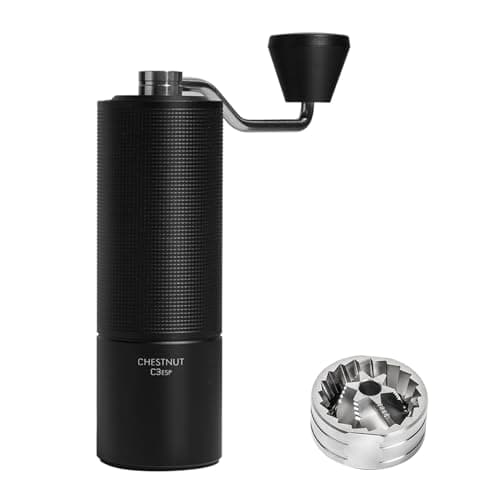
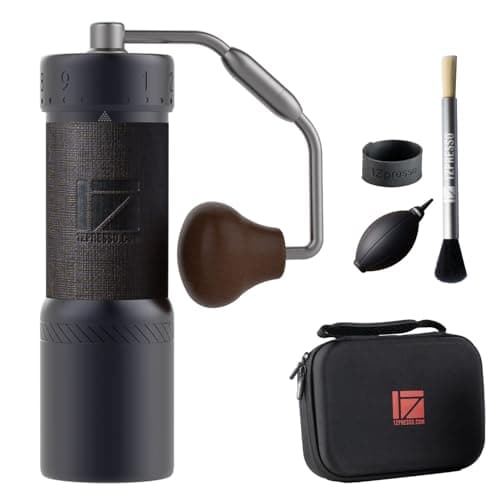
Manual grinding is the one category where the cheap option is genuinely excellent, which makes this a harder comparison than it looks. 1Zpresso and Timemore between them account for most of the hand grinders worth owning, and their flagship espresso-capable models — the J-Ultra and the Chestnut C3 ESP — sit at very different prices while claiming the same job.
The specs tell most of the story. The J-Ultra runs 48mm titanium-coated stainless conical burrs with external stepped adjustment at 100 clicks per rotation and roughly 8 microns per click, weighs about 700g, and holds 35–40g in its magnetic catch cup. The C3 ESP runs 38mm stainless S2C conical burrs with internal adjustment at 30 clicks per rotation and about 23 microns per click, weighs around 530g, and holds 25g. Bigger burrs, finer clicks, more capacity, external dial — against a grinder that costs a fraction as much and still reaches espresso.
Below is where each of those differences actually shows up in a morning, and the honest answer about who should buy which.
The spec that actually decides it: microns per click
| | 1Zpresso J-Ultra | Timemore Chestnut C3 ESP |
|---|
| Burrs | 48mm titanium-coated stainless conical | 38mm stainless S2C conical |
| Adjustment | External dial | Internal dial (remove cup) |
| Clicks per rotation | 100 | 30 |
| Resolution | ~8 microns per click | ~23 microns per click |
| Capacity | 35–40g | 25g |
| Weight | ~700g | ~530g |
Espresso is adjusted in very small steps: the difference between a 22-second gusher and a 32-second shot can be a few microns of grind. At roughly 8 microns per click the J-Ultra lets you creep up on a target; at roughly 23 the C3 ESP moves in strides. For medium and dark roasts, which have a wide forgiving window, the C3’s strides usually land somewhere good. For light roasts, which want to be ground fine and have a narrow window, they sometimes straddle it. That is the entire premium, stated plainly.
External versus internal adjustment
The J-Ultra’s dial is on the outside: you turn a numbered ring, count clicks, grind. The C3 ESP’s dial sits under the burr assembly, so changing grind means removing the catch cup and turning an internal nut. If your setting never changes, this is a non-issue. If you alternate espresso and French press, it is a small daily friction that adds up — and it is the reason people who brew two ways often end up with the more expensive grinder.
Effort, honestly
Both are hand grinders and both are work. Larger burrs cut more coffee per rotation, so the J-Ultra clears an 18g espresso dose in fewer turns and with less resistance. The C3 ESP is lighter to hold, which helps on long coarse grinds, and harder to turn at espresso settings, which is where the effort actually lives. If arthritis or wrist strain is a real consideration, an electric grinder is the honest recommendation over either — see manual vs electric.
Which brand, more broadly
Both brands make wider ranges than these two models. 1Zpresso’s line runs from travel grinders to large-burr flagships, generally with external adjustment and finer resolution as you move up. Timemore’s Chestnut family spans budget filter grinders to the ESP models, with the value proposition consistent throughout: the same burr philosophy at a lower price with fewer conveniences. Neither brand makes a bad grinder in this class, which is why this comparison is about workflow rather than quality. The full field is in best manual coffee grinders.
The verdict, without hedging
Buy the Timemore C3 ESP if you are getting into espresso, if you brew mostly filter, or if the price difference would come out of your machine budget — it is the better value by a wide margin and it is not a compromise on grind quality, only on convenience and resolution. Buy the 1Zpresso J-Ultra if espresso is your main drink, if you buy light roasts, or if you switch between espresso and filter regularly. The external dial and the 8-micron clicks are worth real money to that person and almost nothing to anyone else.
How we picked
We did not lab-test this gear
Everyone in this category says they tested twenty machines. We have not lab-tested any of these, and we say so. What we did instead: compiled the published manufacturer specifications, read the manuals, ran the math where there was math to run (heat-up time, pressure, dose capacity, grind range, cost per cup), and scored each pick against a published rubric. The scores are judgments from documented research — not measurements we took, because we do not have a lab and we will not pretend we do. Where a number came from someone else's work, we name them in Sources.