Skip to content
Tamp & Pour

Roundups & reviews · Grinders

1Zpresso J-Ultra review

A hand grinder that dials espresso as precisely as electrics several times its price. What the external dial actually solves, and where a manual grinder still stops.

By Stephen V.Updated How we review
#ad

We earn a commission when you buy through our Amazon links, at no extra cost to you. It never changes a verdict, and we say so when the cheaper product is the better buy. How this works.

The J-Ultra is the grinder that ended a long-standing argument. Hand grinders have always out-ground electrics per dollar, because none of the money goes to a motor — but they were awkward to dial for espresso, because adjustment usually meant an internal nut you counted by feel. The J-Ultra puts a numbered dial on the outside, and that one change turns a cheap-per-quality grinder into one you can actually run espresso on.

It is not the answer for everyone. It is a hand grinder, and it asks for about a minute of your arm for every double shot. This review is about whether that trade is worth it for you.

01
1Zpresso 1Zpresso J-Ultra

Manual espresso, dialed precisely

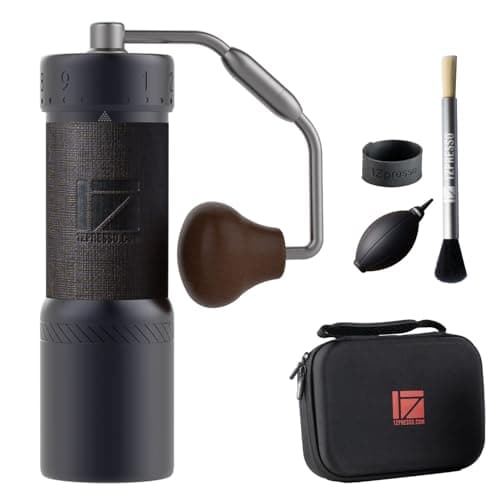
1Zpresso J-Ultra

48mm heptagonal stainless burrsExternal numbered adjustment dialEspresso through filter rangeMagnetic catch cupNear-zero retention
9.1/10

The best manual grinder for someone who pulls espresso: external numbered micro-adjustment, fast heptagonal burrs and near-zero retention, at a fraction of an equivalent electric.

Grind consistency
9
Adjustment range
9.5
Retention
9.5
Build
9
Value
8.5

Pros

  • External dial makes settings readable and exactly repeatable — the historic weakness of hand grinders, solved
  • Fine enough adjustment increments to genuinely dial espresso, not just approach it
  • Heptagonal burr geometry pulls beans in aggressively, so it grinds faster than most hand grinders
  • Retains almost nothing, so switching beans costs you no purge
  • Silent, portable and has nothing electronic to fail

Cons

  • Costs as much as a decent entry-level electric grinder
  • Still a hand grinder — roughly a minute of cranking per double espresso dose
  • Large filter doses are genuine work
  • The catch cup is small; a big pour-over dose means grinding in stages

Don't buy this if…

you make several drinks back to back, or you brew a full carafe daily. The J-Ultra rewards a considered one-or-two-cup routine and punishes volume — an electric will make you happier there.

The external dial is the whole product.On most hand grinders you adjust by turning a nut beneath the burrs and counting clicks you cannot see, which means a setting you find is a setting you can lose. The J-Ultra puts a numbered ring on the outside of the body with clearly marked increments, so “espresso is at 1.8” becomes a fact you write down rather than a feel you re-derive. For espresso, where the difference between a 20-second gusher and a 40-second choke can be a fraction of a turn, that is the difference between a usable grinder and a frustrating one.

The burrs are fast for a manual.The heptagonal cutting geometry grabs beans and pulls them through rather than letting them skate on top, which is why a double espresso dose takes roughly 40 to 60 seconds instead of the two minutes a budget hand grinder needs. Grind uniformity across the espresso range is genuinely comparable to electrics costing considerably more — which is the point of the whole category.

Retention is effectively zero. There is no chute, no hopper and no horizontal surface for grounds to settle on: a tap on the body clears what little clings on. If you rotate beans, or you are dialing in and need to know that what you just ground is only what you just added, this matters more than any spec on the box. It is also why a hand grinder appears in our single dose grinder ranking alongside machines costing twice as much.

The honest limits.It is manual, and that cost compounds with volume: one double espresso is pleasant, four in a row is a workout, and a 60g French press dose is genuinely tedious. The catch cup holds a normal espresso dose comfortably but not a large filter dose in one go. And the price sits right where entry-level electrics start, so the decision is not “cheap grinder versus expensive grinder” but “better burrs and no motor versus worse burrs and a button.” We work through that trade in full in manual vs electric grinders.

$199.00View on Amazon

Price as of Sep 2, 2026. Prices change — Amazon's at checkout is the one that counts.

#ad · we may earn a commission from this link to 1Zpresso J-Ultra

J-Ultra or K-Ultra?

1Zpresso’s two most-recommended grinders are aimed at different drinks. The J-Ultrauses a burr set and adjustment increments tuned for espresso — finer steps, a narrower useful range. The K-Ultra uses coarser increments across a wider range, which suits pour-over, French press and cold brew far better, and it holds a bigger dose. If espresso is your main drink, buy the J-Ultra. If you brew filter and only occasionally pull a shot, the K-Ultra is the better fit and appears in our manual grinder ranking.

What to pair it with

A hand grinder this precise deserves a machine that can use it: a non-pressurized-basket espresso machine is the point, because on a pressurized basket the basket does the resistance work and this grinder’s precision is wasted. Add a 0.1g scale to weigh dose in and shot out, and a WDT tool, since a fine espresso grind from any grinder arrives clumped.

Living with it

Grinding technique matters more than people expect: hold the body rather than the catch cup, crank at a steady moderate speed rather than sprinting, and let the burrs pull the beans rather than forcing them. Write your settings down — the whole benefit of the external dial is that you can return to a number, so keep a note per bag of beans. Clean the burrs with a brush every few weeks; oils from dark roasts build up and dull the cut long before the stainless wears.

Who should buy something else

Buy an electric if you make coffee for more than one or two people, if grip strength is a consideration, or if you know you will resent a minute of cranking on a weekday. Buy a cheaper hand grinderif you brew only filter, where the J-Ultra’s espresso-grade increments are precision you will never use. And buy an electric espresso grinderif you pull several shots in a session — that is the one routine where a hand grinder genuinely fails.

How we picked

We did not lab-test this gear

Everyone in this category says they tested twenty machines. We have not lab-tested any of these, and we say so. What we did instead: compiled the published manufacturer specifications, read the manuals, ran the math where there was math to run (heat-up time, pressure, dose capacity, grind range, cost per cup), and scored each pick against a published rubric. The scores are judgments from documented research — not measurements we took, because we do not have a lab and we will not pretend we do. Where a number came from someone else's work, we name them in Sources.

Questions

Frequently asked

Is the 1Zpresso J-Ultra worth it?
If you pull espresso and make one or two drinks at a time, yes — it grinds as precisely as electrics costing considerably more, retains almost nothing, and its external dial makes settings genuinely repeatable. If you make coffee in volume, an electric is the better buy.
How long does the J-Ultra take to grind a double shot?
Roughly 40 to 60 seconds for an 18g dose, depending on bean density and how fine you are grinding. Its heptagonal burrs pull beans through faster than most hand grinders.
J-Ultra vs K-Ultra — which should I buy?
J-Ultra if espresso is your main drink: its adjustment increments are finer and tuned for the espresso range. K-Ultra if you mostly brew pour-over, French press or cold brew, where its wider range and larger capacity fit better.
Can the J-Ultra grind for French press?
Yes, it reaches coarse settings comfortably — but a full press dose is 50 to 60 grams, which is several minutes of cranking. It is capable, just not enjoyable at that volume.
Does the J-Ultra retain coffee between doses?
Almost none. There is no hopper or chute for grounds to settle in, so a tap on the body clears what little clings on. That makes it excellent for switching beans and for dialing in.

Keep reading

Receipts

Sources

We do not run a testing lab, and we do not pretend to. Where a measured number came from someone else's work, we name them and link them. Where we could not verify something, we say so on the page rather than quietly leaving it out. Read our full method.