Skip to content
Tamp & Pour

Roundups & reviews · Espresso Machines

The best manual espresso makers, ranked

No pump, no boiler, no plug. You supply the hot water and the pressure — and get control an entry-level machine cannot offer. Ranked on shot quality, pressure control and portability.

By Stephen V.Updated How we review
#ad

We earn a commission when you buy through our Amazon links, at no extra cost to you. It never changes a verdict, and we say so when the cheaper product is the better buy. How this works.

A manual espresso maker has no pump and no boiler. You pour in water you already boiled, and you generate the pressure yourself with a lever or a piston. In exchange you get the one thing almost no entry-level pump machine offers: direct, felt control over the pressure curve of the shot, watched live on a gauge. That is the entire trade, and whether it is a good one comes down to how you feel about spending ninety focused seconds on a single cup.

Three kinds of buyer end up here, and they want different things. The first wants shot quality per dollar: a lever maker puts a stainless brew path and true 6–9 bar extraction in your kitchen for the price of a machine that would otherwise ship with a pressurized basket and a plastic brew head. The second wants espresso somewhere there is no outlet — a hotel room, a campsite, an office — and a hand pump is the only honest answer, because a moka pot works at roughly 1.5 bars and does not make espresso. The third simply likes the process, and a manual maker rewards attention in a way a one-button machine deliberately does not.

Now the limits, stated plainly before you spend anything. None of these steam milk. Every one of them needs a kettle. And all of them are moresensitive to grind than a pump machine, not less — when you are the pump, a coarse grind gushes and a fine one stalls under your own hand, with no motor to bully the water through. Budget for a real espresso grinder before you budget for the maker. If that sounds like work rather than fun, a beginner pump machine will make you happier, and we would rather say so here than sell you a lever.

The short answer

Quick picks

  • 01
    Flair Flair 49 Pro (manual lever)
    Flair 49 Pro (manual lever)

    The manual maker to buy if this is your kitchen espresso setup rather than your travel one: an all-stainless brew path, a 49mm portafilter with a 12-20g dose range, and a pressure gauge that turns 6-9 bar from a number into something you can feel.

    7.6Best manual lever overall
  • 02
    Wacaco Picopresso

    The portable that stopped being a compromise: a 52mm naked portafilter and an 18g double-shot basket in a 350g body, so what comes out is genuinely espresso rather than a strong approximation of it.

    8.0Best portable that makes real espresso
  • 03
    Flair Flair 2GO (collapsible lever)
    Flair 2GO (collapsible lever)

    A real lever that folds into a case: 6-9 bar with a gauge, a 40mm bottomless portafilter and a no-preheat cylinder, so you get lever control without the counter footprint or the preheating ritual.

    7.9Best packable lever
  • 04
    Wacaco Wacaco Nanopresso
    Wacaco Nanopresso

    The cheapest honest way to get pressurized espresso away from an outlet: 18 bar from a hand pump, 336g, a built-in cup, and a price that makes it a reasonable thing to leave in a bag permanently.

    7.9Best budget hand pump

#ad · Live prices from the Amazon Product API, as of Sep 2, 2026. Where we have no verified live price, we show none — a gap beats a number that has rotted.

In detail

The picks, in full

01
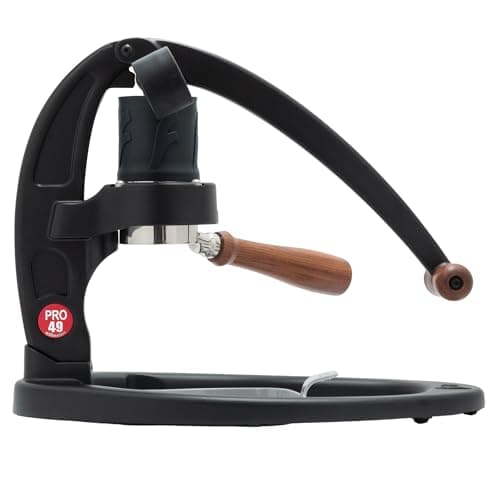
Flair Flair 49 Pro (manual lever)

Best manual lever overall

Flair 49 Pro (manual lever)

49mm portafilter, 12-20g dose90ml brew cylinder6-9 bar, integrated gaugeAll-stainless brew path
7.6/10

The manual maker to buy if this is your kitchen espresso setup rather than your travel one: an all-stainless brew path, a 49mm portafilter with a 12-20g dose range, and a pressure gauge that turns 6-9 bar from a number into something you can feel.

Shot quality
9
Pressure control
9.5
Portability
5.5
Ease of use
6
Value
8

Pros

  • All-stainless brewing system means no plastic touches the water or coffee during extraction
  • Integrated pressure gauge shows the shot as it happens, which is the fastest way anyone learns what 9 bar actually feels like
  • Fixed cylinder-and-piston design lets you pull back-to-back shots without stripping the brew head down between them
  • A 12-20g dose range covers everything from a single to a modern 18g double

Cons

  • You supply boiling water from a kettle every single time — there is no boiler
  • No steam wand at all, so milk drinks need a separate steamer or frother
  • At around 7 lb it is a counter appliance, not a genuinely packable one

Don't buy this if…

you make milk drinks daily or want a one-button morning — there is no steam wand and no boiler, so every shot starts with the kettle and ends with your arm.

This is the one that competes on shot quality rather than novelty. The brew path is stainless end to end, the cylinder holds 90ml, and the gauge on the lever arm is doing real teaching work: you press, you watch the needle settle into the 6–9 bar band, and within a week you stop needing the gauge because your hand knows the pressure. That feedback loop is the argument for a manual maker over a cheap pump machine, where the pump runs at whatever pressure it runs at and a pressurized basket hides your mistakes. The fixed cylinder and piston also matter more than the spec sheet suggests — earlier Flair designs wanted a teardown between shots, and this one does not, which is the difference between making two coffees and making one. Pair it with a good hand grinder and you have a complete espresso setup that never needs an outlet.

$359.00View on Amazon

Price as of Sep 2, 2026. Prices change — Amazon's at checkout is the one that counts.

#ad · we may earn a commission from this link to Flair 49 Pro (manual lever)

02

Best portable that makes real espresso

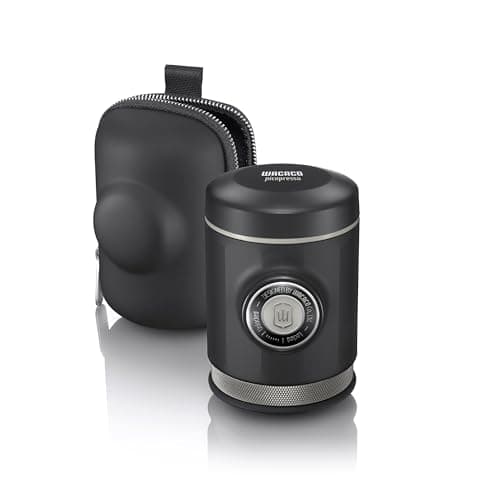
Wacaco Picopresso

52mm naked portafilter, 18g dose80ml water capacityUp to 18 bar hand pump350g; case, tamper and distribution tool included
8.0/10

The portable that stopped being a compromise: a 52mm naked portafilter and an 18g double-shot basket in a 350g body, so what comes out is genuinely espresso rather than a strong approximation of it.

Shot quality
8.5
Pressure control
7.5
Portability
9.5
Ease of use
6
Value
8.5

Pros

  • A 52mm basket taking an 18g dose is close to café geometry, which is why this pulls a proper double rather than a novelty single
  • Naked/bottomless portafilter shows channeling immediately, so it doubles as a diagnostic tool
  • Ships with the tamper, distribution tool, funnel, brush and protective case — nothing else to buy
  • 350g and pocket-sized dimensions make it genuinely luggage-friendly

Cons

  • Demands an ultra-fine, very even grind — this is the least forgiving pick here
  • 80ml capacity means one double at a time and a refill for the second
  • Hand-pumping to full pressure with an 18g dose is real physical effort

Don't buy this if…

you do not already own a grinder that goes properly fine and even — Wacaco specifies an ultra-fine grind, and a mediocre grinder will make this the most frustrating $130 in your kitchen.

The reason this one earns a place above the cheaper Wacaco models is the basket. Most portable espresso makers use a small basket and a tiny dose, which caps how much coffee you can extract and puts a ceiling on the cup no amount of pressure lifts. The Picopresso uses a 52mm naked portafilter with an 18g double basket — close enough to a real machine that the same puck-prep habits transfer, and the bottomless design means you can watch the extraction and see channeling the instant it starts. That is a diagnostic feature you normally pay extra for on a bottomless portafilter. The catch is stated by Wacaco itself: it wants an ultra-fine grind, and it does not heat water, so a kettle is part of the kit whether you are at home or in a hotel.

Check price on Amazon →

We don't have a verified live price for this right now, so we aren't showing one.

#ad · we may earn a commission from this link to Wacaco Picopresso

03
Flair Flair 2GO (collapsible lever)

Best packable lever

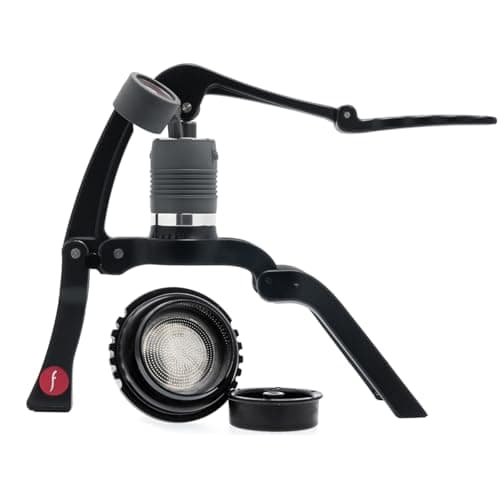
Flair 2GO (collapsible lever)

40mm bottomless portafilter, 12-18g60ml water, ~45ml yield6-9 bar with pressure gaugeCollapsible frame; 9.5 x 5.25 x 4in packed
7.9/10

A real lever that folds into a case: 6-9 bar with a gauge, a 40mm bottomless portafilter and a no-preheat cylinder, so you get lever control without the counter footprint or the preheating ritual.

Shot quality
8.5
Pressure control
9
Portability
8
Ease of use
7
Value
7

Pros

  • Keeps the lever mechanics and the pressure gauge in a frame that folds down to roughly 3.5 x 7 x 3.25in
  • Thin-walled no-preheat cylinder skips the warm-up step that other lever makers require
  • Bottomless 2-in-1 portafilter takes a 12-18g dose — a genuine double, not a token one
  • Stainless brewing components and a silicone sleeve, so nothing critical is plastic

Cons

  • 60ml water and a ~45ml yield is one shot per fill, full stop
  • Costs meaningfully more than a hand pump that also travels
  • Still needs a kettle, a grinder and a flat surface to press against

Don't buy this if…

you want the absolute smallest travel kit — a hand pump packs smaller and lighter, and the lever advantage matters most when you are actually chasing a pressure profile.

The interesting engineering here is the no-preheat cylinder. A traditional lever maker has a thick brew cylinder that steals heat from your 90ml of water, which is why the ritual usually starts with flushing hot water through the thing and waiting. Thin the wall and that problem largely goes away — you lose some thermal stability across a long shot, and you gain the ability to brew as soon as the kettle clicks. Combined with a frame that collapses, it makes the 2GO the pick for someone who wants lever control in a small kitchen or a suitcase rather than a permanent counter station. Just be clear-eyed about capacity: 60ml in, about 45ml out, one drink at a time.

$169.00View on Amazon

$199.0015% off

Price as of Sep 2, 2026. Prices change — Amazon's at checkout is the one that counts.

#ad · we may earn a commission from this link to Flair 2GO (collapsible lever)

04
Wacaco Wacaco Nanopresso

Best budget hand pump

Wacaco Nanopresso

8g basket (16g with add-on)80ml water capacityUp to 18 bar hand pump336g; built-in espresso cup
7.9/10

The cheapest honest way to get pressurized espresso away from an outlet: 18 bar from a hand pump, 336g, a built-in cup, and a price that makes it a reasonable thing to leave in a bag permanently.

Shot quality
7
Pressure control
6.5
Portability
9.5
Ease of use
7.5
Value
9

Pros

  • Under half the price of the Picopresso while still generating real extraction pressure
  • Built-in cup and cloth pouch mean the whole kit is one object you can forget about in a bag
  • At 336g and 62 x 71 x 156mm it disappears into hand luggage
  • Easier to pump than the larger-basket models, so it is the least tiring pick here

Cons

  • The 8g standard basket caps the drink at a single — a real double needs the 16g add-on
  • Mostly engineering plastics rather than the stainless of the lever makers
  • Small dose plus small basket means less margin for a mediocre grind than the spec implies

Don't buy this if…

you drink doubles and this is your only espresso maker — an 8g basket makes singles unless you buy the add-on, and at that point the Picopresso is the better-value machine.

$64.90View on Amazon

Price as of Sep 2, 2026. Prices change — Amazon's at checkout is the one that counts.

#ad · we may earn a commission from this link to Wacaco Nanopresso

How to choose a manual espresso maker

The category splits cleanly in two, and picking the wrong side is the most common way people waste money here. Everything else is detail.

1. Lever or hand pump?

A lever makeruses a long arm and a piston to push water through the puck. The mechanical advantage of the lever means you can hold a chosen pressure steadily and change it deliberately mid-shot — a soft pre-infusion, a ramp up to nine bar, a decline at the end. That is pressure profiling, it is the thing $2,000 machines advertise, and on a lever you get it for the price of paying attention. The cost is size and weight: a lever needs a frame stiff enough to react against.

A hand pumpuses a small piston you stroke repeatedly. You cannot profile with any precision — you are making pressure in pulses rather than holding a curve — but the whole device fits in a jacket pocket and costs a third as much. If the point is espresso in places that do not have espresso, the pump wins. If the point is a better shot than your budget pump machine makes, the lever wins.

 Lever makerHand pump
Pressure controlHeld and shaped, usually with a gaugePulsed, by feel
Typical dose12–20g (real double)8–18g depending on model
Weight~3.7–7 lb~336–350g
Best atShot quality per dollar at homeEspresso where there is no outlet
Needs a kettleYesYes

2. The grinder decides more than the maker does

This is truer for manual espresso than for any pump machine, and it is the point we would most like you to take away. A pump motor will force water through a slightly-wrong grind and give you a mediocre shot. Your arm will not: too coarse and the water runs straight through in eight seconds, too fine and the lever simply will not move. There is no hiding place. If your budget has to cover both, buy the grinder first — our espresso grinder roundup covers the electric options, and the manual grinder roundup covers the hand grinders that pair naturally with a no-electricity brewer.

3. Water is a separate job, and so is milk

Not one maker in this roundup heats water. That is not a flaw, it is the design — removing the boiler is what removes the cost, the failure points and the plug. But it does mean a kettle is part of the kit, and a variable-temperature kettle earns its place faster here than anywhere else, because you are the thermostat. Milk is the same story: no steam wands here, so a cappuccino habit means a separate frother, and if that is most of your drinking you should be looking at machines with a milk frother instead of a lever.

4. Be honest about the ninety seconds

Every manual maker asks for the same things: boil water, grind fine, dose, distribute, tamp, seat the basket, press, clean. It is roughly a two-minute ritual and it does not shorten much with practice, because the steps are the product. Some people find that the best part of their morning. Others discover after three weeks that they want coffee, not a hobby, and the lever goes in a cupboard. There is no shame in the second answer — but decide which one you are before you spend, because it predicts your satisfaction better than any spec here.

How we picked

We did not lab-test this gear

Everyone in this category says they tested twenty machines. We have not lab-tested any of these, and we say so. What we did instead: compiled the published manufacturer specifications, read the manuals, ran the math where there was math to run (heat-up time, pressure, dose capacity, grind range, cost per cup), and scored each pick against a published rubric. The scores are judgments from documented research — not measurements we took, because we do not have a lab and we will not pretend we do. Where a number came from someone else's work, we name them in Sources.
Questions

Frequently asked

Does a manual espresso maker make real espresso?
Yes. Espresso is defined by the brewing conditions — a fine, compacted puck extracted under roughly nine bars of pressure in about 25 to 30 seconds — not by whether a motor supplies the pressure. Lever makers brew in the 6–9 bar band with a gauge to prove it, and the hand pumps here are rated to 18 bar. This is genuinely different from a moka pot, which works at roughly 1.5 bars and makes strong stovetop coffee rather than espresso.
Do I have to boil water separately?
Yes, for every maker in this roundup. None of them has a boiler — that is exactly what makes them cheap, small and unbreakable. You boil water in a kettle and pour it in. A kettle with a temperature setting is a genuine upgrade here, because with no machine managing brew temperature, the number on the kettle is the number in the puck.
Can I use pre-ground supermarket espresso coffee?
You can, and it will be the weakest part of the setup. Pre-ground coffee is ground to one fixed size that suits nobody in particular, and manual makers are unusually intolerant of a grind that is even slightly off, because your arm is the only thing pushing. If you buy one of these, buy a grinder you can adjust in small steps — it changes the result more than moving up a model would.
Can a manual espresso maker steam milk?
No. Not one of them has a steam wand. If you drink lattes or cappuccinos daily, either budget for a standalone steamer or frother alongside it, or buy a pump machine with a wand instead — our milk-frother machine roundup is the better starting point for a milk-drink household.
Is a lever maker better than a $300 pump machine?
For shot quality with a good grinder, often yes — you get a stainless brew path, a non-pressurized basket and real pressure control, where a machine at that price frequently gives you a pressurized basket that fakes crema. For convenience, absolutely not. The pump machine heats its own water, steams milk and needs no technique. Pick on which of those two things you actually care about.
How long does one shot take, start to finish?
Around two minutes once the kettle has boiled: grind, dose, distribute, tamp, seat, press for 25–30 seconds, then knock out and rinse. Cleaning is the fastest part — there is no group head, no solenoid and no drip tray, so a rinse usually does it.

Keep reading

Receipts

Sources

We do not run a testing lab, and we do not pretend to. Where a measured number came from someone else's work, we name them and link them. Where we could not verify something, we say so on the page rather than quietly leaving it out. Read our full method.