Skip to content
Tamp & Pour

Roundups · Accessories

The best espresso cups, ranked by the size that actually fits

A 2oz demitasse was designed for a 1oz shot. Modern doubles pour 36-45g. Ranked on volume, heat retention and feel, with the sizes that fit the drink you actually make.

By Stephen V.Updated How we review
#ad

We earn a commission when you buy through our Amazon links, at no extra cost to you. It never changes a verdict, and we say so when the cheaper product is the better buy. How this works.

Almost every espresso cup sold as a “demitasse” holds 2 ounces, and almost every double shot pulled at home in 2026 is bigger than that. A modern 18g dose at a 1:2 ratio yields roughly 36g of liquid, and plenty of people run longer — so the classic tiny cup fills to the brim, kills the crema against the rim, and gives you nowhere to add water or milk. That is the single most useful thing on this page: buy for the drink you actually pull, not for the picture of a cup you have in your head.

The second thing that matters is heat, and it matters more here than in any other vessel in your kitchen because the drink is so small. A 36g shot has almost no thermal mass. Pour it into a room-temperature ceramic cup and the cup wins — it pulls heat out of the coffee in seconds, and by the time you sit down the drink is lukewarm. This is why cafés keep cups on the machine top, and it is why the fix is free: run hot water into the cup while you grind, tip it out, then pull the shot. No cup you can buy beats that habit; the good ones just make it hold longer.

Everything after size and heat is preference, and we will say so honestly rather than pretend porcelain changes the extraction. A well-made cup does three real things — it holds the right volume, it keeps the drink hot, and it feels good in the hand at the rim — and once a cup does those three, the rest is what you want to look at every morning. If you are chasing a better-tasting shot, the money belongs in a grinder or a matched tamper, not in glassware.

The short answer

Quick picks

#ad · Live prices from the Amazon Product API, as of Sep 2, 2026. Where we have no verified live price, we show none — a gap beats a number that has rotted.

In detail

The picks, in full

01
notNeutral notNeutral LINO Espresso Cup & Saucer, 3oz (set of 2)

Best overall

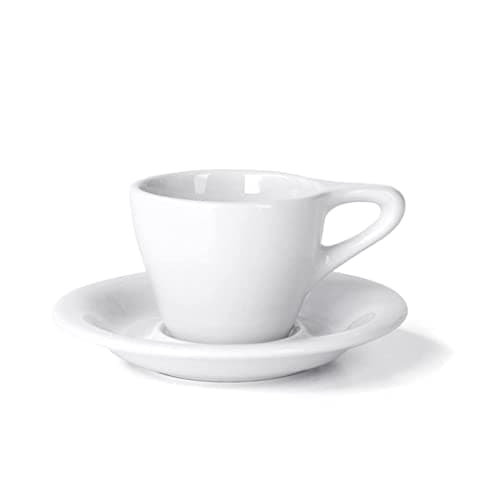
notNeutral LINO Espresso Cup & Saucer, 3oz (set of 2)

3oz (~89ml) — fits a modern doubleFine porcelain, with saucerHandle flush with the rimSet of 2
8.7/10

The cup that gets the details right on purpose: 3oz of fine porcelain, an interior curve shaped for the drink rather than the shelf, and a handle set flush with the rim so it stays controllable when it is full and hot.

Size & fit
9.5
Heat retention
8.5
Build
9.5
Feel
9.5
Value
6.5

Pros

  • 3oz is the practical home espresso size — a 36-45g double sits comfortably below the rim with the crema intact
  • Designed with working baristas, and the interior curvature reflects it: it pours and drinks cleanly rather than trapping coffee in a corner
  • Handle sits flush with the rim, which is a small ergonomic detail you notice every time you lift a small hot cup
  • Fine porcelain holds heat well once preheated, and the matching saucer is genuinely useful for the spoon and the drip

Cons

  • Costs roughly ten times a plain supermarket demitasse for a difference that is real but not enormous
  • Sold in twos, so a set of six is a serious outlay
  • Porcelain must be preheated to perform — cold, it is no better than anything else

Don't buy this if…

you mostly drink cappuccinos and lattes — 3oz is an espresso cup, and a milk drink needs 5-6oz or more. Buy the cappuccino size instead.

The LINO is the cup that most specialty cafés you like are probably using, and the reason is that it was designed for the job rather than styled for a shelf. Three details do the work. The 3oz volume is the correct modern espresso size — big enough that a long-ish double does not drown the crema, small enough that the drink still looks and drinks like espresso. The interior curve is shaped so the liquid pools rather than spreading thin, which is also what makes the larger LINO sizes good for latte art. And the handle finishes level with the rim, so your grip is at the top of the cup where the control is, not hanging off the bottom. None of this changes the taste of the coffee. All of it changes whether the cup annoys you.

$35.95View on Amazon

Price as of Sep 2, 2026. Prices change — Amazon's at checkout is the one that counts.

#ad · we may earn a commission from this link to notNeutral LINO Espresso Cup & Saucer, 3oz (set of 2)

02
Bodum Bodum Pavina Double Wall Glass, 2.5oz (set of 2)

Best double-wall glass

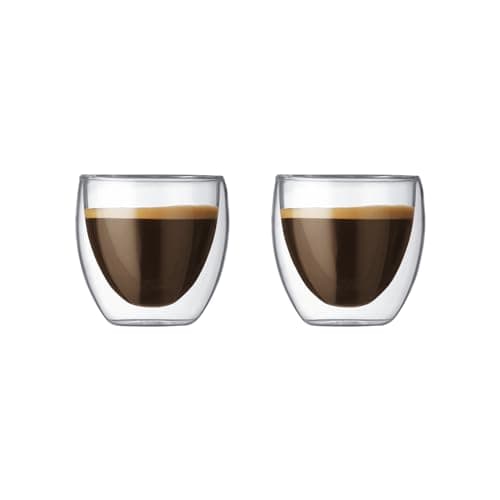
Bodum Pavina Double Wall Glass, 2.5oz (set of 2)

2.5oz (~74ml)Mouth-blown borosilicate, double wallSilicone vent equalizes pressureDishwasher and microwave safe
8.4/10

The one that solves the cold-cup problem structurally: two walls of mouth-blown borosilicate with a dead-air layer between them, so the shot stays hot without preheating and the glass stays cool to hold.

Size & fit
7.5
Heat retention
9.5
Build
8
Feel
8.5
Value
8.5

Pros

  • The insulating air gap keeps the drink hot far longer than single-wall glass, with no preheating step
  • Outer wall stays cool enough to hold comfortably — the practical argument for double wall on a handleless cup
  • You can see the shot, the crema and the layers, which is genuinely useful when you are learning to read an extraction
  • Dishwasher, microwave and freezer safe, and oven safe to 350F — far more robust than borosilicate looks

Cons

  • 2.5oz is tight for a long double — a 40g+ shot fills it nearly to the rim
  • Mouth-blown means small variations, and thin borosilicate is easier to chip than porcelain
  • No handle and no saucer, which some people simply prefer

Don't buy this if…

you pull long doubles or ristretto-plus-water drinks — at 2.5oz there is no headroom, and you would be better served by the 3oz porcelain or a 5oz double-wall mug.

Double-wall glass attacks the heat problem from the opposite direction to porcelain. Porcelain works by thermal mass: preheat it and it becomes a reservoir that holds the drink’s temperature. Double-wall glass has almost no mass at all — instead the sealed air gap between the two walls is a poor conductor, so heat cannot easily escape and your hand cannot easily feel it. That is why these need no preheating and why the outside stays touchable. The small silicone dot at the base is not a defect, it is a vent that equalizes pressure between the layers and stops condensation forming inside. The honest limitation is volume: 2.5oz was sized for a traditional shot, so check your yield on a scale before you assume it fits.

$20.99View on Amazon

Price as of Sep 2, 2026. Prices change — Amazon's at checkout is the one that counts.

#ad · we may earn a commission from this link to Bodum Pavina Double Wall Glass, 2.5oz (set of 2)

03
Sweese Sweese 3.5oz Porcelain Espresso Cups (set of 4)

Best value

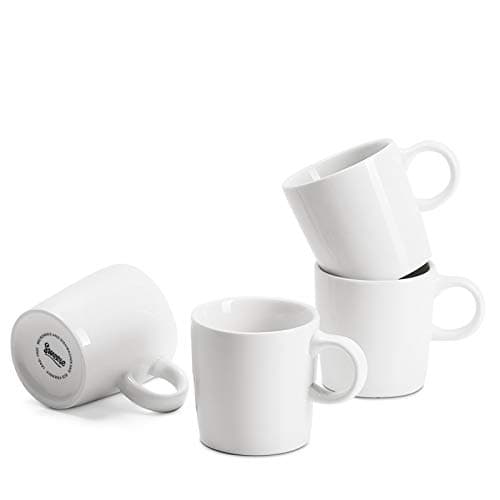
Sweese 3.5oz Porcelain Espresso Cups (set of 4)

3.5oz (~104ml)Porcelain, no saucerSet of 4Dishwasher and microwave safe
8.2/10

The value answer, and quietly the most practical size in the roundup: 3.5oz of plain porcelain in a set of four, with enough headroom for a long double or a short cortado.

Size & fit
9
Heat retention
8
Build
7.5
Feel
7
Value
9.5

Pros

  • 3.5oz is the most forgiving espresso size — a long double, a ristretto with water, or a small cortado all fit
  • A set of four costs less than a single premium cup, which matters when you are hosting rather than curating
  • Plain, thick porcelain preheats and holds heat exactly as well as expensive porcelain does
  • Microwave and dishwasher safe, so it survives an ordinary kitchen

Cons

  • No saucer, so there is nowhere for the spoon or the drips
  • Generic shape and handle — functional rather than pleasant
  • Thicker walls take slightly longer to preheat properly

Don't buy this if…

you want a true traditional demitasse look — at 3.5oz these read as small mugs rather than classic Italian espresso cups, and a single shot looks lost in one.

If the premium cup is about the last 10%, this is about the first 90%, and it makes the case well. Porcelain is porcelain — the material holds heat the same whether the base is stamped with a design house or not, and thick walls actually give this a slight thermal-mass advantage once warmed. The reason we rate the 3.5oz over the more common 2oz and 3oz sets is pure practicality: it is the size that never lets you down. A 36g double sits well below the rim. A 45g long shot still fits. Add 30g of milk and you have a cortado. Buy four of these, keep them warm, and you will not think about cups again.

$15.99View on Amazon

$25.9938% off

Price as of Sep 2, 2026. Prices change — Amazon's at checkout is the one that counts.

#ad · we may earn a commission from this link to Sweese 3.5oz Porcelain Espresso Cups (set of 4)

04
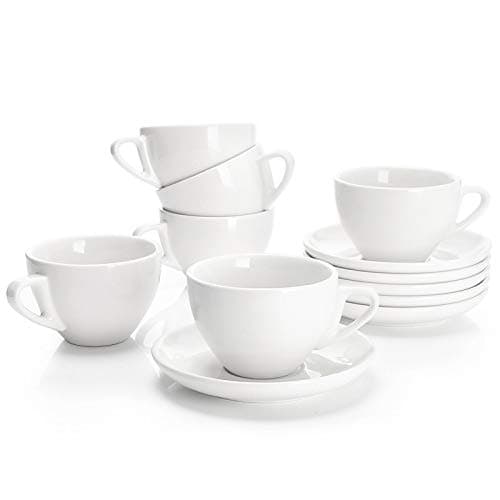
Sweese Sweese 6oz Cappuccino Cups & Saucers (set of 6)

Best for cappuccinos and flat whites

Sweese 6oz Cappuccino Cups & Saucers (set of 6)

6oz (~177ml)Porcelain, with saucersSet of 6Traditional cappuccino volume
8.2/10

The right cup for the drink most people actually make: 6oz porcelain with saucers, matching the traditional 5-6oz cappuccino volume that competition rules were built around.

Size & fit
9
Heat retention
8
Build
7.5
Feel
7.5
Value
9

Pros

  • 6oz matches the classic 5-6oz (150-180ml) cappuccino size, so the espresso-to-milk ratio lands where the drink is supposed to be
  • Wide mouth gives you a surface to pour latte art onto, which a narrow cup makes almost impossible
  • Six cups with saucers for a sensible price makes this the practical household set
  • Same easy-care porcelain: dishwasher and microwave safe

Cons

  • Too big for straight espresso — a double looks and drinks lost in 6oz
  • Plain design with no particular character
  • Storing six cups and six saucers takes real cupboard space

Don't buy this if…

you drink straight espresso — this is a milk-drink cup, and pouring a 36g double into 6oz of empty porcelain gives you a cold shot in a big cup.

$40.99View on Amazon

Price as of Sep 2, 2026. Prices change — Amazon's at checkout is the one that counts.

#ad · we may earn a commission from this link to Sweese 6oz Cappuccino Cups & Saucers (set of 6)

How to choose espresso cups

Three decisions, in order of how much they matter. Get the first one right and the others are preference.

1. Size: match the cup to your actual yield

Weigh a shot before you buy anything. If you pull an 18g dose at a 1:2 ratio, you are producing about 36g of liquid espresso; longer ratios run to 45g and beyond. A 2oz (60ml) demitasse holds that, barely, with the crema pressed against the rim and no room for anything else. That size is a survival from an era of shorter, smaller shots, and it is why so many people find their beautiful new cups useless. For straight espresso at home, 3 to 3.5oz is the size that works. The competition convention is a useful sanity check: World Barista Championship rules have long specified espresso served in a 2–3oz (60–90ml) cup with a handle, and a traditional cappuccino in a 5–6oz (150–180ml) cup.

DrinkCup sizeWhy
Single espresso2–3oz (60–90ml)~18–25g of liquid; a bigger cup makes it look and drink thin
Double espresso3–3.5oz (90–104ml)36–45g yield needs headroom so the crema is not crushed at the rim
Cortado / piccolo4–4.5oz (120–133ml)Double plus roughly equal milk
Cappuccino / flat white5–6oz (150–180ml)The traditional volume the drink’s ratio was built around
Latte8–12oz (240–355ml)More milk, gentler ratio, room for the pour

2. Material: thermal mass or insulation, and they work differently

Porcelain and ceramicwork by thermal mass. Cold, they are the enemy of a small drink — they will steal its heat immediately. Preheated, that same mass becomes a reservoir that holds temperature better than anything else here. Thicker walls hold longer and take longer to warm. The rule is simple: porcelain is the best cup you can own and the worst, and the only variable is whether you ran hot water into it first.

Double-wall borosilicate glass works by insulation instead. Two thin walls with a sealed air gap between them conduct heat poorly, so the drink stays hot without preheating and the outside stays cool enough to hold without a handle. That makes it the low-effort choice, and the one that lets you see the shot. The trade is fragility and, on most models, a smaller volume than you want.

Stainless and enamelwe would generally skip for espresso at home. Metal conducts heat straight out to the air and to your lip, and thin enamel does the same — both are camping solutions to a kitchen problem.

3. Shape, handle and rim

After size and material, three details are worth a look. A cup with an inward-curving interior pools a small drink rather than spreading it thin, which keeps the crema together and gives milk drinks a surface for latte art. A handle set high — ideally flush with the rim — gives you control at the top of the cup, where a small full vessel is most likely to tip. And a thinner rim generally drinks better than a thick one, though it chips more easily. None of these change the coffee. All of them change whether you reach for that cup or the other one.

What you can safely skip

Cup warmers, unless your machine has no cup tray and you make several drinks a session — the hot-water rinse does the same job for free. Matched sets in five sizes: buy the two sizes you actually drink. And any claim that a cup improves flavor beyond what temperature and volume explain. The things that genuinely change the taste in that cup are the grind, the dose and the water, which is why our sour-or-bitter troubleshooting guide never once mentions glassware.

How we picked

We did not lab-test this gear

Everyone in this category says they tested twenty machines. We have not lab-tested any of these, and we say so. What we did instead: compiled the published manufacturer specifications, read the manuals, ran the math where there was math to run (heat-up time, pressure, dose capacity, grind range, cost per cup), and scored each pick against a published rubric. The scores are judgments from documented research — not measurements we took, because we do not have a lab and we will not pretend we do. Where a number came from someone else's work, we name them in Sources.
Questions

Frequently asked

What size espresso cup do I need?
For a modern double shot, 3 to 3.5oz (90–104ml). Weigh your yield to be sure: an 18g dose at 1:2 produces about 36g of liquid, and a 2oz demitasse leaves that no headroom. For a cappuccino or flat white you want 5–6oz (150–180ml), which is the traditional volume the drink’s ratio assumes.
Should I preheat my espresso cup?
Yes, and it is the highest-impact thing on this page. A 36g shot has very little heat in it, and a room-temperature ceramic cup absorbs a noticeable amount of that within seconds. Run hot water into the cup while you grind, tip it out just before you pull, and the drink stays hot for the whole time you are drinking it. Double-wall glass is the exception — there is almost no mass to preheat.
Are double-wall glasses better than porcelain?
They are better at one thing: keeping a drink hot with no effort, while staying cool to hold. Porcelain beats them once preheated, holds more volume in the same footprint, and is harder to chip. If you reliably preheat, buy porcelain. If you know you will not, buy double wall.
Does the cup actually change how espresso tastes?
Only through temperature and, at the margins, through how the drink sits and reaches your mouth. A cold cup makes a measurably cooler, flatter-tasting shot, and a cup so small that the crema is crushed against the rim changes the texture. Beyond that, no — the grind, dose, water and extraction decide the flavor, and we would not tell you otherwise.
Can I use espresso cups for cortados and macchiatos?
A macchiato, yes — it is a double with a spoonful of foam, so a 3.5oz cup handles it. A cortado is a double plus roughly equal milk, which needs about 4–4.5oz. That is the main argument for the 3.5oz size over a strict 3oz: it stretches into the small milk drinks without needing a second set.
Are expensive espresso cups worth it?
They are worth it for build, shape and how they feel in the hand, not for the coffee. A $5 porcelain cup of the right size, preheated, delivers a shot at essentially the same temperature as a $20 one. If the budget is finite, put it into a grinderfirst — that changes the drink, and the cup does not.

Keep reading

Receipts

Sources

We do not run a testing lab, and we do not pretend to. Where a measured number came from someone else's work, we name them and link them. Where we could not verify something, we say so on the page rather than quietly leaving it out. Read our full method.