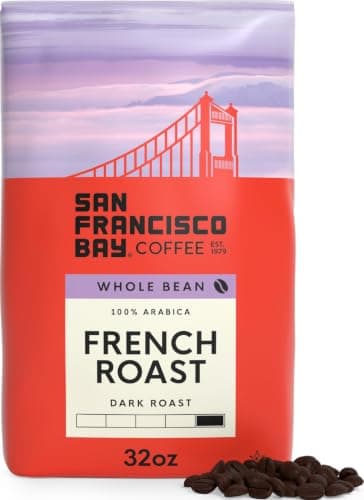
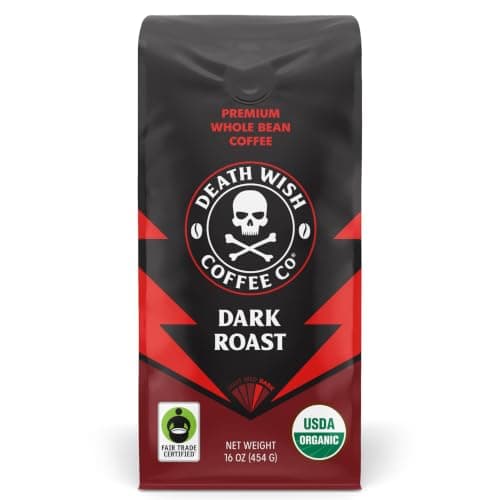
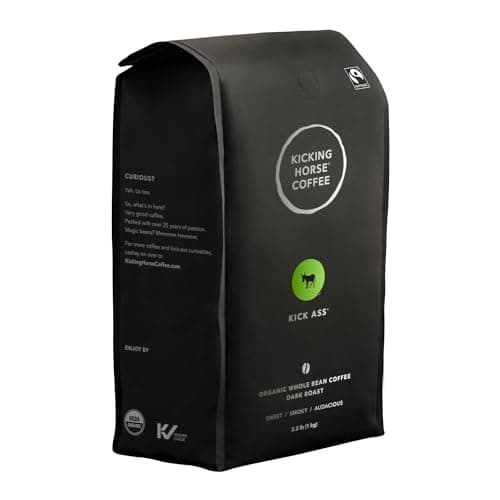
The verdict: Kicking Horse Kick Ass is the best dark roast coffee for someone who wants the full dark-roast experience with real sourcing credentials behind it: organic, Fairtrade, smoky and genuinely full-bodied without the thin, burnt edge most supermarket dark roasts carry. If you drink a pot a day and price per pound is the deciding factor, San Francisco Bay Coffee French Roast is the cheapest whole-bean dark roast here that is still worth grinding. The budget pick is Death Wish Coffee, the cheapest bag on this page — a real organic, Fair Trade dark roast underneath the novelty branding.
Dark roast gets talked about as though it were a quality tier, with light roast as the connoisseur's choice and dark roast as what people drink before they know better. That is not what roast level is. Roasting longer and hotter does three measurable things: it breaks down more of the bean's structure, it drives off more of the acids that read as brightness, and it develops caramelisation and eventually carbon. A good dark roast is one that has taken the first two as far as they go and stopped before the third takes over. A bad one is a cheap bean roasted until the defects are hidden.
So the ranking here is about depth without ash. First criterion: does the cup have body and sweetness, or just smoke? Second: is there evidence behind the sourcing — organic, Fairtrade, a published origin — or is "dark roast" doing all the work? Third: value, which for dark roast means price per pound against how fast the bag goes flat, since a dark roast's oils migrate to the surface and stale faster than a medium's.
Two honest notes before the picks. Dark roast does not mean more caffeine — if anything, by weight it is slightly less, because roasting burns off mass, and a scoop of dark beans is fewer grams of coffee than a scoop of light ones. And taste here is personal: we have not run a cupping panel and we are not going to present a score as a measurement. Every bag below already appears somewhere on this site; its tasting notes, pros and cons are carried over unchanged from that entry, and what is new is how it ranks as a dark roast specifically.
How to choose a dark roast
Dark roast is the widest band in coffee — it covers everything from a chocolatey medium-dark espresso blend to a carbonised Italian roast — so "dark" on a bag tells you much less than people assume. Four things narrow it down.
Depth versus ash is the whole question
Roasting develops sugars through caramelisation, and if it keeps going those sugars carbonise. A good dark roast is harvested from the roaster at the end of the first process; a bad one is taken into the second, where the cup tastes of carbon and the origin is gone entirely. You cannot tell which from the word on the bag, but two signals help: a named origin or a published sourcing certification suggests a roaster with a bean worth not destroying, and a surface so oily the beans look wet suggests a roast taken very far indeed. Our light vs dark roast coffee page walks through what each stage of roasting actually changes.
Dark roast does not mean more caffeine
This is the most persistent myth in the category and it is worth being blunt about. Roasting longer burns off mass, so by weight a dark roast has marginally less caffeine than the same bean roasted light; scooped by volume the gap is slightly larger, because dark beans are less dense and a scoop holds fewer grams. The reason dark roasts feel stronger is body and bitterness, not stimulant. If caffeine is what you are after, weigh a bigger dose — it moves the number far more than roast level does.
Dark roasts stale faster, so buy smaller bags
A dark roast's oils have migrated to the surface of the bean, which is what makes the beans shiny, and surface oils oxidise much faster than oils still locked inside. That is why two of the cheapest-per-pound options on this page come with a caveat about bag size. Dark roast rewards buying 12 oz every two weeks over buying 2 lb every two months, even though the second is cheaper on paper. Keep whatever you buy sealed, dark and off the counter next to the kettle — the best coffee storage containers page covers the hardware.
Grind a notch coarser, and watch your burrs
Dark roasts are more brittle than lighter ones, so they shatter into more fines at any given grinder setting. More fines means faster extraction and more bitterness, which is why a dark roast often tastes better one or two notches coarser than a medium in the same brewer. The other practical consequence is maintenance: those surface oils build up on burrs and in chutes, and ceramic burrs in particular gum up. Clean the grinder more often than you would on a medium roast — how to clean a coffee grinder covers the routine.
Where dark roast is the right answer
Three places, concretely. Milk drinks: a dark roast's body and chocolate notes survive steamed milk, where a bright light roast disappears into it, which is why most espresso blends sit at medium-dark or darker. Immersion brewing: French press and cold brew both produce heavy, low-clarity cups that suit a dark roast's profile, and cold brew in particular strips acidity further. And forgiving machines: a dark roast gives up its solubles easily, so it is the safer bean in an automatic brewer that may not be running hot — the argument made at length on best coffee beans for drip coffee.
Where it is the wrong answer
If you want to taste where the coffee came from, dark roast is working against you — roast character replaces origin character, and that is the trade by design. A single origin roasted dark is largely a waste of a single origin, which is why our best single-origin coffee beans ranking is dominated by light and medium roasts. And if your complaint about coffee is bitterness rather than sourness, going darker makes it worse, not better. The fix for bitterness is a coarser grind, a shorter brew or a lighter roast — in that order.
How we picked
We did not lab-test this gear
Everyone in this category says they tested twenty machines. We have not lab-tested any of these, and we say so. What we did instead: compiled the published manufacturer specifications, read the manuals, ran the math where there was math to run (heat-up time, pressure, dose capacity, grind range, cost per cup), and scored each pick against a published rubric. The scores are judgments from documented research — not measurements we took, because we do not have a lab and we will not pretend we do. Where a number came from someone else's work, we name them in Sources.