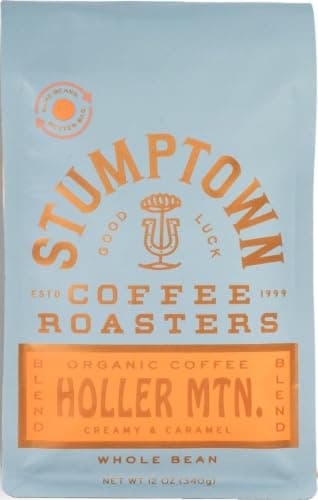
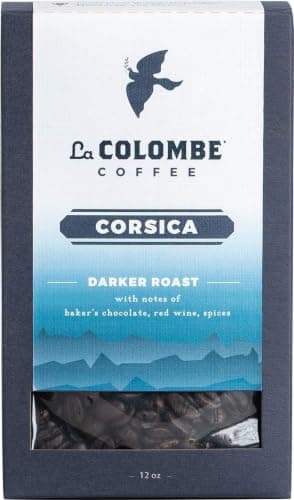
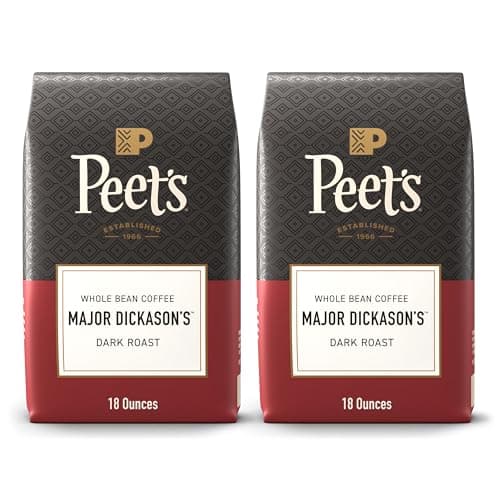
The verdict: Peet's Major Dickason's Blend is the best coffee for a drip machine for most households: a rich, full-bodied dark roast that is genuinely hard to brew badly, available anywhere, and consistent bag to bag. If you want more character and a printed roast date, Stumptown Holler Mountain is the specialty pick and costs less per bag. The budget pick is La Colombe, the cheapest bag here that still tastes like cafe coffee rather than like a supermarket dark roast.
A drip machine is a specific set of constraints, and they are not the same as a French press's or a pour-over's. The water is poured for you, at a flow rate you do not control, through a bed that is usually flat-bottomed and thin, for roughly four to six minutes. You cannot stir it, you cannot bloom it by hand, and you cannot slow the pour if the cup is coming out thin. Everything you can change is in the bag and the grinder.
That pushes the answer toward medium and medium-dark roasts with real body. Light roasts are denser and need more agitation and hotter, longer contact to give up their sugars; in an automatic brewer with a cool element they very often come out sour and thin, and the machine gives you no lever to fix it. Very dark roasts go the other way: they give up solubles fast, which is forgiving, but in a long drip cycle the roastiness dominates and the cup turns ashy. The sweet spot for a drip basket is a roast that is developed enough to extract easily and not so dark that four minutes of contact burns it out.
So that is the rubric: roast level suited to a drip cycle first, body second, freshness evidence third, value fourth. Taste is personal and we say so on every pick — we have not run a cupping panel and we are not going to pretend a score is a measurement. Every bag here already appears somewhere on this site, and its tasting notes, pros and cons are carried over unchanged from that entry; what is new is how each one behaves in a drip basket specifically.
How to choose beans for a drip machine
A drip machine takes four decisions away from you — water temperature, flow rate, agitation and contact time — and leaves you two: the bean and the grind. These are the questions that matter.
Roast level: medium to medium-dark is the sweet spot
Roasting breaks down the structure of the bean, and the further it goes, the more easily the coffee gives up its solubles. That is why roast level matters more for drip than for almost any other method: your machine cannot add heat or agitation to help a stubborn bean along. A light roast in a cool automatic brewer usually comes out sour and thin, and there is no lever to pull. A very dark roast extracts readily but has little left besides roast character, and four to six minutes of contact brings out the ash. Medium to medium-dark is where a drip basket is happiest, which is why five of the six picks here sit in that band. The full mechanism is in light vs dark roast coffee.
Grind: medium, and consistent matters more than fine
Drip wants a medium grind — roughly the texture of coarse sand — and a flat-bottom basket wants it a notch coarser than a cone does. What matters more than the exact setting is uniformity: a grind full of both boulders and dust extracts unevenly, giving you a cup that is simultaneously under- and over-extracted, and that reads as muddy and bitter at the same time. A blade grinder cannot produce a uniform grind at any setting, which is why fixing the grinder usually beats changing beans. Our best grinders for drip coffee page covers that choice, and the settings are in the coffee grind size chart.
Freshness: a roast date beats a best-by date
Coffee is at its best roughly two to four weeks after roasting. A bag printed with a roast date tells you where you are in that window; a bag printed with a best-by date tells you only when the roaster stops guaranteeing it, which could be a year away. One bag on this page prints a roast date. That is not a criticism of the others so much as a fact worth knowing when you compare them on price — you are sometimes paying a specialty premium for information as much as for flavor.
Dose: 1:16 by weight, and a scale settles the argument
The working ratio for brewed coffee is about 1 gram of coffee to 16 grams of water, which is roughly 60 grams per litre. Most machines' included scoops are smaller than that implies, and most weak drip coffee is simply under-dosed rather than under-extracted. Weigh it once with a cheap scale and you will know whether your cup needs a different bean or just more of the one you have. The arithmetic for every brewer is in coffee to water ratio, and the scales are in best coffee scales.
Whole bean, always, and store it dark and sealed
Pre-ground coffee loses its aromatics within days of grinding, and a drip machine's long contact time makes stale grounds taste flat rather than bad — which is worse, because it makes the problem hard to notice. Buy whole bean, grind for each pot, and keep the bag sealed away from light and heat. The case either way is in whole bean vs ground coffee, and the containers are in best coffee storage containers.
If the machine is the problem
There is a point at which no bean rescues a brewer. If your coffee is consistently thin and sour with a medium-roast bean, a correct dose and a burr grinder, the machine is brewing too cool and nothing in a bag will fix it. The brackets where that changes are best coffee makers under $200 and best coffee makers under $500, and the thing to look for is a published brew-temperature window or a certification rather than a branded heating system.
How we picked
We did not lab-test this gear
Everyone in this category says they tested twenty machines. We have not lab-tested any of these, and we say so. What we did instead: compiled the published manufacturer specifications, read the manuals, ran the math where there was math to run (heat-up time, pressure, dose capacity, grind range, cost per cup), and scored each pick against a published rubric. The scores are judgments from documented research — not measurements we took, because we do not have a lab and we will not pretend we do. Where a number came from someone else's work, we name them in Sources.