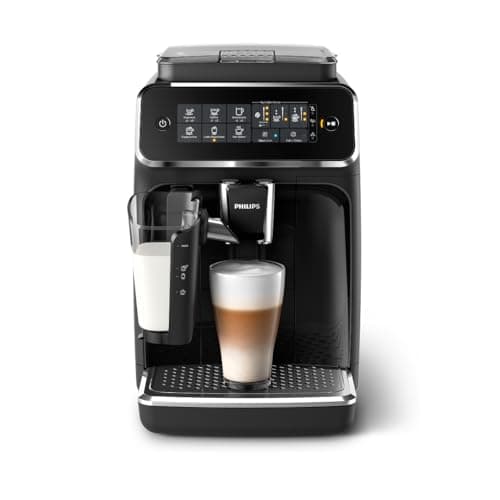
Buy the Philips 3200 Series LatteGo. For a shared office kitchen the decisive specs are not shot quality — they are the milk system and the descaling interval, and the LatteGo is two snap-off parts with no tubes that rinse under a tap in about fifteen seconds, with an AquaClean filter rated for up to 5,000 cups between descales. If your office drinks its coffee black, skip straight to the Jura E4: no milk system at all means nothing to sour, and a 64oz tank and 10oz bean hopper mean nobody refills it mid-morning.
Every office coffee machine fails the same way. Somebody makes a latte at 9am, the milk line does not get rinsed, and by Thursday the machine smells. Six weeks later the pump is noisy because nobody descaled it and the building water is hard. The machine is not at fault; the shared-responsibility model is. So this page ranks on the specs that survive that reality — tubeless or detachable milk systems, long descaling intervals, big tanks, and in two cases no milk system at all — rather than on the specs a home barista cares about.
How an office machine differs from a home machine
Nobody owns it. A home machine has one person who notices the drip tray. An office machine needs the maintenance either automated or reduced to a prompt on a screen, because a task that belongs to everyone belongs to no one.
Throughput is spiky. Eight people want coffee between 8:45 and 9:15, then nothing until 2pm. That punishes a small water tank and a small bean hopper far more than it punishes brew speed.
Skill cannot be assumed. A manual machine with a portafilter is the wrong answer here regardless of how good the coffee is. If you want to know why, our semi-automatic versus super-automatic comparison sets out exactly what a portafilter asks of the person holding it. Every pick on this page is bean-to-cup or pod for that reason.
Water is the building’s, not yours. You do not get to choose the water hardness in a leased office. That makes a long descaling interval and a filter system worth real money, and it is the reason the Philips wins this page rather than a machine that makes marginally better espresso.
How we ranked them
Each pick keeps the scores it already carries elsewhere on this site, so no two pages disagree about the same hardware, and the axes come from published manufacturer specifications rather than tests we did not run. The order on this page is an office recommendation order, which is not the same as the general-purpose average: the Jura ENA 8 scores highest here and sits fourth, because its 37.2oz tank and 4.4oz bean hopper are an office refill chore. We would rather explain that than re-score a machine to make the list look tidy.
Below are the five we would actually put in an office kitchen, with the honest failure mode of each.
The short answer
Quick picks
01Philips 3200 Series LatteGo (EP3241)The office answer. The LatteGo milk system is two snap-off parts with no tubes that rinse in about fifteen seconds, the ceramic burrs are rated for roughly 20,000 cups, and the AquaClean filter lets you skip descaling for up to 5,000 cups.
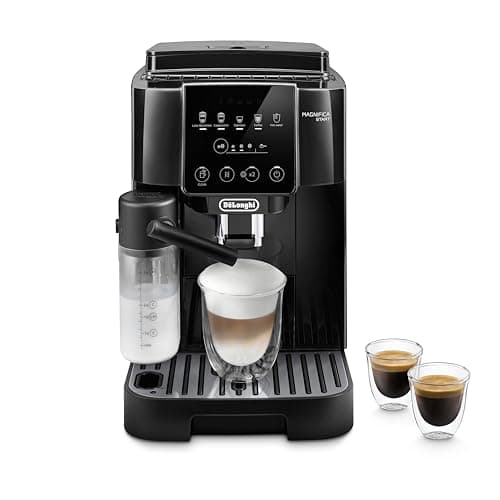
8.2Best overall for an office — lowest-maintenance milk system 02De'Longhi Magnifica Start (auto milk)The least intimidating machine here: a row of plain soft-touch icons, a compact body and a LatteCrema Hot carafe that froths for you, with none of the nested menus that make a shared machine confusing.
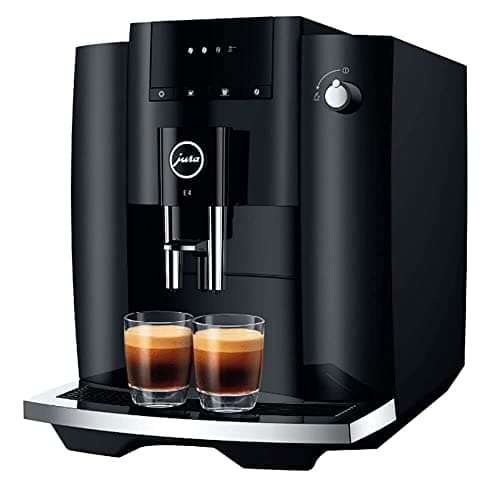
7.7Best for a small office — simplest panel to put in front of strangers 03Jura E4The black-coffee office machine: full-size tank and hopper, Jura's current grinder and Pulse Extraction, and deliberately no milk system — so there is nothing to sour and nothing to clean after a latte.
7.5Best for a black-coffee office — nothing to sour, biggest tank here 04Jura ENA 8The nicest machine here and the one that needs the most refilling: fifteen specialties, a 2.8-inch touchscreen and a fine-foam frother in a body under 11 inches wide, on a 37.2oz tank.
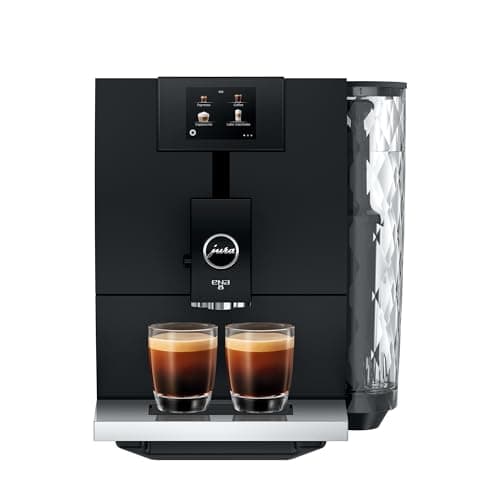
8.4Best for a small premium office — touchscreen and milk, in the smallest body 05Nespresso Vertuo Pop+ by BrevilleThe zero-maintenance option: barcode-read capsules, no grinder, no milk path and nothing to clean beyond emptying the used-pod bin — at the lowest entry price here.
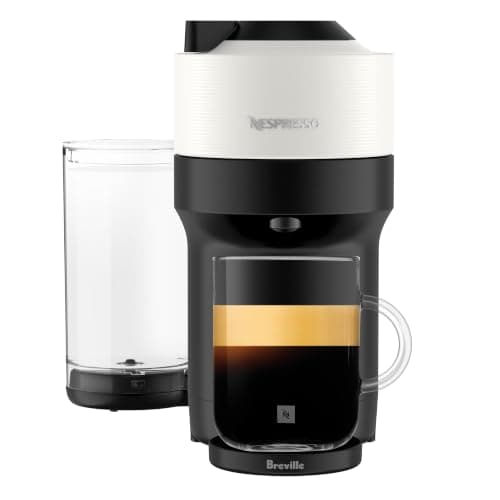
8.0Cheapest sensible office machine — for a team of two to four
| # | Product | Best for | Score | Price |
|---|
| 01 | Philips 3200 Series LatteGo (EP3241)The office answer. The LatteGo milk system is two snap-off parts with no tubes that rinse in about fifteen seconds, the ceramic burrs are rated for roughly 20,000 cups, and the AquaClean filter lets you skip descaling for up to 5,000 cups. | Best overall for an office — lowest-maintenance milk system | | $551.44·Amazon |
| 02 | De'Longhi Magnifica Start (auto milk)The least intimidating machine here: a row of plain soft-touch icons, a compact body and a LatteCrema Hot carafe that froths for you, with none of the nested menus that make a shared machine confusing. | Best for a small office — simplest panel to put in front of strangers | | $749.95·Amazon |
| 03 | Jura E4The black-coffee office machine: full-size tank and hopper, Jura's current grinder and Pulse Extraction, and deliberately no milk system — so there is nothing to sour and nothing to clean after a latte. | Best for a black-coffee office — nothing to sour, biggest tank here | | $1,399.00·Amazon |
| 04 | Jura ENA 8The nicest machine here and the one that needs the most refilling: fifteen specialties, a 2.8-inch touchscreen and a fine-foam frother in a body under 11 inches wide, on a 37.2oz tank. | Best for a small premium office — touchscreen and milk, in the smallest body | | $1,999.00·Amazon |
| 05 | Nespresso Vertuo Pop+ by BrevilleThe zero-maintenance option: barcode-read capsules, no grinder, no milk path and nothing to clean beyond emptying the used-pod bin — at the lowest entry price here. | Cheapest sensible office machine — for a team of two to four | | $129.95·Amazon |
#ad · Live prices from the Amazon Product API, as of October 18, 2026. Where we have no verified live price, we show none — a gap beats a number that has rotted.
In detail
The picks, in full
Best overall for an office — lowest-maintenance milk system
Philips 3200 Series LatteGo (EP3241)
100% ceramic grinder, 12 settingsLatteGo tubeless milk (cleans ~15s)5 drinks + hot waterAquaClean: up to 5,000 cups between descales
The office answer. The LatteGo milk system is two snap-off parts with no tubes that rinse in about fifteen seconds, the ceramic burrs are rated for roughly 20,000 cups, and the AquaClean filter lets you skip descaling for up to 5,000 cups.
- Coffee quality
- 7.5
- Milk system
- 8.5
- Ease & cleaning
- 9
- Drink range
- 7.5
- Value
- 8.5
Pros
- +LatteGo milk system is two parts with no tubes to clog, rinsed under the tap in about 15 seconds or dropped in the dishwasher
- +100% ceramic burrs run cooler than steel and are rated for roughly 20,000 cups
- +AquaClean filter means no descaling for up to 5,000 cups, and the touch display keeps it simple
Cons
- −Only five drink presets, with no big menu of specialty one-touch drinks
- −Milk foam is good but a touch less refined than a twin-chamber carafe system
- −Strength and length adjust, but there is less fine control than on pricier machines
Don't buy this if…
…you want a long menu of one-touch specialty drinks. This keeps it to the core five, so a Gaggia Cadorna or a Jura suits a big-menu household better.
Who it is for: an office of roughly four to twelve people where some drink milk drinks and nobody will be assigned the cleaning. Two specifications decide it. The milk system has no tubes, so there is no interior surface that quietly sours — the two parts come off and go under a tap or into the dishwasher. And the AquaClean filter means descaling becomes an occasional event rather than a monthly argument, which matters most in exactly the buildings where you cannot control the water. Five presets is a short menu, and for a shared kitchen that is closer to a feature than a limit: fewer buttons, fewer wrong presses.
Best for a small office — simplest panel to put in front of strangers
De'Longhi Magnifica Start (auto milk)
Bean-to-cup with adjustable grinderLatteCrema Hot automatic milkSoft-touch one-touch panel250g bean hopper
The least intimidating machine here: a row of plain soft-touch icons, a compact body and a LatteCrema Hot carafe that froths for you, with none of the nested menus that make a shared machine confusing.
- Coffee quality
- 7.5
- Milk system
- 8
- Ease & cleaning
- 8
- Drink range
- 7
- Value
- 8
Pros
- +Soft-touch icons make it the most approachable De'Longhi super-automatic, with nothing to read a manual for
- +This model's LatteCrema Hot system froths milk automatically, so cappuccinos are still one touch
- +Compact footprint and a fast-heating, grind-fresh bean-to-cup workflow
Cons
- −Fewer recipes and less personalization than the step-up Magnifica Evo
- −Entry-level plastic build, with no color screen or saved user profiles
- −Grinder is adjustable but simpler than the ceramic burrs on some rivals
Don't buy this if…
…you want the extra recipes or the My Latte personalization. Spend a little more on the Magnifica Evo, which adds both for not much money.
Who it is for: a team of three to six, or any office where the machine has to be obvious to a visitor. The panel is clearly labelled icons rather than a menu tree, which is the single most underrated office specification — a confused user is how settings get changed and blamed on the machine. The milk carafe is a detachable unit, so it can live in the office fridge between uses, which is both more hygienic and the reason we rank it above the two Juras for a mixed-drink team. The plastic build is honest entry-level, and in a shared kitchen that is a real consideration over several years.
Best for a black-coffee office — nothing to sour, biggest tank here
Jura E4
5 specialties (espresso, 2x espresso, coffee, 2x coffee, hot water)Professional Aroma Grinder (P.A.G.), P.E.P.No milk system64oz tank, 10oz beans, 22 lbs
The black-coffee office machine: full-size tank and hopper, Jura's current grinder and Pulse Extraction, and deliberately no milk system — so there is nothing to sour and nothing to clean after a latte.
- Coffee quality
- 8.5
- Ease & cleaning
- 8.5
- Drink range
- 5
- Build
- 8.5
- Value
- 7
Pros
- +Full-size capacity without the milk premium: a 64oz tank and 10oz bean container, matching the E8
- +Pulse Extraction Process and the Professional Aroma Grinder — Jura's current coffee technology, not a cut-down version
- +Hot water as a listed specialty, which the ENA 4 does not offer and tea drinkers will care about
- +Simple symbol display with programmable strength and volume — the same near-zero learning curve as the ENA 4
Cons
- −No milk system, so the five specialties are really two drinks, their doubles, and hot water
- −Costs more than the ENA 4 for capacity alone — the cup is not different
- −11 in x 13.8 in x 17.6 in and 22 lbs, so it takes full-size counter space to make black coffee
- −A symbol display at a price where the ENA 8 gives you a touchscreen and a frother
Don't buy this if…
…you are a one- or two-cup household. You would be paying the full-size premium for a tank you never empty — the ENA 4 brews the same coffee.
Who it is for: an office where the coffee order is americanos and long blacks. The absence of a milk system is the feature: the most common office-machine complaint is a milk line nobody rinsed, and a machine with no milk path cannot have that problem. The hot-water tap matters more at work than at home, because it covers the tea drinkers from the same appliance. The trap is buying it by mistake — it is a big, expensive-looking Jura that physically cannot make a cappuccino, so confirm the drink orders in your office before you choose it.
Best for a small premium office — touchscreen and milk, in the smallest body
Jura ENA 8
15 specialtiesProfessional Aroma Grinder (P.A.G.)HP1 / CX1 fine foam frother2.8-inch touchscreen, 37.2oz tank
The nicest machine here and the one that needs the most refilling: fifteen specialties, a 2.8-inch touchscreen and a fine-foam frother in a body under 11 inches wide, on a 37.2oz tank.
- Coffee quality
- 8.5
- Ease & cleaning
- 9
- Drink range
- 8
- Build
- 8
- Value
- 8.5
Pros
- +The least expensive route into Jura's milk system — below this model the lineup makes black coffee only
- +Fifteen specialties covers espresso, coffee, flat white, latte macchiato and cappuccino, which is every drink a normal household orders
- +At 10.7 inches wide and 20.7 lbs it fits where the full-size E and S machines do not
- +2.8-inch touchscreen rather than Jura's older symbol display, so drink selection is obvious on day one
- +CLEARYL Smart+ filter detection and an automatic milk-system rinse keep upkeep to a prompt you tap
Cons
- −The 37.2oz tank and 4.4oz bean hopper are roughly half the size of the full-size models — fine for two people, a refill chore for four
- −Single interchangeable milk spout (HP1 / CX1) rather than the HP3 / CX3 system on the bigger machines
- −Still a four-figure machine; a De'Longhi Magnifica Evo makes a good latte for a fraction of it
- −Locked into Jura's own filters, cleaning tablets and milk lines, which is a running cost rather than a one-off
Don't buy this if…
…you drink your coffee black. You would be paying for a milk system you will never switch on — the ENA 4 is the same idea without it.
Who it is for:a small studio or a client-facing reception area, where the machine is partly a statement and the headcount is low. It scores highest on this page and we still rank it fourth, because the two numbers that matter in an office go the wrong way: a 37.2oz tank and a 4.4oz bean hopper are a couple of days’ use for two people and a daily refill for six. The automatic milk-system rinse and filter detection are genuinely good for shared use — the machine asks rather than relying on someone remembering. If your headcount is above about six, the full-size Juras or the Philips are the better fit, and we rank the range on best Jura espresso machines.
Cheapest sensible office machine — for a team of two to four
Nespresso Vertuo Pop+ by Breville
Centrifusion barcode brewingFour cup sizesCompact bodyVertuo pods only
The zero-maintenance option: barcode-read capsules, no grinder, no milk path and nothing to clean beyond emptying the used-pod bin — at the lowest entry price here.
- Cup quality
- 8
- Speed & convenience
- 9
- Pod cost
- 5.5
- Footprint
- 9
- Value
- 8.5
Pros
- +The cheapest way into Vertuo's crema and cup quality
- +Small and light enough for a dorm, office or small kitchen
- +Same automatic barcode brewing as the full-size Vertuo
Cons
- −Smaller water tank and drip area — more refilling
- −Fewer cup sizes than the full Vertuo range
- −Still tied to Nespresso-only Vertuo pods
Don't buy this if…
…you make several drinks a day — the small reservoir turns into a chore fast.
Who it is for: a two-to-four person office, or any workplace that wants the capital cost near zero and will absorb the running cost in capsules. The honest maths: a pod machine moves the spend from the appliance to the consumable, so it is the cheapest machine and usually the most expensive cup. For a small team that is often the right trade, because it also removes every maintenance task except emptying the bin. For a busy floor it is the wrong one — the small reservoir becomes the bottleneck. We set out the system choice in full on Keurig vs Nespresso.
The office specs, side by side
| Machine | Type | Milk system | Water tank | Bean hopper | Best headcount |
|---|
| Philips 3200 LatteGo | Bean-to-cup | LatteGo, tubeless, 2 parts | Per Philips spec sheet | Sealed hopper, 12 grind settings | ~4–12 |
| De’Longhi Magnifica Start | Bean-to-cup | LatteCrema Hot carafe (detachable) | Per De’Longhi spec sheet | 250g | ~3–6 |
| Jura E4 | Bean-to-cup | None | 64oz | 10oz | ~4–10, black coffee only |
| Jura ENA 8 | Bean-to-cup | HP1 / CX1 fine foam frother | 37.2oz | 4.4oz | ~2–5 |
| Nespresso Vertuo Pop+ | Capsule | None (no milk path) | Compact reservoir | None — capsules | ~2–4 |
Where a manufacturer does not publish a figure in the same unit as the others we say so rather than converting a number we cannot source. Tank and hopper figures above are the ones the manufacturer lists.
The milk system is the whole decision
In a shared kitchen, a milk system is a hygiene system. There are three designs and they age very differently. A tubeless two-part system like LatteGo has no internal milk path to colonise — you rinse two parts. A detachable carafelike De’Longhi’s LatteCrema can be lifted out and put in the fridge, which is good practice and easy to forget. An integrated line with a pickup tube is the design that causes office complaints, because the part that needs cleaning is the part nobody can see. And a machine with no milk system at all sidesteps the problem entirely, which is exactly why the Jura E4 is on this list.
Descaling, when the water is the landlord’s
Scale is the main thing that kills a bean-to-cup machine, and in an office you have no control over the supply. Two mitigations are worth paying for: a machine-specific filter cartridge, and a long published descaling interval. Philips rates AquaClean at up to 5,000 cups between descales, which in a small office is a once-a-year job instead of a monthly one. Jura’s CLEARYL cartridges with Smart+ detection do the same job by prompting the machine instead of trusting a person. If you want the full picture of what scale does and how long machines actually last, we go through it on how long espresso machines last.
Cost per cup, honestly
Do not compare sticker prices; compare the consumable. A bean-to-cup machine uses roughly 7–11g of coffee for a black cup and around 18g for a double, so a 2.2lb (1kg) bag makes on the order of 90–140 single cups. Divide whatever you pay for a bag by that and you have your real cup cost. A capsule machine, by contrast, has a fixed per-pod cost that does not improve with volume. That is the whole reason the Vertuo Pop+ ranks last here despite being the cheapest machine: at four cups a day it is fine, and at twenty it is the most expensive option on the page. Our bean picks for super-automatic machines cover what to actually fill the hopper with, and is making espresso at home worth it runs the same arithmetic for a household.
What we deliberately left off
Manual portafilter machines. Excellent coffee, wrong setting. They need a grinder, a tamper, a scale and a trained operator, and in a shared kitchen they produce one enthusiast and eleven bad shots.
Plumbed commercial machines. A two-group machine is the right answer for a cafe and the wrong one for an office: it needs a water line, a drain, a dedicated circuit and a barista. Nothing on this page needs more than a socket.
Anything with a milk pickup tube and no auto-rinse. It will be the thing somebody complains about in the office chat.
How we picked
We did not lab-test this gear
Everyone in this category says they tested twenty machines. We have not lab-tested any of these, and we say so. What we did instead: compiled the published manufacturer specifications, read the manuals, ran the math where there was math to run (heat-up time, pressure, dose capacity, grind range, cost per cup), and scored each pick against a published rubric. The scores are judgments from documented research — not measurements we took, because we do not have a lab and we will not pretend we do. Where a number came from someone else's work, we name them in Sources.
Questions
Frequently asked
What is the best espresso machine for an office?+
For a mixed-drink office of roughly four to twelve people, the Philips 3200 Series LatteGo — its milk system is two snap-off parts with no tubes, and the AquaClean filter is rated for up to 5,000 cups between descales. For an office that drinks coffee black, the Jura E4, because it has no milk system to clean at all.
Do I need a commercial espresso machine for an office?+
Almost never. A commercial machine needs a water line, a drain, a dedicated circuit and someone who knows how to use it. A bean-to-cup super-automatic plugs into a socket and needs no training, which is why every pick here is one.
How many people can one office espresso machine serve?+
Capacity is limited by the tank and hopper far more than by brew speed, because office demand arrives in a fifteen-minute spike. As a rough guide: a compact machine with a ~37oz tank suits two to five people, and a full-size 64oz tank with a 10oz hopper suits roughly four to ten.
Who cleans an office coffee machine?+
In practice, nobody — which is why you should buy for that. Choose a machine whose milk parts detach and go in a dishwasher, whose milk rinse is automatic, and whose descaling prompt appears on the screen. A machine that depends on a rota will smell by the second month.
Are pod machines cheaper for an office?+
Cheaper to buy, usually more expensive per cup. A capsule has a fixed cost that does not fall with volume, while a bean-to-cup machine uses roughly 7–11g of coffee per black cup. Below about five cups a day the pod machine often wins; above that the beans do.
Receipts
Sources
We do not run a testing lab, and we do not pretend to. Where a measured number came from someone else's work, we name them and link them. Where we could not verify something, we say so on the page rather than quietly leaving it out. Read our full method.