Skip to content
Tamp & Pour

Roundups & reviews · Grinders

Eureka Mignon Specialita review

55mm flat burrs, stepless adjustment and a sound-insulated case that makes it the quietest grinder most people have heard. What it does brilliantly, and the one workflow it fights you on.

By Stephen V.Updated How we review
#ad

We earn a commission when you buy through our Amazon links, at no extra cost to you. It never changes a verdict, and we say so when the cheaper product is the better buy. How this works.

The Specialita is what happens when a commercial grinder company builds for a kitchen instead of a bar. Eureka has made grinders in Florence since 1920, and this model takes the parts that matter from that world — 55mm flat burrs, a stepless micrometric adjustment collar, a 1350 RPM motor — and wraps them in a sound-insulated metal case with rubber mounts and gaskets, specifically so it does not wake the house.

That last part gets dismissed as a soft feature and it is not. A grinder is the loudest thing in a quiet kitchen at 6am, and the Specialita is the machine people describe as a whisper next to what they replaced. But the more consequential question is what stepless adjustment and flat burrs actually buy you over the cheaper conical grinders on our espresso grinder list, and where the Specialita gives ground to newer single-dose designs.

01
Eureka Eureka Mignon Specialita

Best quiet espresso grinder

Eureka Mignon Specialita

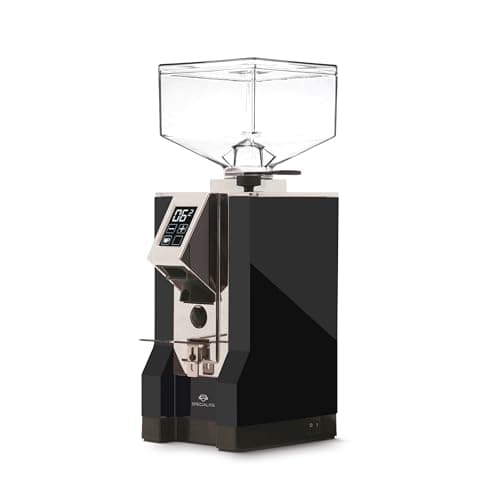
55mm flat steel burrsStepless micrometric adjustment1350 RPM, 310WTouchscreen timed dosing (single, double, continuous)300-400g hopper, ~12.3 lb
8.3/10

The quiet, fast, stepless home espresso grinder: 55mm flat burrs and micrometric adjustment give you infinite fine control, and the insulated case makes it usable at any hour — as long as you accept it is a hopper grinder, not a single-doser.

Grind consistency
9
Adjustment
9
Retention
6.5
Noise
9.5
Value
7.5

Pros

  • Stepless adjustment means there is no such thing as 'between two settings' — you can land exactly where a light roast wants to be
  • 55mm flat burrs are large for a home grinder and grind fast, at around 1.8g per second for espresso, so a double dose takes seconds
  • The sound-insulated metal case with rubber mounts is genuinely transformative if you grind early or live in an apartment
  • 1350 RPM is deliberately slow for a flat burr, which keeps the grounds cooler and reduces static clumping
  • Touchscreen timed dosing with single, double and continuous modes, plus an adjustable portafilter fork so it doses hands-free

Cons

  • Stepless is a double-edged spec: there are no numbers to return to, so if you move it you rediscover your setting by taste
  • It is a hopper grinder at heart — single dosing works but you fight retention and the bellows-and-purge routine that single-dose grinders avoid by design
  • Expensive next to conical home grinders that will still make you very good espresso
  • Tall at roughly 13.9 inches with the hopper, which is an under-cabinet problem in some kitchens
  • Timed dosing drifts as beans age — a scale is not optional with this grinder

Don't buy this if…

you switch beans constantly or want to single-dose seriously. A purpose-built single-dose grinder gives you near-zero retention and repeatable numbers, which is a different and better workflow for someone rotating three bags.

Flat burrs, and what they actually change. Conical burrs crush beans between a cone and a ring; flat burrs shear them between two parallel rings. The practical difference is particle distribution: flat burrs tend to produce a narrower, more uniform spread, which in espresso reads as clearer separation of flavors and slightly higher extraction at the same grind setting. Conicals produce a broader distribution, which many people describe as rounder and heavier-bodied. Neither is better, and anyone telling you flat burrs are an upgrade rather than a different flavor target is selling something. The full argument is in conical vs flat burr grinders.

Stepless adjustment is the real headline.Most home grinders move in clicks — the Baratza Encore has 40 steps across its whole range, and even good espresso grinders often give you a few dozen. Espresso needs adjustment at a much finer resolution than that, and on a stepped grinder you eventually meet a coffee that wants to be between two settings. The Specialita’s micrometric collar has no steps at all: it rotates continuously, so any grind size in its range is available to you. That is the feature you are paying for, and it is why this grinder handles light roasts that stall cheaper machines.

The catch is memory.Stepless means no numbers. There is a reference scale on the collar, but it is not a repeatable index in the way a Baratza’s numbered steps are — if you move off your espresso setting to grind for a French press, coming back is a matter of feel and a test shot. In practice most owners find a setting and simply stop moving it, which works beautifully if you drink one coffee and badly if you rotate bags. This is the single most important thing to understand before buying.

Speed and heat. 55mm burrs at 1350 RPM is a deliberate combination: big enough to grind an 18g dose in around ten seconds, slow enough that the grounds do not heat or fling static everywhere. Faster motors on smaller burrs do the same job with more heat and more clumping. It is the kind of engineering decision that does not photograph well and shows up every morning.

Retention, honestly.Eureka’s anti-clumping chute is short and it helps, but this is still a grinder with a chamber and a chute between the burrs and your portafilter, and a gram or so lives in there. If you dose one bean at a time you will need a bellows puff or a small purge, which is the standard workaround and is mildly annoying forever. If you keep a hopper of one coffee, retention is invisible because what comes out is the same as what went in. Choose the grinder that matches how you actually drink.

$549.00View on Amazon

Price as of Sep 2, 2026. Prices change — Amazon's at checkout is the one that counts.

#ad · we may earn a commission from this link to Eureka Mignon Specialita

Specialita vs the rest of the Mignon range

Eureka sells several Mignon variants that look nearly identical and differ in ways that matter. The Notte sits below with 50mm burrs and a simpler interface, and is the value pick in the family. The Specialita steps up to 55mm burrs and the touchscreen. The Zero is the single-dose configuration for people who want that workflow from the factory. If your objection to the Specialita is the hopper, buy the Zero rather than fighting this one.

Do you need stepless adjustment?

If you drink medium and dark roasts and buy the same coffee repeatedly, honestly no — a well-made stepped espresso grinder will land close enough, every time, and give you numbers to return to. Stepless earns its money in two situations: light-roast espresso, which frequently wants a setting finer than a stepped grinder’s nearest click; and dialing in a new bag every week, where you want to move in very small increments rather than jump. Be honest about which describes you before paying for it.

What to pair it with

This grinder is well matched to a Gaggia Classic Pro, a Bambino Plusor any 58mm machine — the classic pairing is a simple machine plus a serious grinder, which is where the money makes the most difference. You will want a 0.1g scale, because timed dosing drifts as beans stale, and a WDT tool, because flat burrs produce fluffy grounds that benefit from redistribution before tamping.

Cleaning and burr life

Coffee oils build up on burrs and in the chute and gradually make the grind taste stale before the beans do. Run grinder cleaning tablets through periodically and brush out the chute; the full routine is in how to clean a coffee grinder. Steel burrs on a home grinder last for hundreds of kilos of coffee, so replacement is a many-years question rather than an annual one — but they are a stock part and can be replaced, which is part of what you are buying at this price.

How we picked

We did not lab-test this gear

Everyone in this category says they tested twenty machines. We have not lab-tested any of these, and we say so. What we did instead: compiled the published manufacturer specifications, read the manuals, ran the math where there was math to run (heat-up time, pressure, dose capacity, grind range, cost per cup), and scored each pick against a published rubric. The scores are judgments from documented research — not measurements we took, because we do not have a lab and we will not pretend we do. Where a number came from someone else's work, we name them in Sources.

Questions

Frequently asked

Is the Eureka Mignon Specialita worth the money?
If you pull espresso most days and want stepless adjustment and near-silence, yes — it grinds fast, cool and precisely, and it is a component you keep across several machines. If you drink one medium roast and are happy with numbered settings, a cheaper stepped espresso grinder gets you most of the cup.
Does the Specialita have stepped or stepless adjustment?
Stepless — a micrometric collar that rotates continuously, so any grind size within its range is available. The trade is that there are no repeatable numbers to return to, so moving between espresso and filter grinds means re-dialing by taste.
Can the Mignon Specialita be single dosed?
It can, but it is not designed for it. It is a hopper grinder with a chute, so single dosing means using a bellows or a small purge to clear retained grounds. If single dosing is your plan, the Mignon Zero or a purpose-built single-dose grinder is the better buy.
How loud is it?
Very quiet for an espresso grinder. Eureka builds it with a thick sound-insulated metal case, rubber mounts and gaskets specifically to damp the noise, and the 1350 RPM motor is slower than most. It is the standout practical feature for anyone grinding early in a shared home.
Specialita or Baratza Encore ESP?
The Encore ESP is far cheaper, stepped, numbered and completely capable of good espresso. The Specialita gives you larger flat burrs, stepless adjustment, more speed and much less noise. Buy the Encore ESP if you want value and repeatable numbers; buy the Specialita if you are chasing light roasts or grind at unsociable hours.
Does it grind for filter coffee too?
Yes, its range covers filter grinds — but the stepless collar makes going back to your espresso setting a re-dial by feel. Owners who brew both usually keep this on espresso and use a second grinder, or a hand grinder, for filter.

Keep reading

Receipts

Sources

We do not run a testing lab, and we do not pretend to. Where a measured number came from someone else's work, we name them and link them. Where we could not verify something, we say so on the page rather than quietly leaving it out. Read our full method.