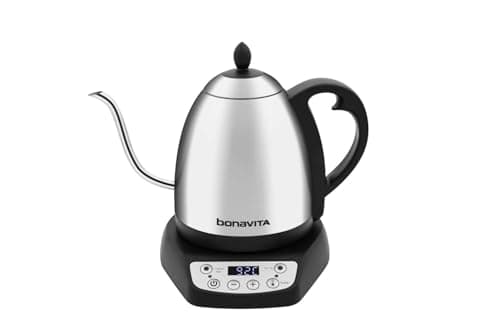
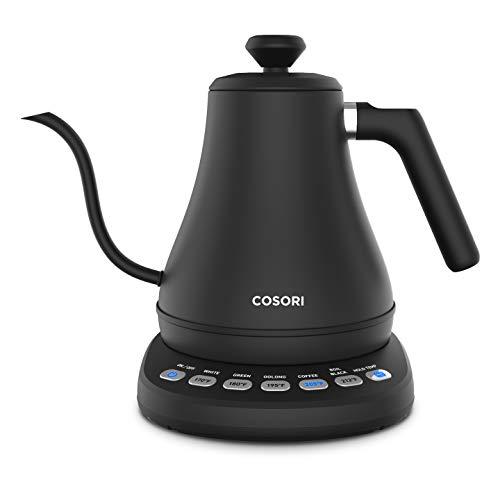
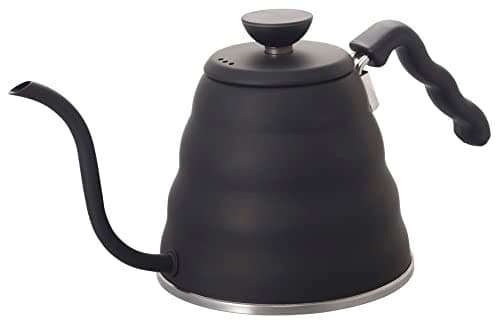
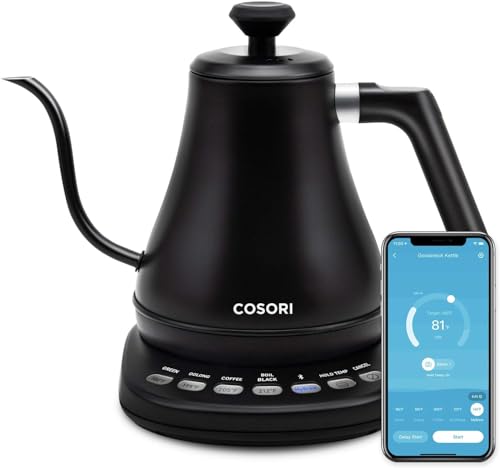
The verdict: the Cosori Smart Gooseneck is the best gooseneck kettle under $100 for most pour-over drinkers, because it sets a target temperature, holds it, and has the slow controllable spout the whole format exists for. If you brew a full Chemex or a V60 for two, buy the Bonavita 1L Digital Variable Temperature instead — the only kettle here with the capacity to do it in one fill. The budget pick is the Hario V60 Buono, a stovetop kettle with the best pour spout of the four and no temperature control at all.
A gooseneck kettle does one thing a normal kettle cannot: it pours slowly, in a thin stream, exactly where you aim it. That matters for pour-over because the water has to wet the bed evenly and keep it submerged without blasting a channel through it. Any kettle boils water. A gooseneck lets you place it.
Under $100 is a genuinely interesting bracket because it is where the second feature — a settable temperature — stops being guaranteed. Above $100 almost every electric gooseneck lets you dial a target to the degree and hold it there. Below it, some do, some give you preset buttons, and some are simply a kettle with a nice spout that you aim with a thermometer or a guess. Since brew temperature changes extraction as much as grind size does, that is the first thing this page ranks on.
The second thing is the one nobody mentions at this price: capacity. Two of the four picks here hold 0.8 liters, which is enough for a single V60 and not enough for a six-cup Chemex with the rinse water included. If you brew for one, it is irrelevant. If you brew for the table, it decides the purchase. Every pick already appears on our best gooseneck kettles ranking; specifications, pros and cons are carried over unchanged and the price ceiling and the capacity question are what is new here. Prices are live from the price layer with the date they were read.
What $100 does and does not guarantee
It guarantees a gooseneck spout, which is the point of the category. It does not guarantee a settable temperature: at this price you will find variable control, preset buttons and nothing at all, sometimes on kettles that look identical. And it does not guarantee capacity — 0.8L is common, and 0.8L does not brew a six-cup Chemex once you have rinsed the filter. Those two gaps are the whole reason this bracket needs sorting rather than just listing.
The four things that matter
1. A target temperature you can set
Brew temperature changes extraction about as much as grind size does. Hotter water extracts faster, which suits a light roast and can push a dark roast into bitterness. Most pour-over recipes land somewhere near 200F rather than at the boil, so a kettle that only boils is a kettle you have to wait beside. Variable control beats presets beats nothing, and that is the first axis on this page.
2. A hold
This is the feature people underrate. In a real kitchen you boil the water, then grind, then rinse the filter, then start pouring, and three minutes have passed. A hold means the water is still at the temperature you chose. Without one, the number you set was the temperature three minutes ago.
3. Capacity, measured against your actual brewer
Work it out before you buy: a brew needs its water plus roughly enough again to rinse the paper, and a full Chemex wants considerably more than a single V60. 0.8L is a one-cup kettle. 1L is a two-cup kettle. 1.2L covers a batch. Nothing about the spout changes this.
4. The spout itself
Goosenecks are not equal. A narrow spout with a long curve gives you a slow stream you can start and stop precisely, which is what a pulse pour needs. A wider, shorter spout pours faster and is harder to control at low flow. The Hario Buono shape is the reference here, and it is on the cheapest kettle on the page, which is a useful reminder that the spout and the electronics are separate purchases bundled together.
Do you need a gooseneck kettle at all?
For pour-over, yes, and more than most accessories: you cannot place water precisely from a wide spout, and pour-over is a technique built on placing water. For French press, drip, moka pot or espresso, no — those brewers do not ask you to aim. If pour-over is not what you make, the money is better spent on a grinder or a scale, and our coffee brewing methods page covers which brewers need which tools.
What spending more than $100 buys
Build, mostly, and a better interface: a counterbalanced handle, a stiffer lid, a display and a hold you trust. A premium kettle does not place water better than a Hario Buono; it makes the temperature part effortless and lasts longer doing it. If that is worth it to you, the open-ended ranking is on our best gooseneck kettles page, and the temperature you should actually be setting is in coffee to water ratio.
How we picked
We did not lab-test this gear
Everyone in this category says they tested twenty machines. We have not lab-tested any of these, and we say so. What we did instead: compiled the published manufacturer specifications, read the manuals, ran the math where there was math to run (heat-up time, pressure, dose capacity, grind range, cost per cup), and scored each pick against a published rubric. The scores are judgments from documented research — not measurements we took, because we do not have a lab and we will not pretend we do. Where a number came from someone else's work, we name them in Sources.